In the early 60's, MAG 13, consisting of two A4D squadrons, one F8U squadron, and a helo squadron of H-34s plus support squadrons was part of the First Marine Brigade at Kaneohe Bay on Oahu. I was a Plane Captain in VMA 212, one of the A4 squadrons, from '61 to '63. The First Brigade had two distinct factions, The Air Wing and the Grunts. Each had its own part of the base and had little or no interaction. We didn't mix well. Even though we wore the same uniform, utilities, you could tell at a glance the difference because grunts bloused their boots and air wingers didn't. You might say there was a bit of animosity between the two groups. Grunts thought air wingers had it easy and wingers thought grunts were, well, grunts.
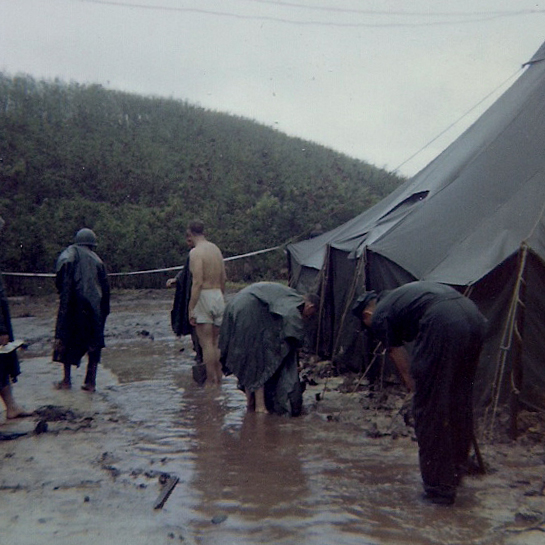
In October of '62, the 1st Brigade went on maneuvers to a place called Dillingham. Dillingham Air Force base in 1962 was an abandoned, single paved runway in Northern Oahu. There was no infrastructure to speak of besides the runway. It was basically out in the middle of nowhere, surrounded by hills and jungle on one side and ocean on the other. It was a perfect spot to simulate a forward combat base.
To make things real, the grunts were assigned roles as guerillas and had the task to attack and harass the air wing and disrupt operations. This they did exceedingly well, even blowing a hole in the middle of the active runway one day. Although they couldn't actually blow up any airplanes, they did infiltrate the flight lines and would hang signs on the planes stating that this plane is now blown up. Rules of the game would take that plane out of service. They would also "capture" pilots from the flight line and march them into the jungle, blindfolded, and turn them loose to fend for themselves. We were all armed, although with blanks. The grunts had weapons able to fire on full auto while we wingers had our M1s and only three rounds apiece. Part of our job was to stop the "guerillas" anyway we could. If we captured one, we were told, we could get a promotion. The Group even had a POW camp set up for them. It got very physical at times, and people got hurt.
We lived in eight man tents with dirt floors which turned to mud when it rained. The heads were at the end of the company street and consisted of two p-ss tubes and a row of toilet seats, all out in the open, exposed to the elements. And it did rain in buckets, which meant that the company street became our sewer. Adding to the misery, the "guerillas" would pop into our tents in the middle of the night, weapons on full auto, and machine gun everybody there. They always got away. Me and Doon decided we were going to do something about that.
Doon was from Cincinnati. Nobody knew why, but he got the nickname "Doon" from the cop character "Muldoon" on the old TV sitcom "Car 54 Where Are You". Doon was a funny guy. He talked so fast you couldn't understand what he was saying most of the time. I would say "Doon, slow down, I can't understand you". He would say "I'm not talking too fast, you're listenin too slow".
So, one day, me and Doon cooked up a plan. There was a hill with a lot of jungle type foliage between our tent and the head. This was the place the guerillas used for camouflage before attacking us. Our plan was to wait until late at night, sneak around behind this hill, stealthily crawl to the top and charge down the other side into their midst. Luckily, the rain had stopped, so our route which took us crawling past the head would be less odiferous than usual.
That night, after lights out, me and Doon became ninja warriors, out to get ourselves a go-rilla, although we had no idea exactly what we were going to do with him, so we armed ourselves in case we had to kill him. We stealthily left the tent while the rest of the troops were asleep. It was a dark night and we blended into the shadows until we got to the p-ss tubes which were more or less out in the open. This is where we went into a low crawl. Those of you with field experience can imagine what a low crawl would be like anywhere near a p-ss tube. Marksmanship is a revered skill in the Marines – except when it comes to this necessary piece of field hygiene, especially if you are aiming uphill at night. But me and Doon were on a mission. We were going to get a go-rilla.
Continuing on, our low profile crawl brought us up to the recently flooded line of toilets which we had to pass in review below grade if we wanted to maintain stealth. The toilets faced the aforementioned jungle covered hill. We had to get on the other side of that hill and crawl over the top so that we could be above what we thought was the go-rilla staging area. During this leg of our approach we encountered several obstacles that would have deterred lesser men. Toilet paper, as an example, becomes hard when wet while it is still in the roll, and can become attached to you if you happen to crawl over it.
Finally after enduring extreme hardship we reached our jump-off rendezvous on the opposite side of the hill, and paused to prepare for the final assault. This took several minutes of white streamer removal inadvertently picked up during our stealth approach. Also we needed to make sure our weapons were unclogged from the overflow. Now began the long crawl up the steep hill. The higher we got, the steeper it got, pulling ourselves uphill hand to tree, until we reached the top. Here we again paused, catching our breath and listening for go-rillas.
And then we heard a metallic sound at the base of the hill. They were going to shoot up our tent! We started the attack, crawling downhill, but it grew steeper. We started sliding. Rocks started falling around us. We rolled into each other, bouncing off trees, using the vocabulary we learned in boot camp to describe each other on the way down, until we landed on top of where the go-rilla should have been.
We beat around the bushes for several minutes, yelling our war cries and bumping into trees and each other until we managed to wake up the whole company. The sh-thouse go-rilla was long gone! Next day, we went back to investigate the suspected go-rilla hideout from where the metallic sound originated and found a pile of C-ration cans; our squadron dump. Somebody must have thrown an empty can on the dump just as we reached the top of the hill which made the metallic sound that brought us charging through the jungle and down the hill.
We crawled through odiferous slime, climbed the highest hill, ran through the jungle screaming our war cries and attacked a coconut tree and a pile of C-ration cans. We may not have captured a go-rilla, but we were never attacked again.
Norm Spilleth
Cpl. 1960-1964