Sgt. Grit:
The recent inquiry from Cpl. Steven Andre about Flame Tanks, struck home.
I am one of "the older tankers" he referred to, and proudly served in the original Flame Platoon, Headquarters Company, First Tank Battalion, First Marine Division FMF during the Korean War. I refer him, and anyone else interested in our unique Flame Tank, to www [dot] flamedragons [dot] info, is a website relative to the Flame Platoon in the Korean War.
This little know unit of nine M4A3E8 Sherman flame-throwing tanks got its baptism of fire when three of the specialized double-barreled Sherman's went into Wolmi do Island to help rout North Korean People's Army defenders from their caves and hills prior to the Inchon Landing, 15 September 1950.
Those Marine Corps Flame Tanks were highly upgraded from the M4A3 Sherman's that were converted to flame-throwers and used in the Pacific Islands campaigns in World War II. In fact some of the tanks we had in Korea were on their way to the Pacific to be used for the invasion of Japan. When Japan surrendered and WWII became history, the new flame tanks were sent back to the States.
Five years later, the Korean War broke out and nine of the Flame Tanks quickly were pulled out of the Barstow (Calif. tank farm, crewed and formed into three sections of three tanks each. It was the birth of the Flame Platoon, because WW II flame tanks were scattered and came under command of gun tank companies.
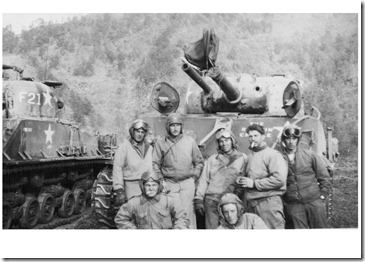
The WWII Sherman flame tanks fighting in the Pacific were stripped of their main armament (75 mm weapons) to insert a flame gun. The Korean War version (two of them pictured right
with their crews) maintained its 105 mm howitzer while the POA-CWS-H5 flame gun was mounted to the right of the cannon. This tank could defend itself, and do a lot more, including direct and indirect firing with the 105. It had a 30-caliber machine gun fixed on the co-axel shield to the left of the 105, another "30" handled by the assistant driver in the right bow hatch. A 50-caliber machine gun could be mounted on two positions atop the turret. Believe me, every bit of that firepower came in handy.
We could get about 100+yards, maybe a little more on a good mix of napalm – naphtha, palmetic acids in salt form, and gasoline . Yes, early in the war and during my tour, the concoction was all hand-mixed in 55-gallon drums, then hand-pumped through an intake valve on the port side of the hull, into two stainless steel storage tanks. Late in 1952, a roving tender mixed the napalm and power-pumped the jelly into the Sherman's storage tanks.
The above-mentioned website contains many of the pictures, and briefs about Flame Tank operations in Korea.
Ironically, the Flame Tanks which fought in Korea, never saw action after the Armistice was signed 27 July 1953. By the time Vietnam erupted, the faithful Sherman M4A3E8 had been retired and was replaced by more modern equipment.
Semper Fi!
S/Sgt. Jack Carty,
Flame Platoon,
Korea 1951-52