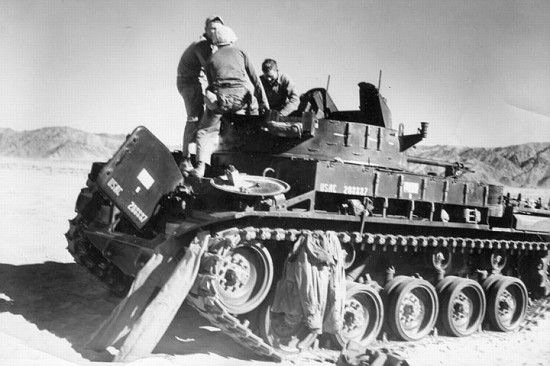
I was TAD at the 29 Palms Base Training Tank in the summers of ’64 and ’65. I visited the base two years ago and the same training tank including the lifeguard office was still there, however, they had civilians working the facility. I worked as an instructor and lifeguard the first year and the second year I was in charge of all three pools (tank, officer’s pool and dependent’s pool for enlisted personnel). The reason for the name and strange size of the pool, we were told, was that an earlier base general had sought funds for an Olympic-size pool for the men but the funds were refused. So, he resubmitted a request for a base training tank and that was approved. However, when the plans were submitted and the pool was 50 meters (Olympic size) he was questioned again. So they added three meters to the plans so that the pool ended up being 53 meters long. I swam on the base swim team and when we had meets, the fifty-meter swims were always stopped short by a rope across the pool at the fifty meter mark. To make some of the reservist marines mad, when we ran overboard drills where the men had to practice jumping from the tower, we only made the reservists jump from 40 feet. This was because many of them would boast (at the EM club) of their great jobs and careers when they were off active duty and they thought we were dumb for being full-time Marines. Sometimes I would tell one of them, “You will see me again before you leave here.” However, Vietnam changed my duty in swim trunks to humping with 2-9 as an artillery Scout/F.O.
Author: Dan Gibson
That reminds me of a story—I swear to God this is true….
We had set up a position so that we could get badly needed resupplies. I was
just standing around wondering, if I started yelling “short” would the CO
believe me and send me back to An Hoa so I could get orders for the states. The
Platoon Sgt. decided that I needed to do some work in order to get such
foolishness out of my head. I volunteered to “off load” the supply choppers. I
have no doubt that every Marine who reads this knows what it’s like to stand in
the open as the chopper is landing in a dirt clearing. After the first one came
in and we managed to push and pull the large crate out of the back of the
chopper; three of us took the plastic sheet and held it up in front of ourselves
for protection. Man, you would have thought we invented the light bulb. We
stood there laughing at the fact that the plastic kept us from being belted.
In Memory Of…
I had the honor and the privilege to serve with “Iron” Mike in Vietnam..He was a perfect example of what a Marine is supposed to be. When I checked into my unit, he greeted me and told me not to worry about a thing-I couldn’t die unless he gave me written permission. Now he is with the ages-“Old Marines never die, they just go to hell and regroup!”
NCO tattoo
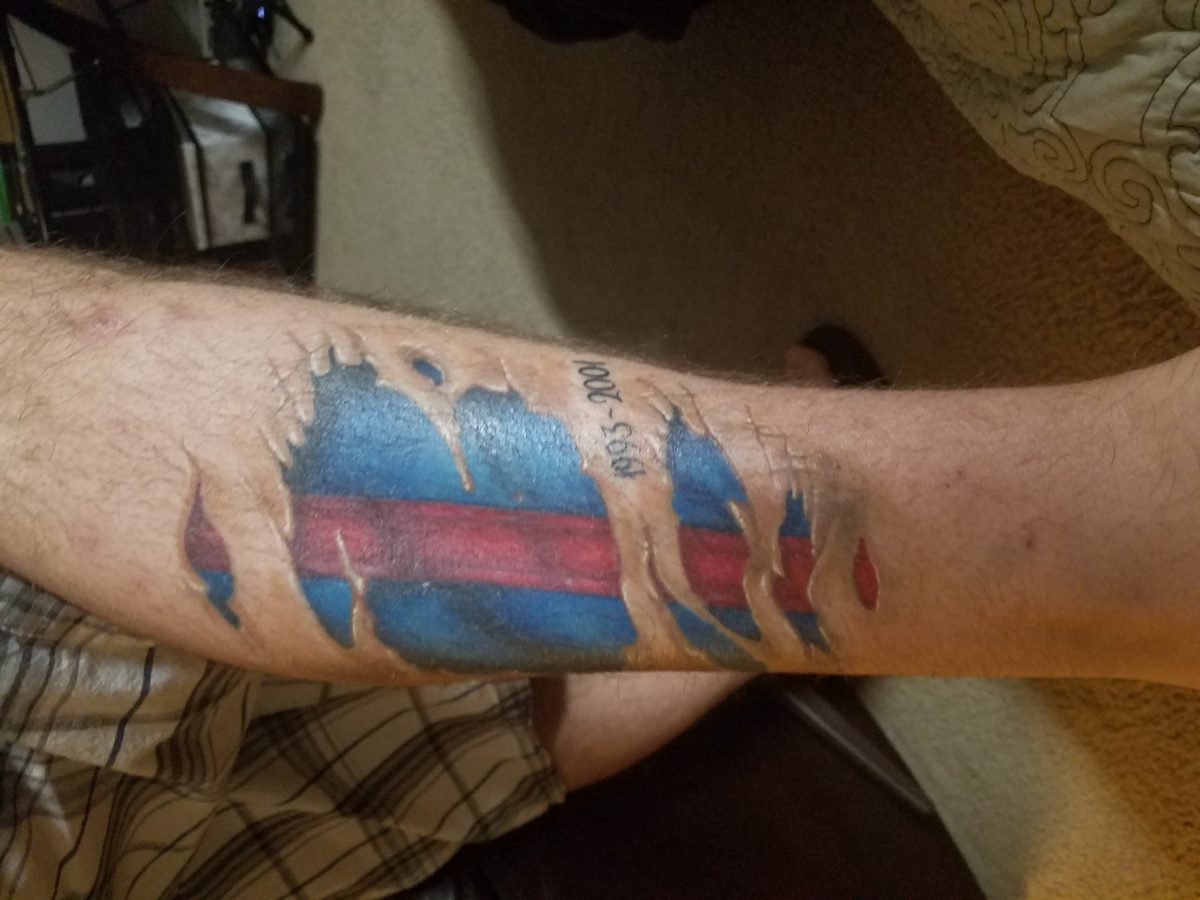
Wanted something different. Love it.
So anyways, we’re on this float—
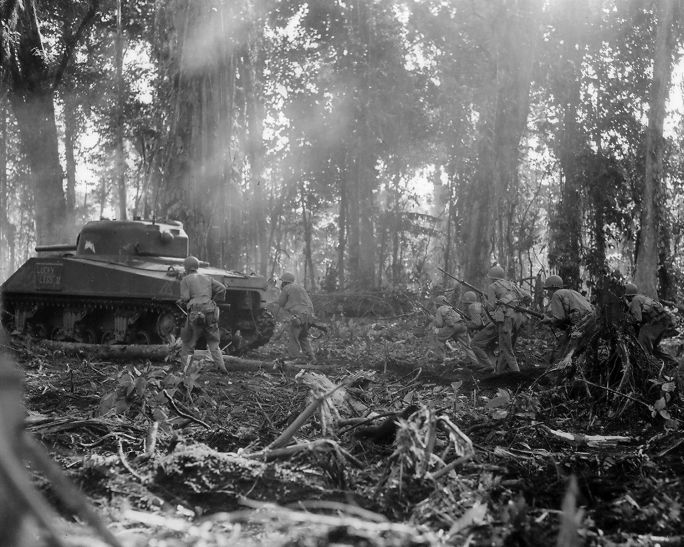
It’s 1969 and I’m with Fox Company, 2nd. Bn./ 2nd Mar. Reg/ 2nd. Marine Division on a Caribbean float. We’re doing jungle training in Panama with the Black Palm Jungle Survival school; which is run by the Army’s Green Beret unit. We were waiting to learn about using a Zip Line for a river crossing. It’S true, we were riding on zip lines years before it became a fun experience that you paid to do. Like I was saying, we’re standing around this Army Captain as he demonstrated how to make a floating device from our ponchos. I guess he didn’t understand that Marines know how or are taught to swim before leaving boot camp. He also told us how to use a zip line in order to get back across this same river. When questioned about the safety of this wire, the captain stated that he would give a month pay to learn what it felt like just before this wire broke. Well, we took our turns swimming across this stream and climbing up this tree using a ladder. I’m not sure where this ladder came from. I never saw anyone humping one of these in the bush. But I digress, I was number three in line so I’m sure about this. A Marine put the strap over his head and under his arms—he takes one step off and about to become air born when—you guessed it—the wire broke. We got it fixed without the benefit of instructions from the Green Beret. We finished the training without further incident or this captain. By the way, he never made good on his promise to give the Marine his paycheck and I’m sure this young man could have used the money—-a PFC only made about $105.00 a month back then. Now for those who are wondering about making a floating device using your poncho, you lay your poncho flat on the ground and take off all your clothes and put them in the center. Then using your boot laces, you tie the four corners together and get into the water holding on your poncho. You then quickly get out of the water and open the poncho up and get redress. My concerns about this: no weapon came across with you (maybe that’s why “they” exchanged the M-14 for the M-16—it must float), you are butt naked standing on the river bank trying to dry off before putting your clothes back on (I guess the enemy have to stop laughing before they can shot you full of holes), and , lastly, you may have noticed that I didn’t say anything about your pack and other gear that is still on the other side of the river. I guess that would be the least of your concerns as you are running through the jungle butt naked, bare footed, wet, and without a weapon. No wonder those Green Berets are so tough and few. oh well, it’s like Capt. George, my CO, told me as my feet were turning a different color from being so wet for so long (remember the floating device), I finished the Black Palm Survival Training.
The Night I Averted War with Canada
During the summer of 1993, I was a gunnery sergeant, serving as the assistant operations chief for 2d Reconnaissance Battalion, 2d Marine Division, having just finished a platoon deployment to the Mediterranean with the 22d Marine Expeditionary Unit.
2d Recon Battalion was then located on Onslow Beach at Camp Lejeune, North Carolina. We pretty much had the place to ourselves, other than the beach goers or units occasionally training on the training beach. Located about a mile from the beach was Drop Zone (DZ) Falcon, one of the largest DZs on Camp Lejeune. The Canadian 1st Parachute Regiment was encamped at DZ Falcon. For whatever reason, division had placed them under the wing of 8th Marine Regiment, though it seems that it would have been logical (there’s that word) to place them with us, as we not only had the airborne capability, but were located much closer. Our 1stSgts allowed them to use our shower and laundry facilities. The battalion also opened our small club, the Harbor Site, to them. Our small battalion was heavily committed, so there usually wasn’t a lot of our Marines in the club.
One night during that summer, I was standing staff duty, assisted by Sgt. Garritt Duncan. We had been in the First Gulf War together, and Duncan later retired as the battalion sergeant major. The duty phone rang, and it was Brenda, the club manager. She said to me, “You need to get over here quick. Those Canadians have a girl in here and she’s naked!” Immediately, the tone of her call made me think that some forcible and unwanted activity was about to take place upon some innocent young damsel. I checked to ensure that I had a round chambered in my 9mm pistol, thinking that I may have to shoot some Canucks, which would likely trigger a war. When I entered the club, what I saw was not what had been described. A shapely young woman, wearing only her panties, was dancing suggestively with what must have been the youngest and most inexperienced Canadian soldier, as his mates cheered him on, his face as red as the maple leaf on the Canadian flag.
I asked who was the senior man in charge, and was directed to the deputy company commander (what we would call the executive officer). I told him this had to stop. He didn’t seem too concerned, and responded with something like, “Okay, I’ll take care of it.” However, he wasn’t in any hurry to take care of it. He seemed more interested in taking in the show. Now, full disclosure—I was a young man, and wasn’t averse to looking at an attractive woman, but I also knew that these events, particularly with alcohol and a high male to female ratio could get out of hand. Pretty soon she took the young paratrooper into the head and locked the door. I don’t know what happened, but you can probably imagine. As I could see that our allies were in no hurry to stop this, and without the real authority to stop them without creating an ugly scene, I decided just to let it play out, unless it turned into a riot (it didn’t). I went back to the duty hut, which was only about thirty yards away, and told Sgt. Duncan he may as well enjoy the show, too. Finally, the party broke up and the normal peace of Onslow Beach returned.
I wasn’t sure what to record in the log book, so I wrote nothing, though I did tell the battalion sergeant major about it the next day. A couple of days later, an agent from the Criminal Investigation Division (CID) showed up, and asked me what happened that night. It turned out that the battalion commander had gotten a call from the division chief of staff, Col. Van Riper, the brother of Lt. Gen. Paul K. Van Riper. There were reports of a hooker from the Norfolk, Virginia, area working the Canadians. I told them what happened, and heard no more of it. However, driving toward mainside past DZ Falcon, I saw this same woman, with a collie on a leash. getting out of a white Mazda Miata with a blue officer’s sticker on the windshield.
I don’t know what happened to her. I assume she made a good bit of money off the Canadians and was told not to return. Not long after this incident, the Canadian 1st Parachute Regiment was found to have abused detainees in Somalia, and was disbanded by the Canadian government.
That night I was certainly on the horns of dilemma, but I like to think that I may be credited with maintaining the prolonged state of peace we enjoy with our neighbors to the north.
Semper Fi,
Wayne Dillon
SgtMaj. USMC (Ret.)
1975-2003
Naming A US Warship for Iwo Jima Flag raising photographer Joe Rosenthal
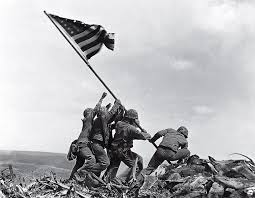
JOIN THE FIGHT! The Marine Corps Combat Correspondents Association is petitioning the Secretary of the Navy to name a US Warship after legendary AP photographer Joe Rosenthal, who took the iconic picture of the Iwo Jima flag raising. The image was also used as part of the Seventh War Bond Drive in 1945 to raise more than $26 billion to support the war effort. You can sign an online petition to support the cause for the USS Joe Rosenthal at www.ussjoe.org. Please specify “warship” vs. “ship”. Thanks for your support. SemperFi!
First Days In Vietnam
My First Days In Vietnam
My name is Gary Parker and I was born on March 22, 1949. I joined the Marine Corps December of 1966. It was just 2 months after my mother passed away and 1 month after I had a bad car accident that left my girl friend in the hospital not to mention my father who took to drinking. I figured I had to get away from my spiraling downword life at that time so I quit school and signed up.
I went to boot camp in San Diego Christmas day ’66 and realized at 17 years old I would have to grow up fast and my life was going to change. After boot camp I was sent to radio school for 4 months and then to more infantry training in Camp Pendleton, California. It’s then I knew for sure I would be going to Vietnam soon. Ended up there 2 days before Christmas of 1967.. As soon as I arrived in country I was sent to Danang to await orders. About a week later I was assigned to 1/26 infantry division that was up in a place called Khesanh. Never heard of Khesanh but knew it was about a mile from the border of South Vietnam and North. On the way to Khesanh I got a call on my radio that I was being diverted to Hill 881s which was about a mile or so from the Khesanh base to replace another radio operator who was killed the night before. I also found out that I was also going to be doing landing zone duties along with radio duties. My job with that included calling down the hill for supplies and replacements to be helicoptered in. The worst part of my duties were when I had to call in choppers to get our seriously wounded off the hill because those who were killed could wait. There were priorities first. I remember looking out if the helicopter window and wondering if I could do what was expected of me. When we got there I remember being told we would have to circle for awhile because the hill was taking incoming and it wasn’t safe to land. When we did the crew chief screaming to get the hell off and fast because the mortar and snipper fire was all coming in. Didn’t have to ask twice. The first thing I saw as I was running of the helicopter was about 6 dead Marines covered up with their ponchos waiting to be taken off the hill. I knew It was going to be a bad place. I asked someone as to who was in charge. And that someone was Lt. Dabney. Later after the firing stooped he told me that he wanted me to work off of 2 landing zones on the hill and to check in with him every night to relay down the hill what they needed such as food, water and ammunition. He also wanted me to get whatever I needed off the Marine I replaced. He was one of the dead Marines next to where I got off the chopper. I took the radio off his back and a few radio batteries and that was the first time I saw a dead Marine and knew I was in for a long hell on earth. I set up in a fox hole next to 2 Marines manning a .50. Every morning before I set out to get in contact with the Lt. I had to decide which landing zone I would be using and both were zeroed in by the North Vietnamese army. No matter which one I picked I had only 20 Seconds the get them in and loaded with dead and wounded before the bullets and mortar rounds came in and that was nerve racking to say the least. It didn’t always work that way and sometimes I would loose. I can remember being the only Marine out in the open guiding the help in to hover in becaus It was too risky landing. I also remember many, many times standing under the cooper hooking up cargo nets while others took cover while the mortars came in. It was funny but being there you couldn’t hear the bullets or explosions because of the noise of the chopper blades. It was better that way because you just didn’t know and I didn’t have time to think about getting killed till the job was done. There was no other choice other than to stand there and prey that today wouldn’t be the day. I not only had to worry about my butt , but the lives of so many seriously wounded Marines. It was my responsibility to get them out as soon as I could. Something that I think about almost daily. There were times When I had very badly injured and when I say badly injured I mean clinging to life lying right next to me at times asking for their mothers or wives waiting to get off the hill so that they might have a chance to live another day. I also remember at times the incoming was so bad that the helicopters just couldn’t risk landing. There were times I even felt God like because I was the only one that could get the helicopters in at the time. If I couldn’t sometimes they died and something died in me also. I felt like I failed them. I believe I carry every dead Marine inside me to this day. I remember everything they said to me as they took their last breath. Something over whelming for a 19 year old. There was nothing more I could do for them. I just wante to crawl under a rock and die. I also that if I could have given my own life to save there’s I would have in a heartbeat.
Another Marine Joke
A young Marine out on the town sat a civilian bar, He’s in the head taking a piss. In walks a young Army private. The Marine private finishes and starts to leave. The Army private says to him, “In Army boot camp, they teach us to wash our hands after we’re done. The Marine private says to him, “In Marine Corps boot camp, they teach us not to piss on our hands.”
Boot Camp during 1968
Boot Camp Parris Island January 1968
Standing on the passenger side of the bench seat in my mother’s 54 Olds looking out the windows as she drove the dirt roads into town was cool to this kid. I would hold my hand out the window and pretend I was flying. There was one paved highway we eventually got to then she would say to me “Roll the window up son, I gonna be doing 60 now we’re on the highway!” There were no child seats and most disdained any restraint like seat belts. My 5-year-old mind could not conceive the mileage, speed, and distance back then. I could only watch as the telephone & power poles started to go by like fence posts as mom speed-ed up the powerful V8 car on the blacktop high way into the small town on the Western side of the great state of Georgia. As a boy I would marvel at the Olds’ radio that picked up a few AM stations, it’s gleaming knobs along with the other protrusions from the dash, the controls for all the mysterious functions of the heat and defrost, wipers and various switches. We had no idea of how dangerous these old cars were in the deadly crashes in that era before the automakers were forced into making safety a priority. I don’t recall having a seat belt in a car until the 69 Chevy I bought as an adult.