I’ll never forget when we finished boot camp at Parris Island in 1966. Our drill instructor called 3 of us over to tell us we were going to radio school. After he told us where we were going he said, and I quote: “I just want you boys to know that once the shootin starts the average life of a radio operator is 30 seconds.” That was not something we wanted to know. Thanks be to God I lived much longer.
Category: Main
Dark Glasses and Suntan Oil
We arrived at the San Diego airport at 2AM, three days late, leaving Houston after a hurricane. Everyone was herded off onto “cattle cars”. While standing on the “yellow foot prints”, a couple of guys in the back row were whimpering like someone who had just got a spanking from an angry Mother. When questioned by the DI, using a lot of colorful descriptives, “What do you mean you’re not supposed to be here?” one of them said, “We joined the Navy!” Naturally, we all were “invited” to do 50 push-ups for laughing. Our next experience was a not-so-professional haircut by the DIs, because there were no barbers there that early. The only thing I can say different about being a “Hollywood Marine,” is that we didn’t have “sand fleas”. MSgt (Ret)
Old radio equipment
I joined the USMC in 1961 and after leaving boot camp I was assigned to “H” Battery 3/10 as a cannoneer. I loved the job but in 1963 I went to NGF School at Little Creek Va. Then transferred to HQ BTRY I was assigned to the NGF section and went on a CPX and sat with a PRC-10 and never talked with anyone. Transferred to 1st ANGLICO in Hawaii it took me over a year to pass our Comm test for promotion to Corporal. We had to set up and operate all kinds of radio and wire equipment I did fine with high powered gear like the AN/Mrc 83 and 87 but A Comm SGT named Burton failed me a couple times on tuning a PRC-10, As I got salty and knew my gear we would trained using Morse Code . A 2533 RTO would transmit corrections to our ship in code, I was not required to know how to send or receive in code and I always wondered if the 2533 sent in his own corrections. A lot of guys in TACP teams had holes in the back of their utilities by battery acid from the battery of their MAY or MAW( UHF radio) an other thing Wire folks worked their butts off running wire comm while the rest of us slept.
Why it started
Sgt Grit,
I have been reading these post for years and have responded once but thought it was time to chime in again. In the spring of 1975 I was about to finish high school and was trying to figure out what I was going to do with my life. My oldest brother had already joined the Marine Corps and of course I couldn’t be less of a man then him. I told the recruiter that I was interested and got a couple of burgers out of him before I signed up. I was in the delayed entry program which was great since I got into a motorcycle accident right after graduating from high school and broke my wrist. I reported to boot camp the day after Thanksgiving that year. Ok let me give you a little back round info me. I was a B+ student who was into all sports and excelled at them and of course I was poor. With that said, I reported to boot camp without my glasses because I had broken them a few weeks before and couldn’t afford to buy new ones. One more thing I should mention was that I was wearing colorful overalls when I reported in. Well as you can imagine the DI’s were really happy to see me and the fun soon began. I enlisted in Seattle WA and landed in San Diego that night. I couldn’t figure out why it took all day for us to get to San Diego but we didn’t arrive until 2 am. Of course everyone knows what happens once we arrived, off the bus onto the feet and snap to attention whatever that is. Lots of yelling and screaming that didn’t make sense and then sent to get the proper attire and footwear. Finally we got to sleep in a bed and then guess what yeah you guessed it at 5 am were woke up with trash cans and lots of yelling. So with that said I will end this post and continue the story later.
’69 – 3d MPs War Dog
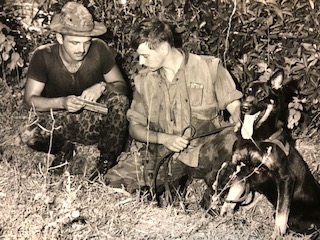
With the recent proliferation of stories about military working dogs (MWD) I thought I would add my two cents. This picture is Sgt. John Martino and a dog team from 3d MP Bn, and was taken in the summer of 1969. Martino was Guide for the H&S Bn provided platoon of the Provisional Rifle Company, which provided external security for the Force Logistics Command /Camp Books compound located about 1o miles north of DaNang. I think this dog must have been related to Conan. Hell, he looks just like him. Semper Fi!!!
AFTER THE CELEBRATION
On May 8th the world commemorated the 75th anniversary of the surrender of all armed forces of Nazi Germany, bringing to an end the fighting in the European Theatre. But for American GIs who had fought from the beaches of Normandy to Berlin’s doorstep, the celebrating was muted by the prospect that they would soon be transferred to the Pacific theatre. It was a very real fear, for the Japanese were tenaciously defending every inch of their shrinking perimeter. They closely followed news of the savage battle for Okinawa, which raged from April 1st to June 21st – a month and a half after the German surrender.
Yet to come was the Invasion of the Japanese homeland which, it was estimated, would cost 1 million Allied casualties – the toll in Japanese civilian lives would be multiples of that figure.
The expected shift to the Pacific theatre was unnerving in another way – the Japanese soldier, sailor or airman was a totally different opponent from the German. Following orders, they fought to the death, refusing to surrender in even the most hopeless situations. Fighting across the Pacific, from Australia to Okinawa, produced very few Japanese prisoners. They were fanatical and feared bringing disgrace to their family.
On the home front, the still defiant military leaders were training civilians – old men, women and children to resist battle hardened Allied troops with sticks and stones. It would take the dawning of the Nuclear Age, with the dropping of the only 2 nuclear weapons to ever be employed in combat, to end the deadliest, most savage, war in human history. Some depict that action as a “war crime”. In fact, it was the most humanitarian act of the war.
Sparky and Me
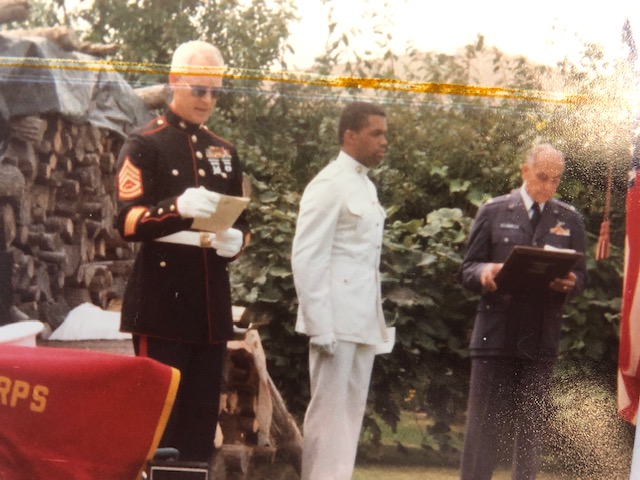
August 1978 to November 1981 found me on recruiting duty with the Officer Selection Office, RS Hartford CT. We recruited candidates for the Platoon Leaders Class & Officers Candidate Class from 72 colleges and universities in Connecticut, Rhode Island and western Massachusetts. To say the least, adapting to the culture and language of college students and northerners was not an easy task for a farm boy from Mulvane KS with 14 years Marine Corps service. In the early summer of 1980 a new officer joined our station, 1st Lt. John Sparks. Lt. Sparks was an 0302 Infantry Officer, Naval Academy graduate from Maryland, and had been selected for Captain. He and I were assigned together as one of two officer recruiting teams.
Emergency Head call
At Edson Range, everyone gets to take their turn “pulling the butts”. I was assigned a target about a dozen from the right side. And of course, the Heads were all the way on the Left end of the butts. The DI assigned to the group of targets that I was in was SSgt Martinez (Sr Drill Instructor of one of our sister platoons and would be considered a Light Green Marine from South of the border). One of my Drill Instructors, Sgt Fischer was assigned to the group of targets only a few targets down. The Private that was assigned to the same target as me needed to take a leak, so he did the proper thing and asked the SSgt Martinez if he could make a head call. Here is how the “conversation” took place:
Pvt: SIR, Private requests permission to make a head call, SIR!
SSGT M: Is this a ‘mergency head call?
Pvt: SIR, Yes, SIR!
SSgt M: Are you sure this is a ‘mergency head call?
Pvt: SIR, Yes, SIR!
SSgt M: I donno. I don beleive you.
Pvt: SIR, Private really needs to make a head call, SIR!
By this time Sgt Fischer heard the comotion and decided to join in.
Sgt F: Wheres your siren?
Pvt: Sir?
SSgt M: A sireen, you need a sireen!
Pvt: Sir, I don’t have a siren, sir.
Sgt F: A siren, you know – WHHRRRRR, WHHRRRRR.
Pvt: Sir?
SSgt M: Sireen, a sireen, I wanna hear your sireen.
Pvt: whhrr whrrr
Sgt F: No louder, LOUDER!
Pvt: WHrr WHrr
SSgt M: No LOUDER REAL LOUD
Pvt: WHHRRRR WHHRRRR WHRRRR
SSgt M: Good. Now where is flashing light?
Pvt: Sir?
SSgt M: A flashing light. you need to have a flashing light. (putting his fist on top of his head, with his thumb down, opening and closing his fingers. Sgt Fischer also mimicing SSgt Martinez.)
Pvt: (putting fist on top of his head and mimiced the gesture)
Sgt F: Good, Good.
SSgt M: You need to have your sireen going. Let me hear your sireen.
Pvt: (With his hand on his head, fingers opening and closing) WHHrrr WHHrrr WHHrrr
SSgt M: LOUDER, LOUDER!
Pvt: (Hand still on his head, fingers opening and closing) WHHRRRR WHHRRRR WHHRRRR
SSgt M: Good. Now you can go. I wanna hear you all the way!
PVT: (headed down the full length of the butts – Flashing light and siren)
The Scourge of PTSD
Like most Marines who have served in combat or experienced extreme, life altering, uncontrollable situations, I suffer from the affects of PTSD. With help, I’ve learned that it isn’t necessarily the event itself that causes the problem, but how we choose to allow it to affect our well being that really makes the difference.
SemperFi Marine
I had a similar experience in Vietnam, I was nominated for the Navy Cross but because I was not attached to a marine unit it was downgraded to the Silver Star, reason my actions were not heroic enough for the Cross I was awarded the Silver Star. Medals are not given they’re earned and then awarded. We serve our country and hope that we serve with honor and valor and when we do the hope is that we are observed doing it and are recognized for the execution of that action. OOHRAH MARINE!!!!!!!!