Slant Pocket sateens

Sgt Grit,

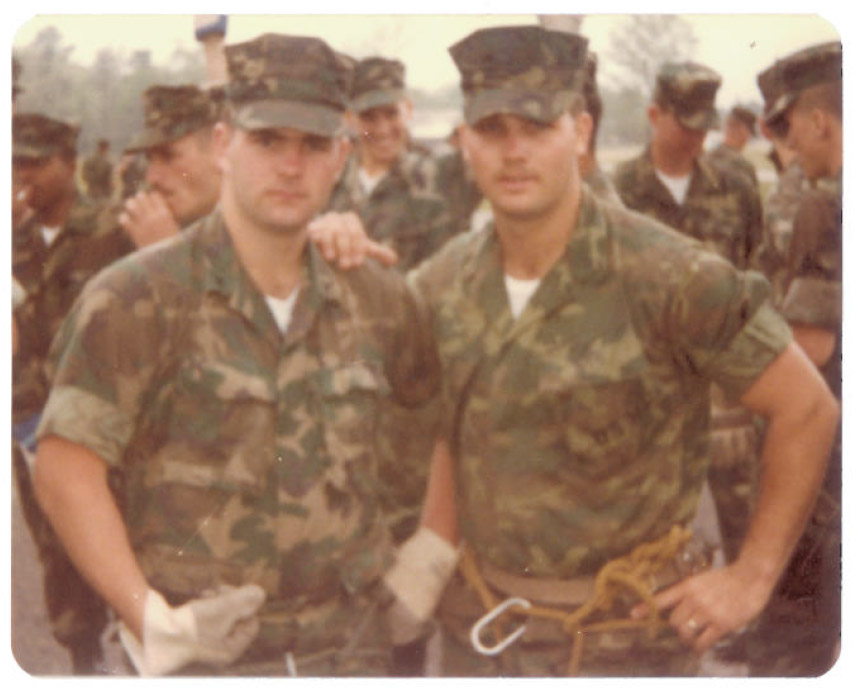
I can’t believe it. I lied. I posted last week saying I never owned a pair of slant pocket sateen cammies and then just last evening I came across this picture. I am on the right standing next to Max Lesko as we are getting ready for one of our helo repelling practices. And I am clearly wearing the lighter green, slant pocket sateen cammies. Max is wearing the more standard straight pocket sateen cammies. The photo is not dated, but must have been at least 1983 as I believe that is when the woodland pattern came in and there are clearly guys in the background wearing the woodland pattern as well. read more

MCAF Santa Anna

Sgt Grit,

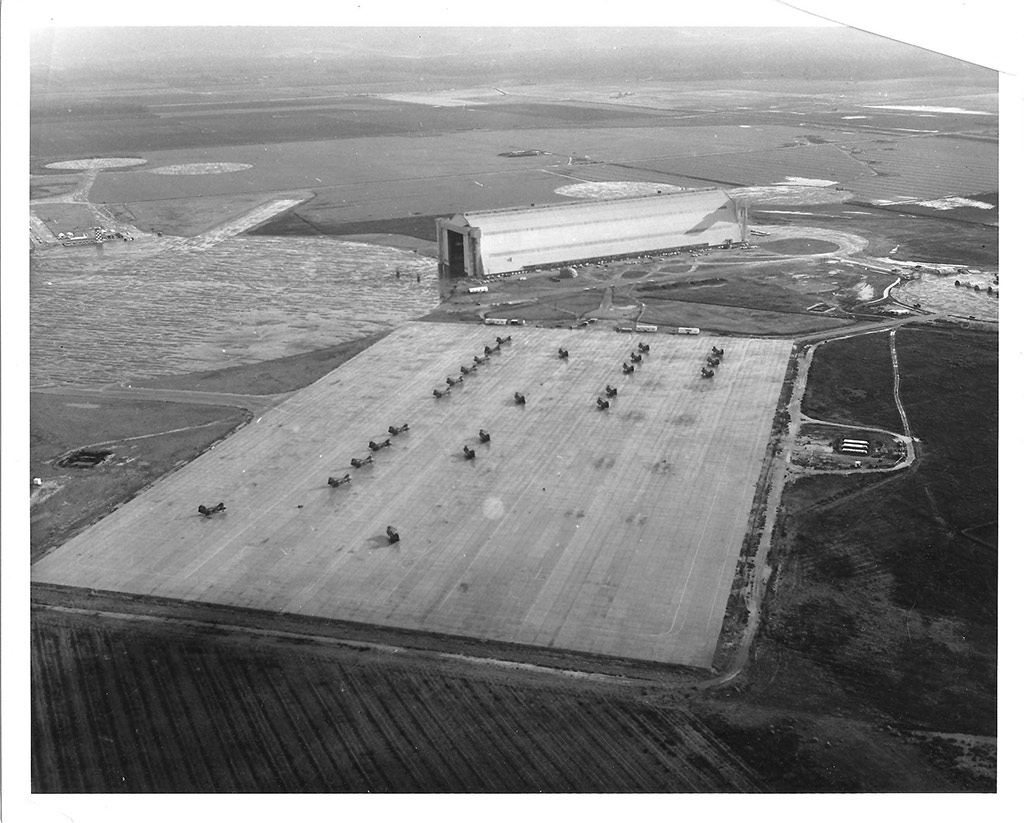
My first duty station turned out to be my only duty station (66-69). It is strange how a Parris Island Marine ended up in Califorina but it was great duty and a wonderful place to live. The pictures are of MCAF Santa Ana around 1965. The hanger on the left (closes to the main gate) is where H&MS-30 had its parachute shop but most of the "hams" offices were in the hanger on the right. The only other base that had blimp hangers that I know of was NAS Lakehurst, New Jersey. This famous base (the Hindenburg crashed there) was where I went to Parachute Rigger A school in early 1966. read more

Push Ball

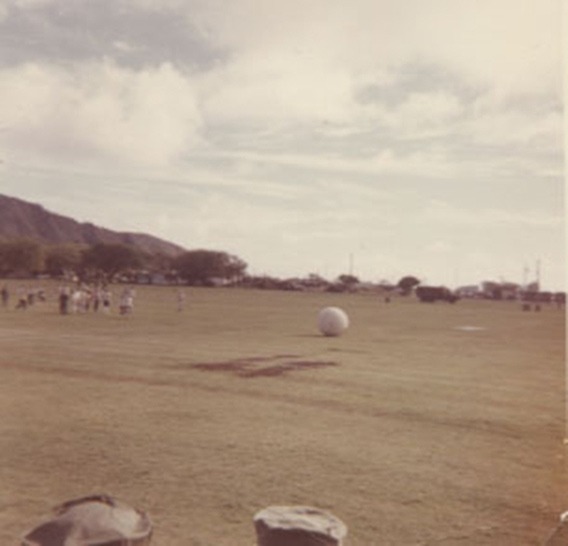
In the Sgt Grit Newsletter – 26 JUL 2012 there was an article about "Push Ball" fun and games. While at K-Bay in the early 60's the sport was played in the large field behind 3/4. As I remember it was about platoon size teams that played, but that is a little fuzzy after 50 years. I do have a picture of the event though it's hard to really get a good feel for the size of the ball. I seem to remember that it was about 7 to 8 feet tall, something like a huge soccer ball. As the article indicated, there were few rules short of murder and 1st aid was generally really close by. read more

Can’t Remember

I really appreciate your newsletter and I'm hoping it will help me out. I remember at least one or two Marines and usually more from every unit I served in except one.

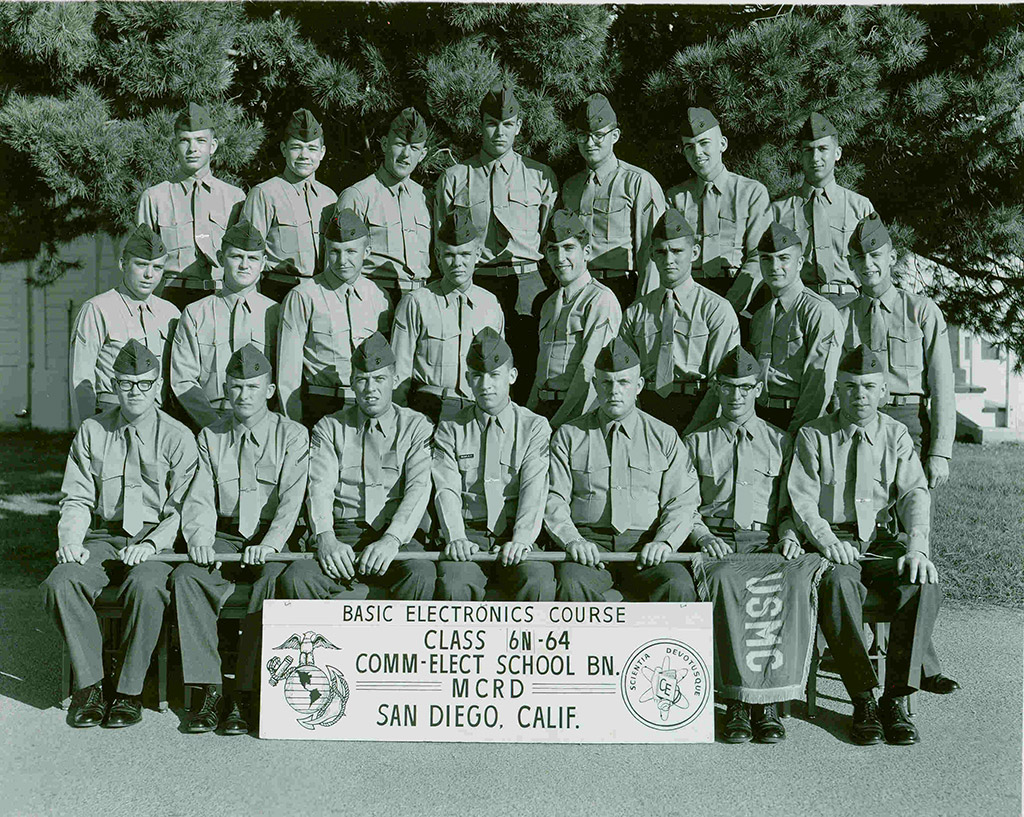
I spent approximately six months with twenty other Marines going through Basic Electronics School and Radar Fundamentals at MCRD San Diego from early July of 1963 until about Christmas of 1963. I can't remember a single name. Well, that may not be entirely true. I think one of them was named Bishop but I'll be damned if I can remember which one or even if that's correct. We lived together, ate together, spent time together on weekends fishing and various other things. I even rode back from Illinois after Christmas leave with one of the guys and his wife and baby. We headed for San Diego in his 55 Chevy whose odometer didn't work and the speedometer gave up somewhere west of St. Louis. In Amarillo TX the fuel pump took a dump at 0300 and I split the seat out of my trousers someplace in Arizona but we drove straight through and made it back in time to report in before our leave was up. I was able to decipher the name of our instructor (Cpl. Robert Delikat) from his name tag in the class picture and I was able to find him but the names of my classmates eludes me like so many ghosts. The faces are as familiar as if it were yesterday but those names are all a complete blank. Maybe I should try hypnotism. read more

Bermuda Marine Detachment

Sgt. Grit

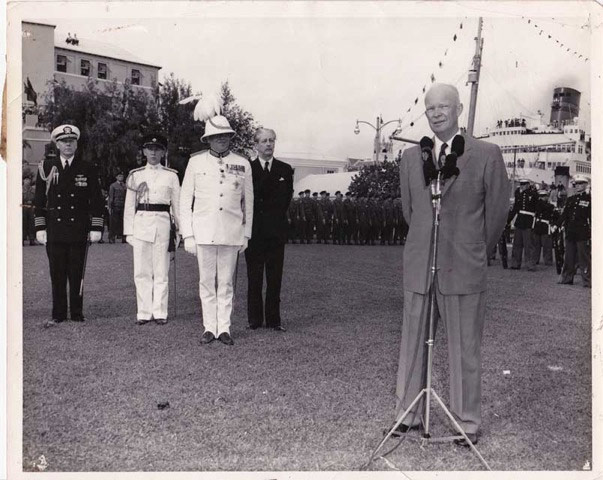
Here are two pictures of the Marines in Bermuda welcoming President Dwight D. Eisenhower for his meeting with Prime MInister Anthony Eden of England in February 1957.The top picture is President Eisenhower speaking to the people of Bermuda, Anthony Eden stands in the back ground with the Governor of Bermuda. The bottom picture shows President Eisenhower going to inspect the Bermuda Marines, Captain Grant Dunnagan Commanding Officer of the Bermuda Marine Detachment. salutes the President with his sword, the Naval Captain commander of the Naval Base Bermuda is bringing up the rear. When the President arrived and was coming ashore in one of two boats, a man stood up in the front boat and waved at the people, but when the boats landed at the dock, President Eisenhower got out of the rear boat. Marines guarded the third floor of the Hotel where the talks were being held, where the Desks for the Emissaries worked and all the United States documents for the meeting were held. The British Legation was on the floor below, we were dressed in civilian clothes and armed with .38 revolvers borrowed from the Navy. Prime Minister Anthony Eden quit as Prime MInister some months later due to ill health. Just another day of being a Marine, we were lucky it was in February because a few months later and we would have wilted in the Bermuda sun wearing our Dress Blues.   GySgt. F. L. Rousseau, USMC Retired

The “Myth & Legend”

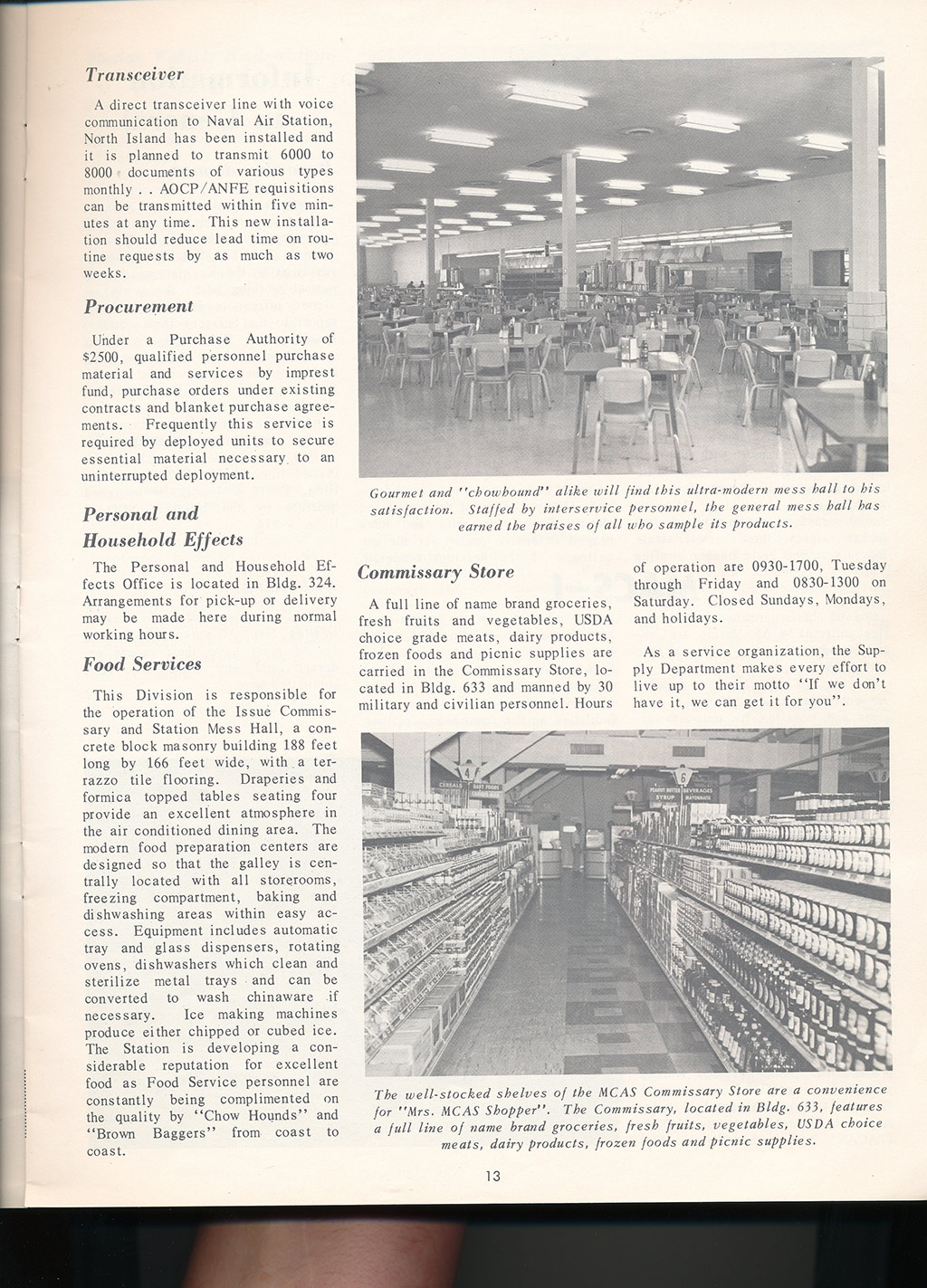
SGT Grit; You continue to deliver great products; just got my 100th Anniversary of Marine Aviation tee, good stories, bring a tear or two, and many good laughs; thank you.   It has been interesting to see the MCAS Yuma stories as I was convinced that few Marines were aware of the station especially the older Marines.  These stories bring back some good feelings.   I started my tour after boot camp/ITR as a 2531 at Camp Pendleton/main-side area 16 with H/3/11 in Feb 1962.  I was with H/3/11 until Feb of 1963; I thought I knew where all of the  Marines bases were at (little did I know), and I was a very naive "salt" (if there is such a thing!).  I went to MCRDSD for Basics Electronics/Aviation Radar school until Jan of '64.  So, by now I considered myself a very Marine Corps knowledgeable "salt"!  Disproved many times over the ensuing years since then!     After graduation from electronics school all my class mates got orders and split.  The First Sgt. had none for me and wasn't sure why.  He told me to stay out of sight, but to check-in  after AM chow every day until he got some word.  I laid low for several days and finally Top called me into his office and gave me my orders.  MCAS Yuma!     I had never heard of it, and worse yet no one in the office had either.  I knew where AZ was and where Yuma was, and I was not excited about that.  But still no info on what went on there or any real pertinent info.  I only knew to report to MACS 1 (Marine Air Control Squadron) in a couple of days.     So in Jan 1964 I drove to Yuma and reported in the night before my report date. I was given an orientation booklet by the Sgt of the Guard, and he had a driver take me to a barracks to get bedding and a temporary rack for the night with orders to have chow and report to MACS 1 at 0800 the next AM.  The duty NCO gave me all the info and directions I needed for the task at hand.  He gave me some bedding and showed me to a receiving room.  It was a ROOM! I reminded him I was not an NCO.  I was informed that this was standard billeting. Major shock.  I was convinced something was amiss!   Next day I did as told and reported into MACS 1; meet the radar maintenance officer (CWO 4), his staff and was taken out to meet the rest of the troops.  This was not the 1st Division!  But it was cool!  A Cpl(E4) was assigned to take me around the area and get me all checked in, and introduce me to all squadron Marines, gear, tools, etc.  At breakfast I couldn't believe the mess hall, 4 men to table and great chow.  I really was starting to think I was at the wrong place, or I was experiencing a mistaken identity; they thought I was someone I was not.  The last stop was at the barracks where I was assigned a room and introduced to my roommate.  This place was like a hotel.     I never complained about the barracks at either the 11th Marines or MCRDSD (all WW ll) barracks); they were comfy etc.., but this was over the top.  And I would have to confirm what the other Marines said; 2 men to a room, shared shower/commode connecting the rooms, wash basins/medicine cabinet in each room, single racks, AND doors on the room!  And if you asked first moderate decorations were allowed!   I have attached some scans from the orientation booklet I spoke of to prove our stories, and to provide a "way-back" machine for the folks that were there to reminisce over (hope you can use them Sgt Grit).   Yuma had a small permanent-duty assignment of Marines and sailors, and made for a very relaxed/friendly atmosphere.  Not that you could get away with murder, but drill, inspections,  etc.. were virtually non-existent.  We were a weapons training base almost exclusively so I don't think there were more than 400 personnel there, and we were all mostly support units.  We could go to the E-club at night and it was rarely more than 20-25 Marines there at any one time. BUT; almost every week 1 or more squadrons checked in for training etc.  Could get a little zoo like, but still mucho fun.  It was always fun when a 1st time squadron was checking in; you would meet a couple of Marines wandering the barracks hallways looking for their rooms, and you always got the same question; "where are the squad-bays?".  After a short explanation they were usually astounded and usually remarked, "wait until so & so sees this; he will s__t  his skivvies!".   The "myth & legend" about the barracks was rampant. The popular story at that time was that when the Marine Corps took over Vincent Air Force Base in 1959 they first considered taking out all rooms and converting to squad-bays.  Engineers said the buildings would collapse.   Well then take all the doors off the rooms and install 4 men in each room; double bunks, foot lockers etc.  Too costly, crowded, and oh by the way the air-conditioning won't work.  How about 2 men and no doors; air is still a problem.  What if we shut down the air and install a different ventilation system and different windows; you know how far that flew in Yuma!  There is probably a thread of truth /reality in all the myth surrounding those days.   All in all Yuma turned out to my best duty station for many reasons.  I thought it would be a remote/isolated h-ll hole, but in fact it was a great place.  It had a million things going for it.  I really enjoyed my time there.  If I hadn't just got married in '65 I was set to re-up, but Nam had hit the fan and my new wife informed me she was pregnant, BTW; still together after 47 years.   Thanks for listening; sorry for the length.  I would love to hear from any Marines that were permanent duty Marines at MCAS Yuma especially you guys from the early 60s when we were the  "secret" base!                   Wayne Mailhiot 1980XXX (nowhere near the "salt" I thought I was!)

GB Flame Tanks

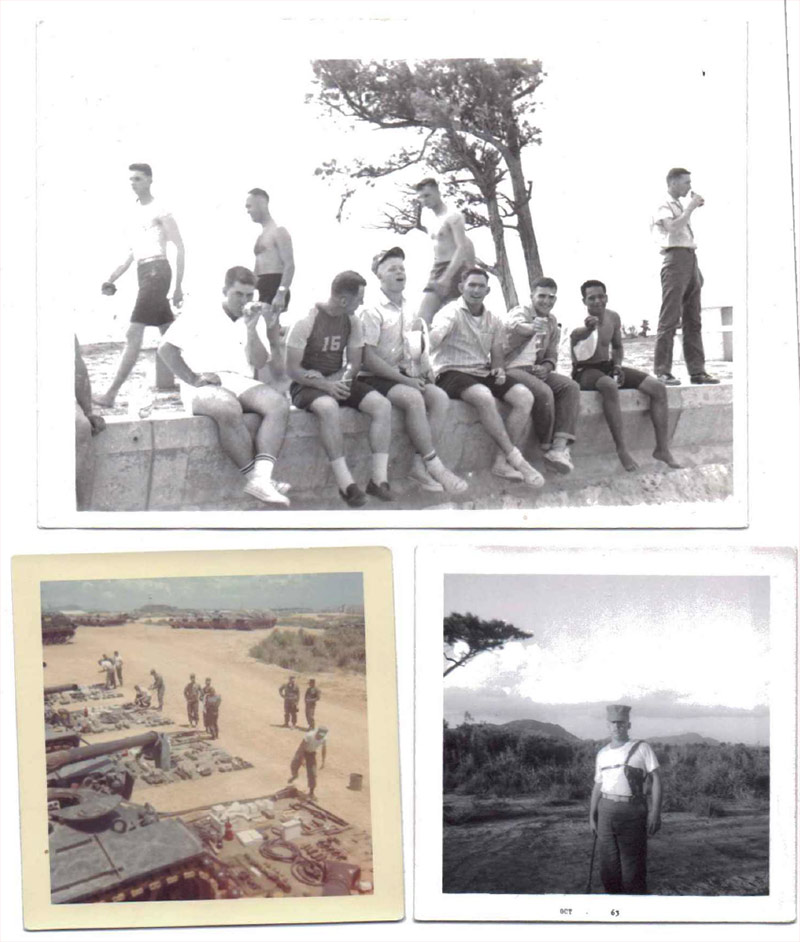
pictures from Okinawa and Los Pulgas and of the Breckinridge.. Lots of Flame Tankers
The picture on the ledge; I'm on the left in white…….Alan Crane is standing on the right. Only the guys sitting on the ledge are Flame Tankers- ??? walking behind
The large group picture is from Okinawa. I'm in the picture with the chest holster and in the picture of the inside of the turret…….Shows how tight of a fit it was……..I have names of some of the others read more

Quantico: the Three-Day War…

I have fond(?) memories of my six months as a butter-bar lieutenant at Quantico and The Basic School.    I remember my TBS (3-72) class and our "three day war" in the wooded hills of Virginia as well, particularly the December "night defense" in the snow.  By that point, people in my class had figured that it was smart to hang out with someone who had some "OJT" time in the bushes when we went to the field.  People were clamoring to be my "foxhole buddy", and it finally came down to coin-flipping.  I found an old, partially filled-in, crew-served weapons hole on the foreword slope of the hill in the snow-covered woods we were to defend, pointed down to the bottom and said to my buddy Joe, "dig".  He said, "Why go to all of that trouble?  We're only going to be here overnight, and the ground's damned near frozen!"  I told him to shut up, unfold his E-tool, and do what I told him.    By dark, we had a two-man position 6 feet deep, 6 feet wide, 7 feet long, floored, roofed and camouflaged with some downed pine limbs and boughs from a nearby tree line, except for a two-foot place at the down-slope lip, above our firing step,  where we could pop up and shoot.  As soon as it got dark, I spread my poncho over the boughs, which kept our little hooch dry, despite the heavy snow that was falling.  I had dug a one-foot niche in the back wall and set up my little "Svea 123" backpacker stove, which heated C-rats, water for coffee and hot chocolate, and did a pretty good job of warming up the hole, without the dull blue glow giving away the roofed position.  As everyone else shivered in wet, frozen sleeping bags in their shallow, snow-soaked prone foxholes, we spread our sleeping bags out on the dry pine boughs on the floor, on top of the mud, and went to "50% alert".   About midnight, we began to get probes from the opposing company’s attackers.  Nervous lieutenants around the perimeter began to "pop caps", and my companion Joe said, "Sounds like someone right below us, in the brush at the edge of the clearing…let's fire-em up!"  I admonished him and explained that their scouts were deliberately making noise so that we would fire at them and give away our positions.   Finally, about 0200, the assault began.  The positions which had been identified by the earlier probing were assaulted, got CS grenades on top of them, and overrun.  Ours, with the roof conforming to the surrounding ground and covered with snow, was bypassed.  Joe whispered to me, “Don, what do we do now?”  I replied, “Do what I do.”  I carefully unzipped my bag six inches, reached out with one hand into the freezing night, grabbed my M-16, shoved the BFA'd (Blank firing adapter) barrel up through the firing slot at the edge of the hole, cranked off a 30-round magazine of blanks on full-auto into the sky, and went back to sleep.  …A legend in my own time!   The best, and funniest, part of the whole incident involved two of our more notable TBS instructors, CPT McKasgell, who was leading the defense, and his friendly rival and buddy CPT North (Yes, Ollie “Old Blue” North, who was just back from his second combat tour in Vietnam, and who taught us “Scouting & Patrolling” at TBS.), who was leading the offence.  ("Rabbit" McKasgell was a Texas native, an Aggie and a competitive marathoner—hence the sobriquet—who owned his own rum distillery in Haiti.  Just before Christmas, his father called him and informed him that a wildcatter, who bought drilling rights on some scrub cattle land McKaskell owned back home, had struck it big.  "Rabbit" bought himself and his wife matching Mercedes sport scars for Christmas!  He had done a two-year exchange tour with the French Foreign Legion in North Africa, and carried a petrified camel penis as a swagger stick…one of the Corps' numerous eccentric characters.)   CPT McKasgell had gone to sleep in a shallow foxhole in the clump of trees at the top of the hill, which constituted the CP, and his sleeping bag had shifted during the night so that his zipper was underneath him, and frozen.  North, about five minutes into the assault, appeared like a wraith through the dark, confusion and snow of the battle, leaped through the defensive lines, deposited a CS grenade next to "Rabbit", and vanished again into the night.  The spectacle of McKasgell, who could neither don his mask nor shed his bag due to the frozen zipper, hopping frantically off down the snow-covered hill into the night, looking like a giant "Willie the Worm", was one from which "tales of the Corps" are made….    Our legendary Three Day War “Defense of McKasgell Hill” is one of the incidents that earned me a reputation as the go-to guy on military field-craft for the remainder of TBS and the nickname of “Gunny” from the other non-“Mustang” lieutenants in my Company.