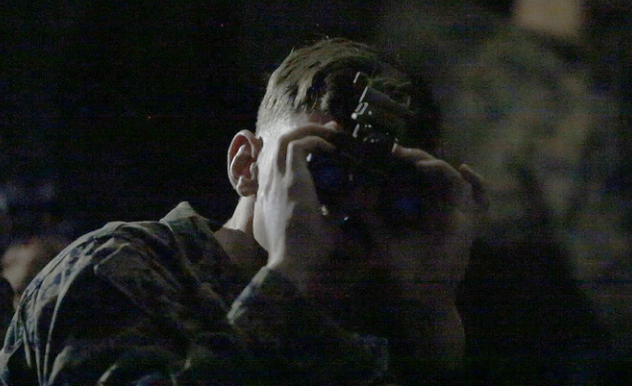
An updated helmet-mounted night vision system is beginning to make its way to infantry units. Marine Corps Systems Command accelerated the acquisition of about 1,300 Squad Binocular Night Vision Goggles using existing Defense Logistics Agency contracts.
FROM TEMPORARY TO PERMANENT: THE STORY OF THE 1ST MARINE DIVISION WHITE HOUSE
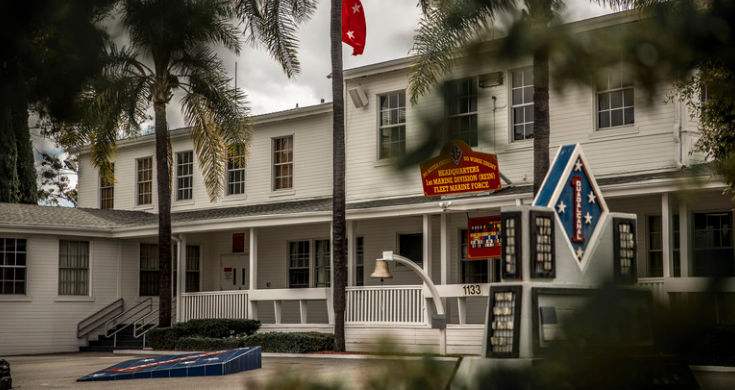
The building has withstood the test of time. It has seen generations of Marines enter and leave its halls. It has seen Marines off to several wars from the shores of Pacific Islands, the mountains of North Korea, the jungles of Vietnam and the deserts of the Middle East. It has served as the operational and cultural epicenter of the 1st Marine Division- the most storied and consequential Division in the United States Marine Corps. It has seen its share of history both for the division and the Corps.
Quiet strength: One Marine’s mentorship
Hey, knuckle-snacks. You suck.”
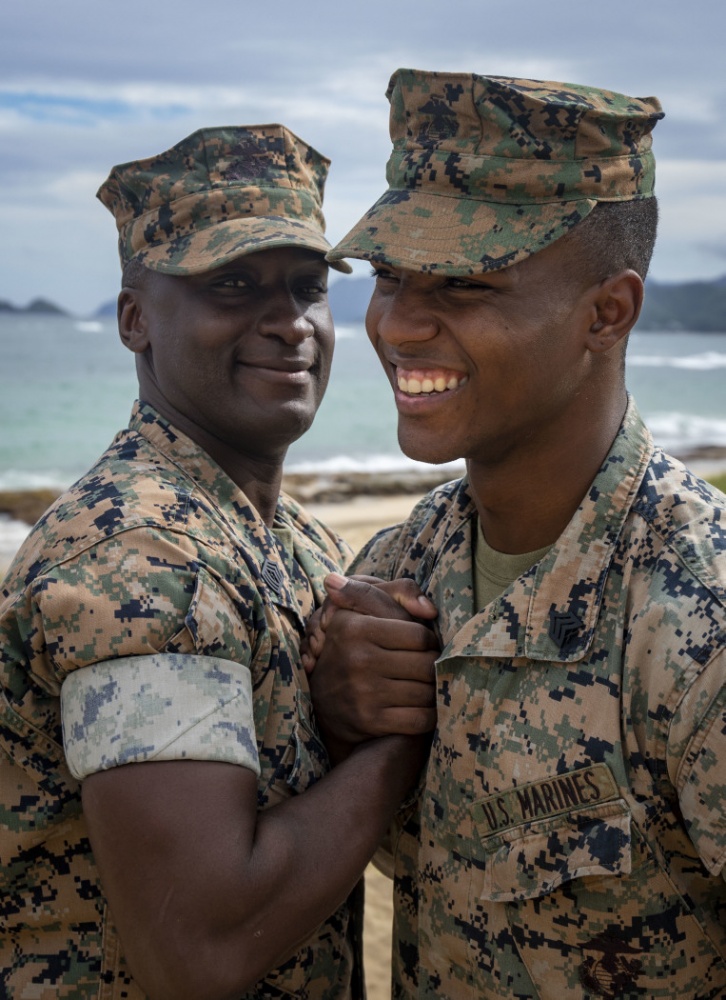
Gunnery Sgt. Ezekiel Kitandwe leaned over my shoulder, scrutinizing the half-completed video project open on my laptop. It had been a long few days of shooting an air assault exercise, and I was finally sitting down to make sense of the hours of footage I have accumulated.
“What’s going on with your color grading? You call that matching action? Where is my continuity?” He leaned back, exhaling a puff of frustration onto the back of my head. “Your work is garbage, bro,” he spat dismissively as he stalked back into his office.
“Aye- Aye, Gunnery Sergeant.” I smiled.
Observing both his methodology and his path through life, Ezekiel Kitandwe is anything but conventional. Born and raised in Uganda during the reign of the notorious military dictator Idi Amin, he was no stranger to hardship before joining the Marine Corps.
“I was the last-born of eight siblings, living in the capitol city of Uganda,” Kitandwe said. “In those days, we would always travel with our father. It wasn’t for our safety; it was for his. They were less likely to make you disappear at a military checkpoint if you had young children with you.”
Kitandwe and his family were members of the Muganda tribe, one of the many ethnic groups that were displaced and persecuted under Amin’s reign.
“Kampala, the city I’m from, was, to put it simply, a warzone,” Kitandwe told me flatly. “By age 8, I could tell what weapons were firing by sound. That’s an AK, that’s a PKM. That’s far away, we’re good, you better duck, that’s flying right over your grape.”
Kitandwe first saw the Marines in action in 1986, when Amin was overthrown and the simmering conflict was brought back to boil.
“Those Marines on Marine Security Guard at the American embassy, they were the cool kids,” Kitandwe said. “When I saw them empty out that embassy when everything was starting to pop off again, getting all those Americans out of there safely, I just thought to myself, ‘These guys don’t play.'”
At the behest of his father, Kitandwe immigrated to the United States in his early 20’s to attend college on a basketball scholarship.
The disparity in cultures was immediately evident to Kitandwe, he said.
“Acclimatizing to American culture was definitely a process. People were worried about the strangest things. You have food, transportation, and a place to stay, and you’re losing your mind over some little monthly bills?”
The reality of American life came with some other challenges, Kitandwe said.
“I couldn’t figure out for the longest how to work those damn pay phones,” Kitandwe said, laughing and shaking his head. “I put probably 20 dollars in quarters in the damn thing, and then I was still like ‘Okay, so now what?”
Kitandwe spent the next four years working different jobs in the United States before finding a Marine Corps recruiter.
“I was tired of going nowhere,” Kitandwe said. “I knew there had to be something more. I walked into the recruiter’s office, and ten days later I was at Parris Island.”
Trading the warzone he endured as a youth for that of his new nation, Kitandwe deployed to Afghanistan in 2013. While deployed with 1st Reconnaissance Battalion, 1st Marine Division, Kitandwe earned a Navy and Marine Corps Achievement Medal with Combat Valor. The citation describes how a then Staff Sgt. Kitandwe posted security and defended a compound from direct insurgent fire with only one Marine under his charge, accomplishing the role of an entire Marine Corps rifle squad.
“I don’t like to talk about it,” Kitandwe said reluctantly. “I truly believe I was only doing my job as a Marine.”
His decorated blues coat and record of valor is not what makes Kitandwe a great leader of Marines, however; it is manifest through his genuine investment in those under his charge.
“He stands out, not the first time you see him, maybe not the second, but once you have observed his actions, his emotions, his charge, it’s incomparable in a lot of ways,” said Sgt. Alex Kouns, the platoon sergeant at Marine Corps Base Hawaii Communication Strategy and Operations. “It’s something Marines greatly benefit from experiencing.”
Kitandwe exemplifies everything that is right with the doctrine of the Corps. He is tenaciously proficient, disciplined, and gives every fiber of his being to his ideals of the total Marine concept. Many leaders loudly preach the lofty standard that is expected of Marines, yet with Kitandwe, there is no need. He lives it, humbly, in plain view of his subordinates. His friendly, quiet strength commands more respect than any righteous belligerence ever could.
“He doesn’t manhandle you, if that makes any sense,” said Kouns. “At the same time, he’s still attentive, and takes care to promote creative thought, to guide, and to educate.”
It was 4:30 p.m. I had just received my monthly counseling as a lance corporal, and saw that my proficiency and conduct marks had each dropped a point. It wasn’t terribly significant, but I was livid. The justification read, “said-named Marine continues to advance himself both in MOS and general Marine proficiency, yet lacks motivation to work as a cohesive team member.”
As I sullenly packed away my things and bolted for the door, Kitandwe stopped me.
“Hey, Cool Kid,” he said quietly as his eyes pierced me.
“You good, bro?”
It was 7:00 p.m. We were in his office, and the light from the Hawaiian glass-slat windows had nearly faded.
I had spent the last couple of hours outlining my case against the unjust counseling, while evading the fact that I had in fact become withdrawn, moody, and distant. I tried to overshadow this with the deadliest of all weapons in Marine Corps logic: statistics. I was producing more products, faster than any of my peers, I argued.
I finished, and there was a silence. Kitandwe rolled a pen through his fingers aimlessly before piercing me again.
“What do you want,” he said.
What did I want?
It was a simple question, but it wasn’t posed as one; he delivered it as more of a challenge. I tried to steer toward safer waters, and began listing things I’d like to see changed about my work flow, but he cut me off.
“Is that what will make you happy? You’re obviously unhappy. What do you want,” he asked again.
I cursed inwardly. My route to the shallows had been cut. Kitandwe forced me into black, turbulent waters I’d been avoiding for months. It wasn’t a challenge from him, as I had previously thought, but a suggestion to challenge myself.
Without knowing why, I spilled.
I told him of a host of problems I had been struggling to bury. Sleeplessness. Constant frustration and anger- So much so, I worked myself into unconsciousness at the gym, waking to an officer dragging me off of the exercise bike.
And he listened.
I thought of my goals, what I would have to do to get there, and everything that had to change. He offered his insight on more than my development as a Marine, but my development as a human being. That was how he handled things. It was the balance of my internal weight scale that he fine-tuned within myself and every Marine with his insight and calm demeanor.
Recently, Kitandwe received his promotion to master sergeant. With the rank, an assignment to a new duty station is imminent. Although my time serving beneath him is coming to an end, I will always be thankful for his mentorship, imbued with quiet wisdom and a healthy dose of playful mockery- and I’m sure the next Marines he leads will be, too.
Happened on 23 June 1968
Returning home from a combat zone can be a very joyous occasion for most military personnel, but for those who were in actual combat, the experience of homecoming can be quite different. This was especially the case for Vietnam veterans, who returned home alone after a couple of days upon completion of their tour of duty. I’m sure many Vietnam veterans experienced a homecoming similar to the one which follows.
CAMP PENDLETON ARTIFACTS OF HISTORICAL SIGNIFICANCE MOVE TO THE NATIONAL MUSEUM OF THE MARINE CORPS
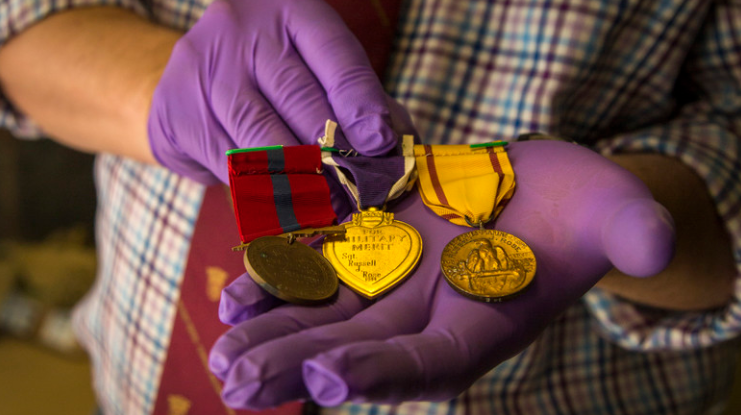
During the Korean War, Marine Corps prisoners of war (POW) in captivity spent time devising ways to let the outside world know their status and situation, but it proved a difficult task to relay information from their imprisonment. As Marines, each had to be creative.
MARINES SAVE AIRMAN’S LIFE IN OKINAWA
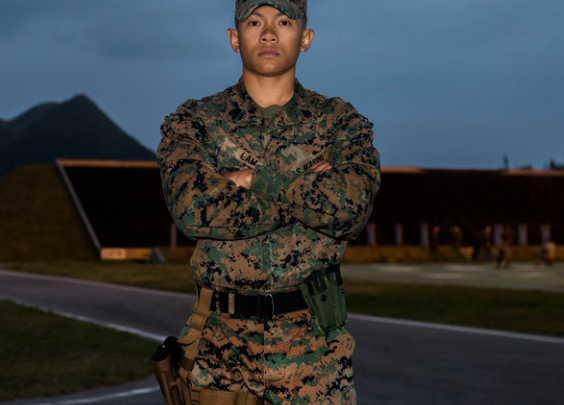
Seven United States Marines played a vital role in saving the life of a U.S. Airman with 353rd Special Operations Maintenance Squadron in Okinawa, Japan Dec. 31.
The airman, whose name is being withheld out of respect for the family’s privacy, was involved in a motor cycle accident along Japan National Route 331. A group of Marines witnessed the accident and rushed to the scene as first responders.
DEPLOYED MARINE CAPTAIN TRAINS FOR RACE IN MEMORY OF DAUGHTER
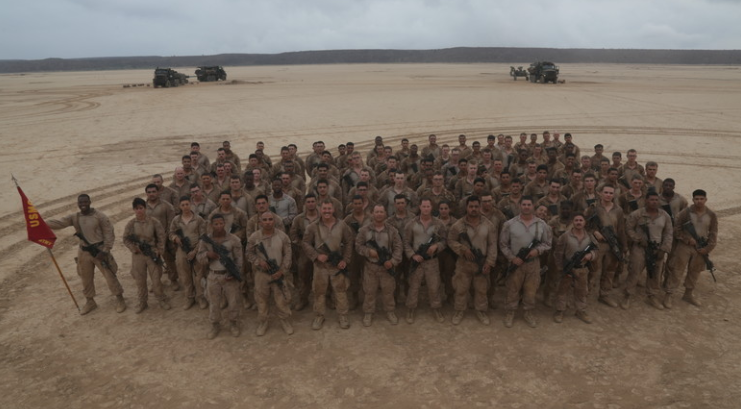
U.S. Marine Capt. John Watkins has to get creative when it comes to training for the Santa Rosa Ironman while deployed at-sea with the 13th Marine Expeditionary Unit, but he pushes through long runs on the treadmill and hours on the stationary bike because of the support from his family back home and the memory of his daughter, Amelia “Millie” Mae Watkins.
Remembering Uncle Alf
I recently read a story that reminded me of my favorite uncle,Uncle Alf(Alfred) My Dad,Harry Sr.,came from a family of 4 siblings my Dad,my Uncles Alfred and Howard and Aunt Helen. My Dad and Uncle Howard were drafted in the spring of 1943.My Dad went to the Medical Corps and served as a Combat Medic in France and then later as a Medic in a POW hospital treating wounded German prisoners Uncle Howard was drafted into the Army Air Corps as an Engineer and helped construct and maintain an airstrip somewhere in France My Uncle Alf,however,enlisted in the Marine Corps in late 1942 and after training was assigned to the 2nd Division as a Jeep Ambulance Driver and was involved in the invasion of Saipan. During the battle and, on the way back from the front with some wounded Marines he got lost and, started driving back towards the battle and right into the shelling.He was hit with some fragments in his left arm and leg but eventually found his way back to the Field Hospital with the wounded Marines For his action he was awarded a Silver Star and Purple Heart all because he got lost.The story does not end there.Uncle Alf took some razing for this incident, even though heroic, was given the handle of “Wrong Way ” so after the war when someone would ask about his service he tended to,lets just say overstate his heroics or, as my Dad would say “Tell a Whopper” One time he was a Marine “Raider” sometimes he was even a member of a “Special Demolition Team” that would sneak behind enemy lines. My Dad and Uncle Howard knew the truth but that never stopped Uncle Alf. I loved hearing his stories.Our weekend fishing trips were always fun. Finally when I was about 14 years old my Dad told me the true story but he was still a hero to me and,part of the reason I enlisted in the “Corps” My Uncle Alf did not live to witness this. He was killed in a mining accident in late 1965. He was a good man and we all loved him even if he told “Whoppers”. SEMPER FI UNCLE!! Harry
STAR OF DAVID
It was explained to me that the six-pointed star on the Marine NCO Sword is the Star of Damascus, not the Star of David. Apparently, Damascus swords had a reputation of very high quality. Later, sword manufacturers simply
started placing this same star on their swords; thus the original meaning has been obscured over time.
Semper Fi,
Steve Wilke, SGT, USMC (’74-’80)
QUITE A CREDIT TO HIS SERVICE
On the evening of 10 September a business trip found me in Atlanta Airport. With a long wait for my flight, I had ample opportunity to watch passengers come and go. I first spotted a young sailor fresh out of basic. The Navy enlisted uniform has never been my cup of tea, but he looked really squared away in his crisp, clean whites. I then saw an airman. Typically, his Air Force trousers were about two inches too short, but otherwise he looked good too. I thought, “another fine representative of our military.”
Some time later, I noticed two Marine privates, obviously fresh out of boot camp, most likely on their first leave home. I went over to them and exchanged a brief handshake and “Semper Fi,” and then left them on their way. Still later, I spotted an Army E-3. High and tight, clean well-pressed uniform and solid bearing. Quite a credit to his service.