“A Place That Always Was”
By Craig W. Tourte
H.Q. 1/13 Khe Sanh 67-68
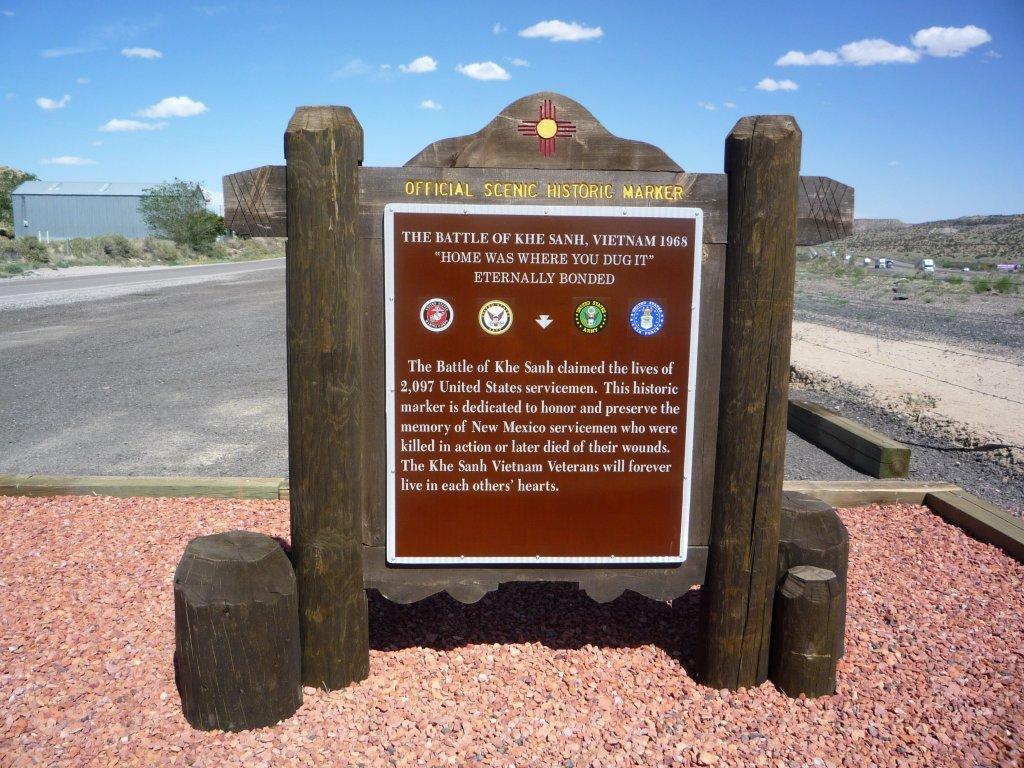
On Tuesday, November 10, 2009, the state of New Mexico dedicated and unveiled an Official Scenic Historic Road Marker honoring those who died at “The Battle of Khe Sanh, Vietnam 1968.” The beautiful wooden marker is inscribe: “The Battle of Khe Sanh claimed the lives of 2,097 United States servicemen. This historic marker is dedicated to honor and preserve the memory of New Mexico servicemen who were killed in action or later died of their wounds. The Khe Sanh Vietnam veterans will forever live in each others’ hearts.” In addition, the marker is inscribed with the names of nine of those who were killed from the State of New Mexico. I am sure more names will eventually be included, as that information becomes available.
“The location of the “Official Scenic Historic Marker” is identified as being at New Mexico 124, Mile Marker 16.5. In actuality, it sits along the old Historic Route 66 Highway, North of Interstate 40 at the 104 Exit in an area identified as Acoma, New Mexico. It was an approximate 50 mile drive along Interstate 40 from the City of Albuquerque to reach an area known as “The Sky City.” The Sky City is actually an area where the Acoma people lived centuries ago atop a mesa to protect themselves from enemy attacks by neighboring bands. The Native American’s who live in the area are identified as the “Acoma” which means “Place of readiness.” According to a little research, “Native American legend” describes Acoma as a “place that always was.” Native history says “…it was first inhabited about 700 A.D.” “Archaeologists agree that it has been continuously occupied from at least 1150 A.D. to the present.” Acoma, New Mexico is generally considered “America’s oldest continually inhabited city.”
The drive from Albuquerque to “The Sky City” where the Historic Marker is located is not unlike any other drive I have taken along a desolated high desert highway. Long, straight and lonely for the bored and weary traveler who too often focuses attention on what’s over the next rise. One could pass Acoma in the blink of an eye and never know anything was there except sand, sagebrush and red dirt. I wondered why a monument honoring these heroes would be erected in such a desolate location and not in a more densely populated area.
It was early evening when I drove out to the site of the Historic Road Marker where I met Harold E. Lockwood (HMH-CH-53 Sea Stallions) for the first time. Harold is a tall, proud Native American, former Marine and Vietnam Veteran who is the Sergeant at Arms of the National American Indian Veterans. We stood together as darkness approached, surrounded by red sky with a few wispy clouds off in the distance and tall red table top mountains rising up from the desert floor. Harold identified his house a quarter mile or so away from where we were standing. With the swing of his arm in a wide arc he told me about his cousins, friends, other relatives and Native Americans who lived nearby and identified those who had served and those who had made the ultimate sacrifice, all from the Reservations. We talked about the arrival of the early Missionaries, the Native American children who had been taken from their parents and even to this day, the hardships his people face.
We spent a few minutes talking about his service in the United States Marine Corps and the three years he served in Vietnam. The tragically brutal injuries and death he had observed as a helicopter machine gunner, too often recovering the dead and wounded. The missions off of ships made by young boys who eagerly entered combat for the first time, all dressed in new green uniforms and combat gear and his painful recovery of their remains after the battles. Harold remembered all of these events clearly and with great sadness as he looked up into that red evening sky, silently remembering the pain that is often overwhelming, as he searched for the words that would somehow explain to the outsider, the horrors he had witnessed. Remembrances I knew were still prevalent.
The following day during the dedication ceremony there were a group of young children from one of the local Native American schools who preformed a dance. Adorned in Native American costume, I observed they all had very intense looks on their faces. I realized that the dance these children performed was a serious cultural interpretation of events and beliefs that had been handed down from one generation to the next. The dance was significant to the Native People and fitting in that it was performed in memory of those who had sacrificed for their people and our country.
As I stood alone looking out across the Acoma, viewing the red earth color of the valley and hills, not so dissimilar in color to the red clay of Khe Sanh, I glanced up into the very wide open sky and understood why fate had brought “The Battle of Khe Sanh” marker here. Somehow fate had brought this remembrance marker to this spot, because this place is a “Place That Always Was,” A “Place of Readiness” and in a way, a place of safety for those who we will never forget.
Craig W. Tourte
CTourte[at]sbcglobal[dot]net