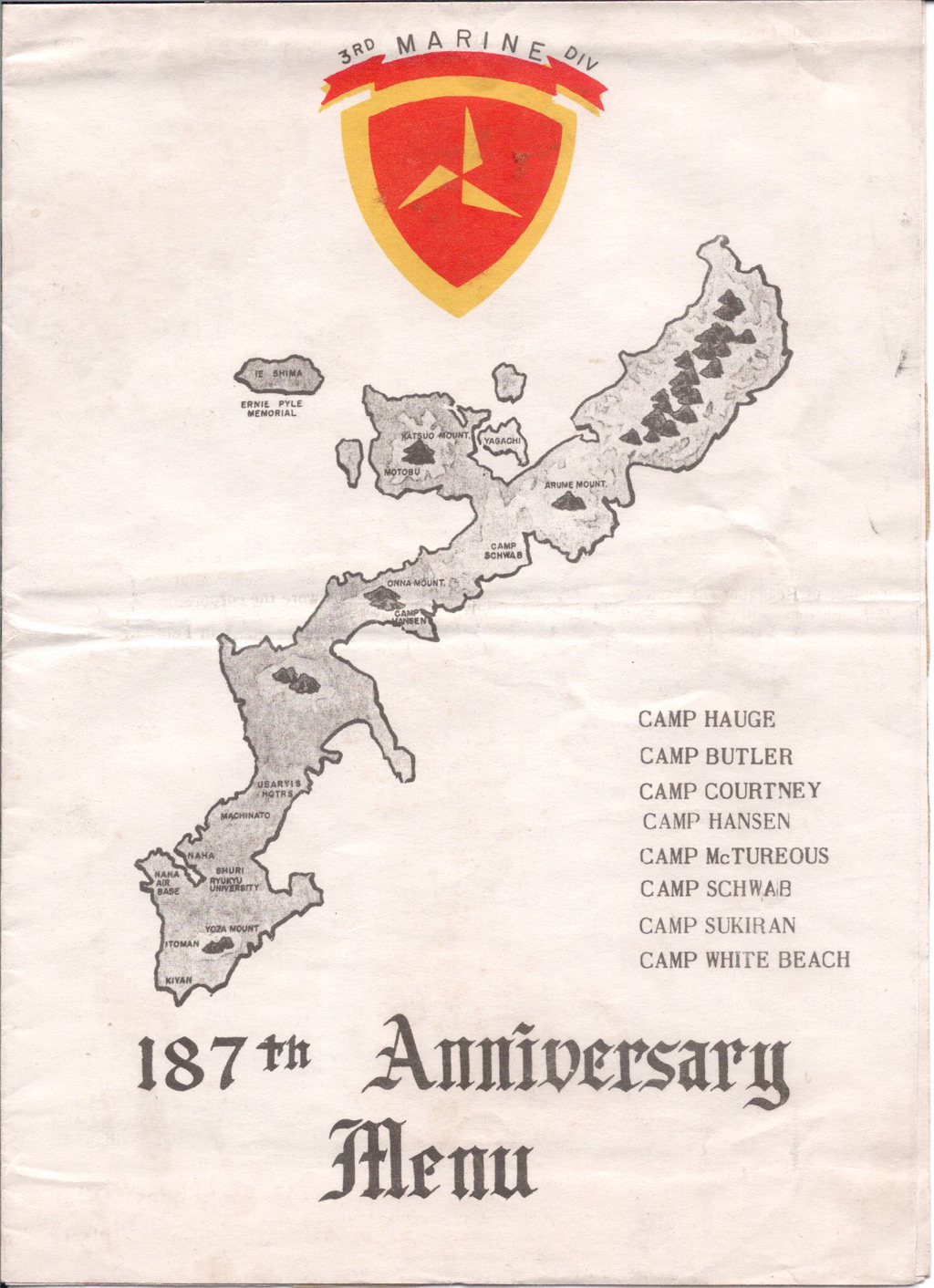
It is Nov 10th 2011 Happy Birthday Marines. I was just reading your latest newsletter and seen another Birthday Menu, then I remembered that I had a menu from the 187th in Okinawa 1962
At that time I was aboard the USS General Mann on my way to to Camp Sukiran Okiinawa. Here are some pictures of the Menu.
Cpl G. D. Sprenkle 1961 to 1966
Category: Marine Corps Stories
192nd 3rd Marine Div Birthday Dinner Menu
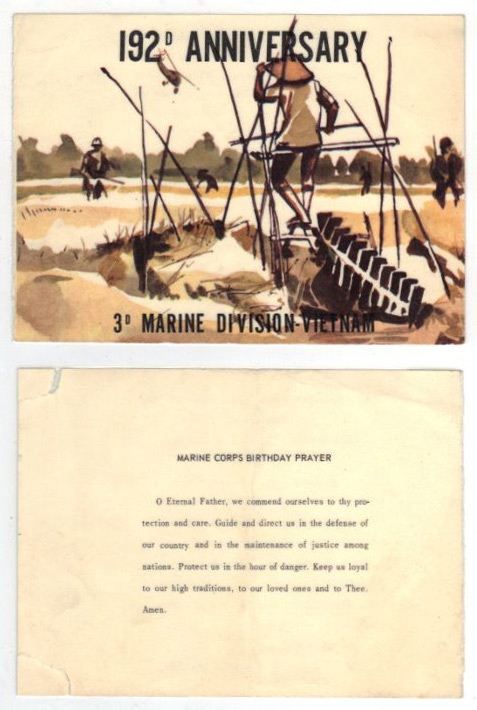
Here is a copy of 192nd 3rd Marine Div Birthday Dinner Menu when I was in country. The Commanding General Hockmuth was the only General to be killed in Vietnam. Use it if you like next birthday or when ever.
S/F
Greg
191st Birthday Cake at MCRD San Diego, 1966
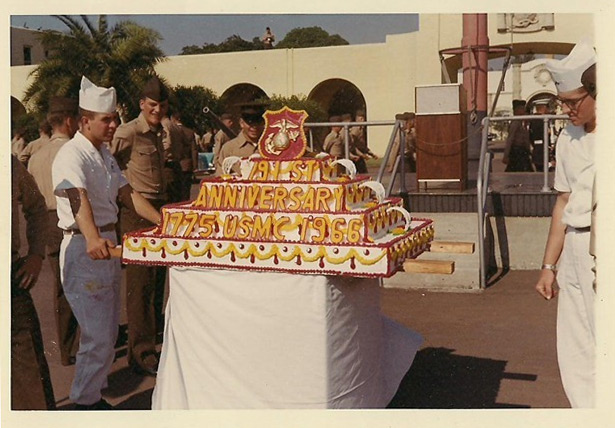
hey Sgt Grit, here’s a picture of the birthday cake at MCRD San Diego, 1966. Happy Birthday to our family, to all our brothers and sisters, past, present, and those who yet dare to serve in our glorious United States Marine Corps.
Semper Fidelis,
Corporal Ted Picado 0311
Greg Wood Marine Vietnam Story
Dedicated to William Overton Winston, Cpl, USMC, who left the world on 8/1/1067
Good day. I am writing this horrible story at the request of my family, although I don’t know why people would want to read about 18-year old Marines 45 years ago running through 125 degree jungles stopping to shoot at someone every 70 yards, dodging bullets all the way. The family justifies it: they tell me it’s a legacy of some kind. Great amounts of death, blood, and trauma for 9 months, 2-3 times a week, around 80 firefights in 1966-67, Vietnam, USMC, WESPAC. Might have been 120 fights; who knows? Who cares.? Dead and wounded both sides everywhere. Penny a point, no one keeping score. I was a 105MM artillery Forward Observer, shooting the big bullets. What a legacy. This is a 2010 Christmas present to them. As a Grandpa (“Papa”), I have 4 sweet kids and 6 grandkids. I haven’t spoken to any of them much about that year I spent as an 18-year old Marine half a century ago. It was pretty rough, and I didn’t want them thinking of me as what “Papa” had become over that year. It wasn’t that I lied; I just chose not to speak the whole truth that much, or tell these stories. This will change that; can’t hide anymore. The only time I cried in the whole stupid war was when I lost count of how many men I had killed as a rifleman, then around 50 or so. I knew the Artillery count was larger, probably 400 or more, but that’s sort of indirect. I was surprised by the grunt work. Afterward, I kept on killing, but never started counting again. How can you lose count of the men you had personally killed? Unforgivable; and it haunts me to this day still. I never did catch up. There are other hauntings, too, as you shall soon see. Then, the Greg I had known as a kid was in the never-never land forevermore, in the either always, no one would ever recognize me, there would be no friends nor lovers, and so it would be such for eternity, doomed, and so it would be, malevolent in the end, as it was that year. The only thing I would ever hear would be gunfire, explosions and violence, and I would end my short life amidst this milieu. And so it was in fact; 50 years later I still live there occasionally, still. I was adrift, morally, forever. No one to blame but myself, I was the shooter with the hot hand. No one ever told me to stop firing, they needed me too badly. I was a volunteer and could have quit any day, but I enjoyed it and never wanted it to stop. I even enjoyed the weekly near-death close calls. Hello Satan. Mark Twain said “You go to Heaven for the Climate, you go to Hell for the Company.” See you soon, Mark. However, as it turned out I had a pretty good life after this, in spite of my darker thoughts. I prefer the legacy at the other end of the story. After an AK-47 punched two holes in you, one under the left nipple going in, and another going out the back; without much blood or hollering, you go quiet pretty quickly. Shock sets in fast, especially with only one lung left. After five months, I recovered, went back to full Marine Corps duty, push-ups and runs, and was discharged (with medals), got out of the Corps and graduated two colleges with a BA and a Masters in business, worked for Merrill Lynch 5 years and was a real estate broker and developer for 15 more years. I married two women, had 4 kids, two each, have 6 grandkids, and am now retired, fooling around with all the kids and grandkids. Now that’s a legacy! Back to Vietnam: There are two stories: 1) The Big Picture; and 2) The Little Photographs. We’ll see how this works out.Marine Corps Birthday Ball Speech Given by Craig Roberts
Marine Corps Birthday Ball Speech Given by Craig Roberts, Marine Vietnam vet and author, to the US Marine Reserve Anti-Tank Battalion, Tulsa, Oklahoma, Nov 9, 2002.
I want to thank you for inviting me to be your speaker on this 227th Birthday of our Beloved Corps. It is quite an honor, and one that I never even considered happening to me when I was a young hard- charging Marine in Vietnam in the mid nineteen sixties. I only wish my father, who was a World War II FMF Marine, Pvt. William F. Roberts, Jr., USMC, serial number 555502, and who passed on last year, could be present to hear his son talk about his Marine Corps.
I know that many of you are wondering why a lance corporal is your speaker. It may because I’m a combat vet, or because I’m known as a writer of military tales, or because I can tell some great war stories. But it might also be because the rank of lance corporal is the best rank to hold in the Marine Corps. At least it was when I was in. A lance was too high a grade to do dirty details, but not high enough to take any responsibility. We supervised working parties of PFCs and Privates, but if anything went wrong, we blamed the Corporal who should have been there supervising, but was down at the slop chute or the gedonk instead, and left us in charge. Yes, lance corporal was a great rank, and a lofty one as well. At least in those days when it was not uncommon for a PFC to re-up after four years to make Lance. And the rank lasted a long time too….at one time I was senior lance corporal of the Marine Corps. I had more time in grade with a clean record than any other lance in the Corps. I was kind of like Sergeant Major of the Marine Corps…but for lance corporals.
Also, there is one misnomer I would like to clear up. There is no such thing as an "ex-Marine." There are only Marines. Some are on active duty, some on reserve duty, and some, such as I, which we can specify as not-presently-serving Marines. The formula is simple: Once a Marine–Always a Marine.
People ask me why I later joined the National Guard and eventually transferred to the Army Reserve instead of joining the Marine Corps Reserve. In 1972 the Vietnam war was still going on, and the USMC reserve unit here was a truck company. I was FMF infantry, and "Motor T" was not something an FMF grunt is interested in. At the time I thought the Guard infantry battalion here could use my experience to train their troops. I could tell you horror stories concerning that decision that would plague me for years, but I won’t. The bottom line is that after 26 years, and various duty assignments–some good and some bad–I managed to retire as a lieutenant colonel in 1999, Infantry branch. During this time with the Army I told my colleagues that if I did a good job, worked hard, and kept out of trouble, I’d eventually get my old rank back as a lance corporal. When I did retire, a Marine gunny I’ve known for years, began referring to me as a "lance colonel." So, in a way, I did come full circle. I am now the only "lance colonel" existing in any branch of the service.
I sometimes am asked what it was like in the Old Corps. Well, I wasn’t in the old corps. When I was in, between 1964-68, the old Korean War salts who served with us called us "boots" and "the new corps." At this point I must clarify what a "boot" is. According to our NCOs in days past, a boot is someone who enters the gate at MCRD ten minutes or more after you do. From then on, he is boot to you and you’ll never let him forget it.
As time passed, the "New Corps" criteria changed with each generation, and my generation now is considered by the WWII and Korean Marines as "the semi-old Corps" or the "not-quite-so-old" Corps.
But a few years back the Sergeant Major of the Marine Corps, standing next to the Commandant at Parris Island during a training inspection said "Sir, There’s the old corps, the new corps, and whatever in the hell this is." I can’t comment on that, just reporting it. But now those lads at Parris Island then are now probably considered Old Corps by today’s young Marines.
I’m also sometimes asked what boot camp was like in the sixties, before Vietnam. It was rough. It was the hardest training I ever went through. It was the same as it was in the Korean War era, except the M-1s had been replaced by M-14s. In fact, my platoon commander, Staff Sergeant Joe Vierra, carried a .50 caliber receiver out of the Chosin Reservoir on his shoulder. He worked for a gent named Colonel Lewis B. Puller. Vierra was the most sadistic, meanest, most cruel bulldog-faced cigar-chomping gorilla who ever wore a campaign cover. But if there’s anyone I owe the successes of my life, and my survival in Vietnam to, it’s him.
If you remember the TV series "Gomer Pyle" you know what our utilities looked like. They were faded forest green cotton sateen utilities that we scrubbed with scrub brushes on the wash racks by hand until they looked turquoise–what we considered salty. Then they were starched like boards until the crease in the trousers could cut raw meat. Our boots were rough-out brown boots that we dyed black and spit shined, and our covers were starched and ironed until they could be used as a deadly weapon.
All this changed in Vietnam. Our boots rotted, our utilities fell apart, and our 782 gear was next to useless for the amount of gear we had to carry. Imagine a place where it is 125 degrees with 98% humidity day in and day out. It was like working in a blast furnace. Then monsoon season came and it rained hard 24 hours a day until the entire TAOR was nothing but a sauna bath of mud, and lakes of chest deep stinking rice paddies. We finally were issued jungle utilities, jungle boots, and pack boards with willie peter bags to carry our gear. The WWII canvas 782 gear, or what was left of it, was turned in or discarded. Our M-14s rusted no matter how well we tried to keep them, and M-16s wouldn’t be issued until the year after I was medevaced out of country. Our meals consisted of green cans of C-rations, normally cold, two, and if we were lucky (or unlucky), three times a day, for weeks on end, and our rifle cleaning gear was simply the butt-well gear, an old skivi shirt torn into bore patches, and a bottle of motor oil drained from a six-by. So began Vietnam for the Corps.
We learned a lot of things in Vietnam. Never return from a patrol on the same trail used in going out; tie and tape down anything that rattles; always use hand and arm signals instead of talking; always carry extra dry socks and plenty of ammo and grenades, make sure your canteens are always filled, and a thousand other things. But we also learned of danger areas when some of our Marines said certain things. For instance:
A PFC when he says "I learned this in boot camp."
A Sergeant saying, "Trust me sir…"
A 2nd Lieutenant saying "based on my experience…"
A 1st Lieutenant saying "I was just thinking…"
A Captain saying "I think I know a short cut…"
A Major saying "Chow and ammo should be on the way…"
A Colonel saying "One more mission this week won’t hurt us…"
A General saying "last night I had a dream…"
And a gunny saying, "Watch this…"
Since my walking tour of Southeast Asia, I’ve written about Vietnam, the Corps, and other wars and services. But I’m often asked why I haven’t written about other "elite" services such as the Green Berets and the SEALs. After all, aren’t they America’s super warriors?
My response is that the Green Beanies, if used according to their mission and charter are school teachers, and capable of doing a great job of working with indigenous populations. But they are not a fighting force like our Corps. But on the other hand, in Vietnam we proved to be excellent school teachers as well… evidenced by our Combined Action Platoon Marines who worked, taught, fought, organized, and lived in the villes with the locals. We didn’t need any Green Berets, we did it ourselves.
And SEALs? They are simply Marine wannabees who were afraid to go to Marine Corps boot camp, so they joined the Navy. What do they do that Marines haven’t done for years? Especially our Force Recon warriors? Can anyone name one mission the SEALs do that the Marines can’t? I can’t think of a single one.
Now, I do have great respect for the Navy. They provide us with three things: transportation to the battlefields, ships to launch our aircraft, and most importantly, our Docs.
A critical part of the Marine Corps family is our FMF Corpsmen. Unlike SEALs, they aren’t afraid of Marine Corps training. So who is the real Naval Hero here? Think about this: when you see your Doc in the field, and the bullets fly and all of us are on the deck taking up firing positions, Doc is the only guy up and running around to take care of us. Unlike some of the old jokes about Army medics, our Corpsmen do make house calls.
Since I have served in the Marines, spent time on Naval Bases and on ships, served in the Army and was attached to the Air Force, I can give you a first-hand observation of comparing the branches. I agree with Col. David Hackworth when he wrote this:
The Air Force is like a French Poodle: always looks pretty, sometimes a bit pampered and always travels first class. But the Poodle was bred as a hunting dog and in a fight it is very dangerous.
The Army is like a St. Bernard. It’s big and heavy and sloppy and a bit clumsy. But it’s powerful and has lots of stamina and is built for the long haul.
The Navy is like a Golden Retriever. They’re good natured and great around the house. Their hair is a bit long and they often go wandering off for long periods of time. They love water and kids love them.
The Marines come in two breeds, Rottweilers and Dobermans. Some are big and mean and some are skinny and mean. All are mean. They’re aggressive on the attack and tenacious on the defense. They’ve got really short hair and they always go for the throat.
My thanks to Colonel Hackworth for those observations. Now here are a few of my own:
From my perspective, a major difference can be seen in how the services build their bases and installations. I now give this insight to our younger Marines so you can see how the system works.
When setting up a new base, the Air Force first decides where to build the clubs and swimming pools and PX, then if any money is left over, where to build the runway and hangars. They know they can still go back to Congress and say, "gee, we ran out of money and we still need a runway," and they know they’ll get it.
The Army first brings in the engineers to build the golf course, then barracks that would put a mid-eastern sultan to shame, a fantastic officer’s club, a recreation center, and a huge PX, all hosted by civilian contractors. They then request more money to build ranges and training areas. And they get it.
The Navy builds a port by erecting a pier or two, while the chiefs develop a liberty call plan and arrange for transportation for the sailors to the bar district. When all is said and done, they have a great facility and all the comforts of home. And they usually have a few bucks left over, hidden in accounts in the budget of the submarine base, which is all secret–but accessible.
The Marines do it different. We find a mud-flats stretch of beach, slog inland until we find a steep hill, build a swamp on one side and a desert on the other, a rifle range at the bottom, and call it a base. If there’s any money left over, which there normally isn’t, we might think of building barracks.
Tactically and politically, there is also something that needs to be said about the Marine Corps. The Marines are the worlds greatest pacifists. According to the dictionary, a pacifist is someone who wants to end war, establish peace, and resolve political unrest. This is exactly what the Marines do best. If you want to pacify a world hot spot, send in the Marines. Twenty-four to forty-eight hours later the place is pacified.
Our motto, First to Fight, is more than that. It is a way of life. Since November 10th, 1775 when a group of fighting men gathered for the first time in a little tavern in Philadelphia to form the Continental Marines, to the fighting tops of the Bonhomme Richard, to the Barbary Coast, and from the Halls of Montezuma to Belleau Wood, Nicaragua and China, and on to Guadalcanal, Tarawa, Okinawa, then the frozen Chosin and the bloody hills of Korea, and then to the steaming jungles and rice paddies of Vietnam, and beyond to the Mayaguez mission, Beirut, Grenada, the Gulf War, Somalia, Bosnia, and now Afghanistan, and a thousand other battlefields, our Marines have truly been the "First to Fight" and have distinguished themselves with honor, bravery, sacrifice, and love of God, Country and Corps.
The Marine Corps is more than a service. It is more than a team. It is a family. I want to tell you a little bit about MY Marine Corps Family.
When I was working on my book, "Combat Medic–Vietnam," I had the honor of interviewing and telling the story of many medics and corpsmen. But one gentleman stuck in my mind for years, Hospital Corpsman 3rd Class Douglas Wean, a silver star recipient who served with Kilo Battery, 4th Battalion, 12th Marines at Dong Ha, Vietnam in 1968. He told me of an incident that we can all relate to.
One of the Marines in his unit had been wounded during a resupply run, bringing 155 howitzer rounds up the road to the firebase at Camp Carrol on the DMZ. The word came that the resupply truck had hit a mine. Doc Wean ran down the trail to where the smoking six-by rested, twisted and riddled with holes. Doc Wean worked on the wounded until he came to a personal friend, Jimmy. Jimmy was in bad shape, and Doug knew that the best he could do would be to cheer him up by telling him he was going home.
"Doc, ya can’t medevac me," said Jimmy. "Ya gotta fix me up so I can stay."
"You’ve done all you can do here, Jimmy. It’s time to go home.
"But you don’t understand, Doc. My battery needs me. I gotta drive the roads to bring up the rounds. If I don’t deliver, they can’t fire the missions. They all depend on me. I gotta take care of MY guys."
There was that word again. My. My guys. My Marines. At first I hadn’t really understood. What was it that brought men so close together that they would do anything–including die–for their fellows? Now I was beginning to understand. It wasn’t any one thing. It was a combination of several factors that all meld together to form a bond stronger than steel. The war, the terror, the dying and every other unspeakable horror men face in combat is countered by a combination of comradeship, trust dedication, an ingrained instinct for survival, and in the Marine Corps, history and tradition. These guys weren’t only responsible to each other, but to ALL the Marines who had come before. It was a family where one generation followed another and each passed a code of honor to the next. It wasn’t really patriotism or loyalty to a higher authority, it was a sense of responsibility to fellow Marines–past and present. Everybody felt like they were an important part of a family, or a team. They were made to feel that way. A feeling of need built dedication, and the dedication built pride, and a special spirit known as esprit d’Corps. Nowhere at home, or anywhere else in life, did a man feel as needed by his friends as he did here. It was all beginning to make sense. And I was beginning to feel a part of it. They made me feel just as needed and as important too. I was part of the team. I was THEIR Doc. And they were MY family. My Marine Corps family.
The Marine Corps Family. It kind of boils down to that. A team. A tradition. Brothers and sisters in arms, ready to go into harm’s way at a moment’s notice.
And our ancestors all had something in common with those who serve today, and we with them. A common link, and a common bond, forged by uncommon men and women. When we look back to such places as the misty, muddy forest of Belleau Wood in World War I, where the Fifth and Sixth Regiments of Marines earned the nickname of Teufel Hund, or Devil Dog, by the Germans who respected them for their bulldog tenacity and fighting spirit, we find they wore a small badge of recognition that set them apart from all other services: the Eagle, Globe and Anchor.
The China Marines, who patrolled the Yangtse River and the Leathernecks who patrolled the jungles of the Philippines and Nicaragua in the 1920s, also wore the Eagle, Globe and the Anchor.
During World War II, our Marines went ashore at places like Guadalcanal, Tarawa, Saipan, Okinawa and dozens of other islands and atolls, and shed blood in the sand and coral, their utilities stenciled with the Eagle, Globe and Anchor.
On the rugged hills of Korea, and at the famous Chosin Reservoir, our Marines fought against odds that were often greater than ten-to-one, and we won every battle and fought the greatest marching battle since Napoleon left Moscow when we came out of the Chosin to the coast bearing all of our equipment and our wounded and even our dead. And in the process, destroyed 13 communist Chinese divisions. On the left pocket of the field jacket of every man was printed the Eagle, the Globe and the Anchor.
In Vietnam, we conducted thousands of combat patrols, hundreds of sweeps, dozens of major operations, and fought in steaming jungles, muddy rice paddies, and even house to house in cities. We endured, we fought, and we won every engagement. And we, America’s young men who volunteered for America’s most unpopular war, also proudly wore the Eagle, the Globe and the Anchor.
In Beirut, 242 Marines died in a horrible terrorist atrocity that is yet to be avenged. But it will be. And for all of those brothers that died and those that did come home, they had one thing in common: They all wore the Eagle, Globe and Anchor.
In Grenada, Somalia, Bosnia, and Afghanistan, our brethren also all wore with pride and honor the Eagle, the Globe and the Anchor. Through all of these campaigns, and through all of these generations, we have all shown that our beloved Corps, and our beloved emblem have literally, as our hymn says, served "in every clime and place."
It’s a small emblem, but it says it all. We serve on in the air, on the land, and on the sea. We go anywhere, accomplish any mission, and are indeed, as the popular saying goes today, America’s 911 service.
And there’s one more family member that ranks alongside every Marine here and in the past. The Marine Corps Wife. God Bless her, she puts up with us, suffers when we suffer, supports us through good and hard times, and above all, understands us. No other wife in the world can claim the honor of being a Marine Corps wife. These women are special, and in their own way, also wear the Eagle, the Globe and the Anchor.
So here’s to OUR Marine Corps family. Here’s to MY Marines, past, present and future, and ….
As we used to scream in unison in boot camp in 1964: God Bless the United States Marine Corps, and Chesty Puller, wherever you are!
Happy Birthday, Marines, and Semper Fi!
Are we smarter than that?
After forty somethin' years it finally occured to me I should be insulted. We all should. Well, most of us anyway. One crisp morning outside of Chu Lai I had the duty of retrieving the Claymores that had been set out the evening before. This being accomplished I came back through the wire, plopped down, and started to heat some water in my canteen cup for coffee. In the few moments it took for the water to heat (C-4 can heat it up really quick) I started fiddling with a Claymore in my lap, trying to see how it was put together and how easy it would be to take apart. A little tentative prying with my C rat can opener and off came the back of it, exposing the pure smooth white of the C-4 layer, all except for a piece of paper, which covered about half the area of the explosive. On this paper it said in large print "DO NOT EAT!" At the time I thought it was silly, but only last week did I sit up in bed and say HEY! Did they really think we were that stupid?!" My wife had no idea what I was blathering about, but ever since I've been asking myself that same question. Did the Army have that on the back of their Claymores too? Maybe it was just for them? Whatever. I'm still wondering. Semper Fidelis, Joe Holt 2158867
The Camp Pendleton Brig 1968-69
I joined the Marine Corps to be working on jets in 1965 for boot camp at San Diego, Edson Range, ITR Camp Pendleton, 1965-66 NAS Memphis Tenn. Aviation Jet metalsmith school, 1966 2nd MAW Cherry Pt. N.C., 1966-1968 1st Maw Danang So. Vietnam,1968 3rd MAW ElToro, Cal. All is normal up to this Point. Then we have a large spread in the Life Magazine on the atrosities of the Marine Corps Brig at Camp Penleton, Cal. If you were in the corps at this time you knew that most of the guys in the brig for U.A. or A.W.O.L. or whatever were there because they didn't want to go to vietnam and the guys guarding them had already been there and lost there friends. So they didn't put up with anything from the men in the cells in fact they beat the tar out of them for anything and they got reported for this. So the powers that were in the marine corps at the time decided that something had to be done. So if you were in the marine air wing, had been overseas, were e-4s and had a year to go or less of your enlistment you were put in the camp pendleton brig as chasers and overall runners of the place. The brig was to have a capacity of 350 prisoners. At one point while I was there we had over 1500 prisoners under lock and key. 2 of us got assigned to hard labor 350 prisoners which meant we marched them for a couple hours every day. After we got there our biggest question was why are we here, to which the captain conducting the meetings, said if you read you enlistment papers you would find that you can be a basic rifleman at any point while in the marines. But he said if you don't like it here you can reinlist for two years and get your pick of duty stations, which caught about 15 of us 384 airwingers, while the rest figured we already had our choice and were yanked out of it to be a basic rifleman, no thanks, we'll do our tour and go back to civilization. It was a very interesting time I wouldn't trade for anything. I was walking across the compound one afternoon when a colored gentleman in a Navy grey bus yelled to me and said "sir do you have a hole here for wrongdoers?" I said no we do not have a hole for wrongdoer's here. What are you here for. To which he answered "Icame back from overseas to find my wife in bed with a stranger, so I killed them both and then went over SanFran. and chained myself to a priest. I said "you probably won't be here very long and then will go to Portsmouth N.H. where they do have a hole for wrongdoers". He said "great that's what I'm looking for". Well he finally got to our area causing a lot of problems along the way. I was going across that same compound as the first time and he was back on that bus and he said " Thank you sir I'm going to Portsmouth" I said "good luck to you". At one point we swore there was a sadistic officer somewhere trying to do something to us chasers. We got most of our prisoners off Navy Grey buses dropping them off for us to prosecute. One week we got a bus load in and they happen to be all white deep south boys, georgia, alabama, louisiana, etc. The next week we got another bus load in and they were all black deep south boys. We had some times keeping them all separated from each other. I was about to go home on christmas leave 1968 when one of the white boys approached me and said they were going to have a todo that coming weekend. I said hold it, don't say anything more for I won't be here and I would have to report him if he said anything more. He said that's okay he understood and said no more. I reported our cinversation so our guys would know what to expect that weekend. After I got back from leave I learned what happened. Somehow the white boys got out of there compound and came over into the black boys hut and tried to distroy them. One of our own guards got up into the rafters and tried to take out one of the biggest black boys with a 2×4. But he just shook his head and looked around for who had hit him several times. and about this time a metal bunk end came flying up into the rafters where the guard was at and decided he'd better get down and out of there before he actually fell among the blacks in there area and knowing he wouldn't come out in very good shape. The last event was a black man chasing a white prisoner with a bunk end and putting the white man in the hospital. For several weeks after the event we were on pins and needles waiting for the next incident. Of course to help things along the next compound kept yelling over that the white man had died. For which the captain would come over the loud speaker saying that he had not died but was recovering nicely. One more thing back at the start of being here and asking the captain why we were here and getting our answer. We decided that if we were bad enough at doing our job they would send us back to where we had come from. They hadn"t had an escape from the brig in a lot of years. So we had 15 escapes the first week but then the captain came over the loud speaker for all to hear that the next prisoner escapeing that got killed by an airwing man, 2 of them in towers with machine guns, the airwing man got to go back to the airwing. Needless to say that was the end of the escapes and our plans were foiled again. So everything settled down. Then some of the guys got wind of a staff carrying arms inside the compound. We didn't want to get him in trouble so we confronted him and asked if he was and he said he was. We said what are you going to do if anything happens, shoot 5 of them and then one for yourself, before they rip you apart? No reply. But a week or so later he was in the mess hall when they started a riot and all the gates came crashing down and he got caught inside with hundreds of prisoners. He never drew his gun but he lost it totally and they sent him to the psych ward. Hopefully he's been out for years by now and doing okay. About february 1969 I got to go to San Diego State for transition to civilian life school and then back to the brig to become a sargeant E-5 and then checked out of the corps Thanks a million Marine Corps Sgt. Dan Rawstern
Some happening in the airwing at Danang
When I first got to vietnam, you grunts will not appreciate this story probably, we had cold water showers, Then the seabees came through and asked if we needed anything and we said hot showers. They said no problem we have a hot water heater we'll loan you till you get your regular hot water tank. We said okay and they brought us this 5000 gallon tank mounted on a trailer with a gas powered heater which made the water hot. You came to the shower with your towel and one of you went outside and started the hot water heater like a lawnmower with a rope start. From there you had three minutes to take your shower at a progressivly hotter till to hot of a shower and somebody went out and turned it off and then you could enjoy your shower for awhile. A real pain if by yourself. Another thing we had going for us at 1st MAW was on sundays we had steak and ice cream for lunch and a lot of you grunts came visiting about this time for some unknown reason. Most of the time we could spot you for the red clay dust still on your boots and you always had your mess kit with you. We would tap you on your shoulder and tell you to put your mess kit in the brush and pick it up after eating on your way home. Because we had plates and cups and silverware inside for you to use. Thanks to all of you who came to eat with us. Sincerly L/cpl Dan Rawstern
3 more airwing stories
All three of these happened between Nov. 1966 and June 1968 I was having enough fun to extend once. We had been at Danang for awhile when we got word that charley had a sniper at the end of the airstrip taking shots at our planes as they come and go with a rifle. We couldn't tell if he hit ours or not but the security M.P.s left him alone for a long time because none our units had much problem with him. We figured he had a very cushey job shooting at our planes but not hitting anything and we could hear his shots at night when it was real quiet. But it all came to a head with the new commander arriving from the states and hearing of this, can't hit a thing sniper, being allowed to stay. The new commander ordered his M.P.s to get the man out of there and they did very quickly but charley replaced him almost immediately. The new guy hit the first six planes to fly over that we knew of and we patched the planes. From then on the M.P.s kept the sniper out of the fly way. Another happening we had was our hangar shaking enough to lose a window every so often. The ground didn"t shake but the hangar did so we would step outside if we were working inside at the time. This went on for more than a week a time and then the first time it happened the stars and stripes came out and informed us the New Jersey was off shore firing sixteen inch diameter shells over us at targets inland. The next time it happened it went on that same amount of time. The stars and stripes came out a week later saying the Army had 16 inch gun implacements in place and firing across the valley from us. So each time we wondered what was causing the shaking only to find out in the stars and stripes a week later it was just us fighting a war. Thanks again L/cpl Dan Rawstern
procrastination of an airwing unit at Danang 1st MAW 1967
Well this story starts in early 1967. We are all working 12 hour shifts and we have metal corrigated 6/12 pitched roofs over wood and screen sided huts about 8' apart. We also have open sand bag bunker in between for the mortar attacks that happened every so often. We could tell when we were going to have an attack because the vietnamese barber was always gone the day of the night attack. They had been telling all of us to put roofs on our bunkers for awhile. Between all of us work was progressing slowly at best and non existant for some bunkers. The attack came late one night and one of the mortars made a direct hit on a bunker of 25 250 lb. bombs. We had been in our bunkers for some time when the hit came and we all watched this, at the time, neat mushroom cloud going up into the atmosphere, it felt like several minutes but was probally seconds, when the concusion blew through our huts and angled them away from the bomb dump at a 45 degree angle. Seconds later we here this rat a tat on our hut roofs and a lot of guys saying words and flying out of our bunkers to get under the angled eaves and out of the falling schrapnel. Quite a few of us got burned by the falling hot schrapnel from our own bombs but only 13 put in for medals for being wounded in a war zone out of 400. Not all got wounded but a lot more than 13 but could not see trying to explain how you got wounded without it being an out and out lie. Needless to say those same bunkers got roofs on them within the week and some were 2 to 3 ft high with old aircraft stripping metal in between the sand bag layers. They could have taken a direct hit and not bothered them or the guys inside. We may be slow at times but we got it done. Thanks again Cpl. Dan Rawstern