Comment on Amphibious Landing Problems.
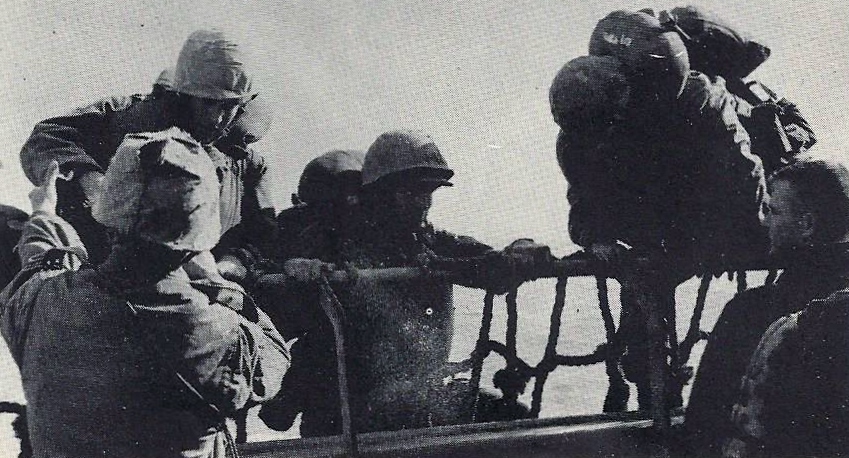
Ken Schweim’s comments on going down the nets for an amphibious landing are pretty much the way I remember it. It looked easy in the movies, but very tricky in rough seas. I am surprised more Marines did not get hurt just getting off the ship. But those who suffered from sea sickness did not care… they just wanted to get off the ship and on dry land. I will also add that going from the landing craft to board ship was just as bad. Grab the net when the landing craft was high… then before you could get your feet in the net you were dangling in the air. Grab the net when it was low… the net is bunched at your feet. Climbing up the net with all your gear was a bit harder than going down.
As to Ken’s question, we did such landings in the early 1970s, the last I remember was 1974. I am sure others will contribute other dates. I will add one personal landing net story. While I was on Okinawa, a BLT had been at sea for some time; and for some reason had come in, but did not offload. Someone decided the Marines on board needed to be paid, and I got elected to pay on one ship. Pay was in cash. Basically, the pay officer went to some heavily guarded building, someone handed you the payroll, you counted it and signed for it, and placed the money in an ammo can. If you as the pay officer came up short, the missing money came out of your pocket. My driver/armed guard and I picked up the payroll and went to the dock. I naively thought the ship would be there. Oh no. The ship had sent a landing craft. The ship was within sight, but way out there. When we got to the ship they threw the landing net over the side so we could board. Ever try to go up one of those things with one hand (and the other hand clutching an ammo can with well over a year’s worth of your pay)? We discovered another use for a web belt. Everyone was paid and happy. I did not come up short or drop all that cash into the Pacific. As I was about to debark down the net I really wanted to heave that ammo can as far as I could into the Pacific. Proper decorum dictated otherwise, so I carried it back down.
We also did landings by going off the back end of LPDs in LVTs. That is a whole different experience, and in some ways worse than over the side and down a net. Hope someone will write about that experience.
The attached photo: from my first landing 1970.
R. Boyer
1970-1975
This is another reprint, it must be recycle week at Grunt.com. I really wish more guys, especially younger guys, would write to tell of their experiences. That way it would give Bill and Murry something to bitch, complain about and criticize; otherwise they don’t get to have any fun. The last time I went down a cargo net into a landing craft was off the USS Francis Marion (APA-249) during Exercise Solid Shield ’78. We boarded at Morehead City, sailed in circles for a couple days and then landed at Onslow Beach, Swamp Lagoon. I was going to Recruiter School in about a month, so I guess the 2d FSSG CEO wanted to make my life miserable one more time, and he did a good job of it. Semper Fi!!! Top Pro
Love your comments and stories Top. I recall Team Spirit 84 , winter in the mountains if Korea. We were advance party and went about a week without showers. When they were finally set up we had about 40-50 marines grouped up to get in and as I got to the entrance from the changing area into the shower tent everyone was stacked up grumbling. No hot water. Well standing there amidst all those smelly marines, and being used to the cold Iowa winters, I ran on in and started, quickly, to shower up. Only took a minute before the herd moved in. It was cold but oh so nice to be clean again. Sgt Gary Erwin.
Never had to be a pay officer, but remember classes and advice given in TBS, 1979. “Always pay yourself last.” Why? If you had miscounted for some Marine, the shortage literally came out of your pocket.
MSgt Prothro, I also went over the side of the USS Francis Marion. It was operation Steel pike 1964. Semper Fi. 64/69. RVN 65/66/69. Young H.L.0311/2311
Operation Silver Lance was one of the largest Marine Navy maneuvers held in peacetime in February 1965 that included 60 ships and 50,000 troops from San Diego, Long Beach and San Francisco. It was an 18 day operation that included boarding and departing the ship in rough seas climbing up and down landing nets with full combat gear. It was very challenging and once on ship and going up the coast from Camp Pendleton many Marines were sea sick from the rough seas and throwing up all over. In March 1965 Marines form Camp San Mateo on Camp Pendleton deployed to South Vietnam. On August 9, 1965 Battalion 1-1 deployed on the USS Lenawee from Long Beach. We were not told were we were going until the 3rd day out to sea. At 0800 the Captain of the ship came on the intercom and said “Congratulations, we are making history today. We are the first non stop voyage made by an attack transport since World War II. Destination Danang South Vietnam. An oil tanker will refuel us off the coast of Japan and our ETA was August 28th. At that point you could hear a pin drop, dead silence. We had salt water showers and long chow lines and it was extremely hot in our sleeping quarters at the bottom of the ship. When we deployed the ship it was on speed nets, something none of us ever heard of let along trained for. 5 Marines on each side of the net facing each other for a total of 10 Marines with full combat gear and pack packs interlocked on a net and it was lifted and placed in the landing boats below. We made a beach landing on China Beach. My outfit was Bravo 1st Battalion 1st Marines but after a couple of months I was transferred to Kilo 3rd Battalion 9th Marines.
Cpl.Joe Matyasik 0311
I was on the Francis Marion in 1970 while it was in the Med. In Aug it conducted a landing exercise at Souda Bay, Crete. One of the hottest places I had ever been up to that point in my career. The Combat Cargo Officer on board royally screwed up and didn’t have water buffaloes positioned to go out early. With just 2 canteens of water per man there were numerous heat casualties that had to be medivaced to the ship. The exercise was halted a few hours after they hit the beach until water could be finally off loaded. Luckily no one died, but I’m sure that was a career ender for the CCO.
Was on an APA , Fremont I think but not certain, in 1962 and went down the nets when we got to Vieques. Remember we went down in 3’s and it was a lot easier if all 3 went down at the same speed. That way the net stayed relative straight. If you had a jack rabbit or a slow poke the net would be uneven and thus more difficult. Never knew of anyone being injured but it was always in the back of your mind.
I was on the Fremont during the Cuban Missile Crisis in 1962 while with India Company 3/6. I hated the iron coffins and favored down the nets.
SSGT Ken Bouchard
My error, I was on the Monrovia during the Cuban Missile Crises.
SSGT Ken Bouchard
We had our Christmas meal on 25Dec64 on the Lenawee. We were in the South China Sea off Vietnam. I would later live in Lenawee County, Michigan. My kids were born and raised there. Over the side in full gear with my rifle was never hard and getting back up from the landing craft wasn’t too bad. I was sea sick on the first day out of to sea from our shores but not after. Even in heavy seas.
To prove it could be done, a BLT was sent to the Aleutians in January of ’56 to make an amphibious landing. Try going down the nets and up them in the middle of winter in the Arctic Ocean. I was aboard an AKA for that occasion. Drew liberty in Seattle going and ‘Frisco coming back. (Great time at the Marine Memorial Club in the latter city.)
I once was boarding a boat (oops I mean ship) using the net. Being a radio operator, I was carrying all my gear and radio equipment (what a mess). As I reached the top some of my stuff loosened and if not for the help from a well positioned Staff Sgt. below me, the sensitive security equipment I was packing would have lost at the bottom of the ocean.