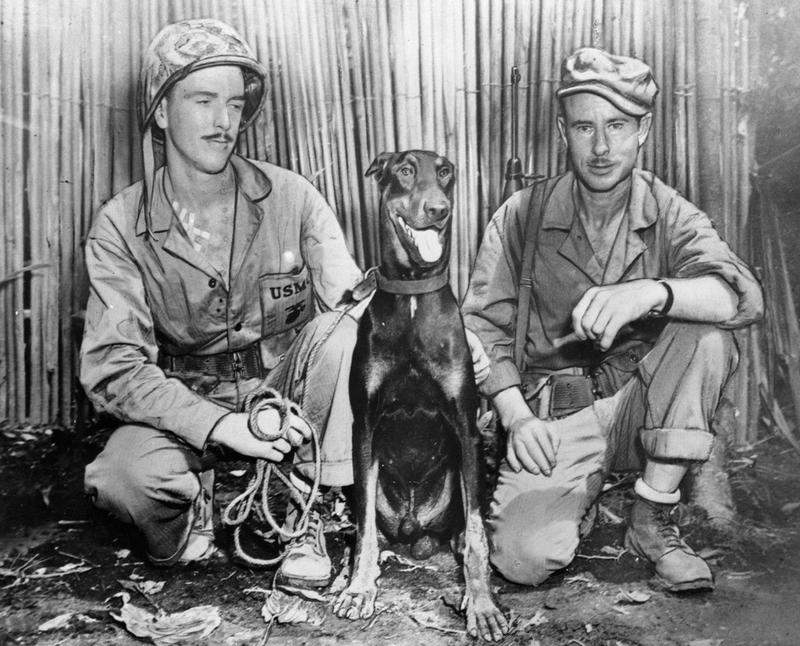
Cappy and the Devil Dogs of the Marine Corps
Few breeds of dog are as intimidating as the Doberman. Powerful, strong, and imposing, this breed was designed to be scary enough to ward off danger, which is why the Doberman breed was adopted by the United States Marine Corps as their canine companion of choice. The USMC’s Devil Dogs, as they became known, served alongside the Marines…and the heroism of one of the Devil Dogs, Cappy, saved the lives of hundreds of men during the Battle for Guam.
Dobermans were the Marine’s Best Friend
Even before the U.S.’s involvement in World War II, the United States Marine Corp recognized the value of Dobermans as war dogs. During the Banana Wars in Central America during the first few decades of the 1900s, the Marines encountered guard dogs situated around the perimeter of guerrilla encampments that thwarted their efforts at surprising the enemy. For their own team of sentry dogs, the Marines looked to the Doberman, a dog breed that was specially created to be a guard dog.

Dobermans were bred to be Guard Dogs
Dobermans were developed in late-19th century Germany by Karl Friedrich Louis Dobermann. Dobermann worked as a tax collector but he had a few side gigs as well. One was as a night watchman and the other was as the overseer of the town’s dog pound. Collecting tax money throughout the countryside put him at risk for bandits, as did his job as a night watchman. Dobermann used his position at the dog pound to start his own breeding program with the goal of developing an intimidating and vicious guard dog who was also intelligent, athletic, and a faithful companion. The result was the dog that now bears his name, the Doberman. Somewhere along the line, one of the Ns was dropped, but it serves as a good way to separate the man from the beast. Unfortunately, Dobermann was a better dog breeder than he was record-keeper so we do not know exactly which breeds of dog he used in the development of the Doberman, but there was most likely some Rottweiler and German Pinscher involved. As he intended, Dobermann developed a dog that is large and ferocious in appearance, but it gentle and loyal to its owner. Dobermans are strong, smart, hard-working dogs with an incredible amount of endurance, making them ideal for the rigors of military work.
Doberman Devil Dogs Formed Dog Platoons
Doberman Devil Dogs joined the U.S. Marines when they landed in Guam in July of 1944 to reclaim the island, a United States territory that had been captured by the Japanese a few years earlier. The Second and Third War Dog Platoons, also known as the Devil Dogs, worked alongside the nearly 500 patrols on the island. The war dogs stood guard over camps, delivered messages, alerted the Marines to landmines and booby traps that the Japanese had set, rescued wounded Marines, and searched through caves looking for Japanese soldiers and military supplies. Their work was vital to the war effort.
Cappy the Devil Dog Saved a Group of Marines
One night, a Doberman sentry named Cappy was standing guard over 250 sleeping Marines when he detected the presence of the Japanese. In fact, an enormous force of Japanese troops was advancing on the unsuspecting camp when Cappy alerted his men. The heroic action of Cappy saved the lives of 250 men, but Cappy was injured in the ensuing battle, as was his handler, PFC Allen Jacobson. Jacobson himself refused to leave the battle or be treated for his injuries until Cappy had been evacuated. Sadly, Cappy later succumbed to his injuries, making him the first Devil Dog to be killed in battle during the fighting in Guam. He wasn’t the last. Sixty war dogs were deployed to Guam and twenty-five of them died in action. Twenty more suffered injuries.
A Statue of Cappy Overlooks the National War Dog Cemetery
Cappy is buried on Guam, along with the Devil Dogs that died with him. Today, the Naval Base in Guam is home to the National War Dog Cemetery and Memorial, thanks to the efforts of William Putney, the commanding officer of the 3rd War Dog Platoon, who was dismayed that the burial plots of the Devil Dogs were all but abandoned. In the 1980s, Putney began lobbying for the establishment of a war dog memorial and initiated fundraising efforts for the creation of the National War Dog Cemetery. The buried remains of Cappy and the other fallen war dogs were relocated to a site on Guam’s naval base. On the 50th anniversary of the Second Battle of Guam – July 21, 1994, the National War Dog Cemetery and Memorial were officially dedicated. A bronze statue of the ever-vigil Cappy, created by artist Susan Bahary of California, sits on top of the memorial. Bahary named her statue “Always Faithful”, a translation of the United States Marine Corps’ motto “Semper Fi.” It is a fitting tribute to Cappy and his fellow Devil Dogs of the Marines for their faithful and loyal service to their country, and a special nod to Karl Dobermann, whose efforts to breed a formidable guard dog led to the development of the Doberman breed.
On behalf of the people of Guam we “Thank you” U.S. Marines and their Marine dog partners for your service and for the Liberation of Guam from the Japanese occupation of our island. Semper Fidelis
Native of Guam
I have had many Dobermans over the years and yes they are very protective, I just love the breed. Currently I have two, but was informed last Tuesday that my Brandy has bone cancer. It is never easy letting them go, I lost Boomer four years ago to a tumor in his nose, now Brady’s time is numbered. So I love them as much as I can, while I can. Their loyalty is unquestioned, Semper Fi.
They love us unconditionally. Each time they see us is as the first time. They ask only to be of service to us. They become family. I have experienced your loss a few times over the years. I share your pain.
Well when this Marine see’s one when riding his bicycle, I make a wide circle to avoid them. They scare the hell out of me. USMC 1972-74
Sadly I read this as my wife lays beside our dying bulldog Recon Teufelhunden. Always faithful and great at opening packages for any occasion. He has been by our side for over 10 years and we will miss him greatly. Tragedy and heartbreak comes too soon with any of man’s best friend though.
I have a couple of dobies; one was born on 10 November, so I had to get him. I got him a mate to keep him company. They are our family members and I make sure their medical treatments are current. They’re such big babies around us, but no strangers (or some extended family) can come near us without fair warning. Best protection and breed we ever had. Wouldn’t have any other breed.
I had a “blue” Dobie for a time. She was given up as a “runt” because of her color and her shorter size but she grew to be a great dog though a bit shorter than most dobies. Very protective yet very playful. I have always maintained dogs and other animals take on the owners personality. If you are tough and mean spirited the dog will be the same, also, a gentle person will have a gentile dog yet it will still be protective. Great breed.