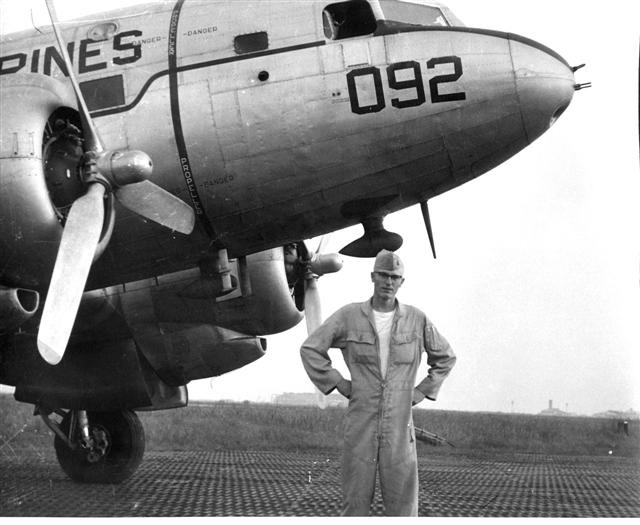
I was a crew chief on the R4D-8 (C117) both in Japan and at MCAS Quantico. I was a Sergeant, drew flight pay, and got to wear a leather flight jacket. Life was good.
But…the hours were long. I would sometimes arrive at the flight line at about 0500 to inspect the aircraft, run up both engines, and get everything squared away to have the R4D ready for the pilots at 0600 for the flight. I might be gone for two hours, or a week, depending on the flight schedule. There were often mechanical problems on the flight and I hoped that I knew enough to fix what ever the problem was.
Had a number of engine failures over the years, “lost an engine” is the aviation term. The R4D could fly all day on one engine so it wasn’t much of a problem. If two engines were lost then there was a problem. Once lost an engine on take off at Quantico with the senior passenger as Chesty Puller. Didn’t bother the General at all, but it did the other Grunt passengers. After landing we herded them all onto the second R4D to continue the flight. Grunts always seem to be nervous around flying machines.
Only crashed once, that was at NAS Atsugi, Japan, when the starboard gear was sheared on landing. Ground looped, no one hurt.
Most pilots were great to fly with but there were a few that made the flight unpleasant. Even flew with some NAPS (enlisted pilots) in Japan. The designated pilot for the flight is always in command of the aircraft. Once the designated pilot was a MSgt and the co-pilot a full Colonel. Interesting situation for the normal military chain of command.
One of the great pilots to fly with was Col. R. R. Burns who was CO of MCAS Quantico. On a flight to MCAS El Toro, California, we landed at Luke AFB in Arizona. Damn was it HOT! The passengers (all officers) beat it into the Air Force terminal to soak up the air conditioning. While refueling I couldn’t touch the metal of the aircraft as it burned the skin. After refueling I made a walk around inspection of the aircraft and then went into the terminal to tell the pilots we were ready to go. Passengers went out to board the aircraft. Col. Burns said “Tom, you go in there and get a sandwich and something cold to drink. We’ll wait for you.” I did, and when I went out to the plane and got on board all the passengers, dripping in sweat from the oven like interior, glared at me as I went up the isle to get ready to start the engines with the pilots. After climbing to about 8,000 feet it cooled down.
My last flight as a crew chief was in January, 1962. We were on a flight from MCAS Beaufort to Quantico. It was about 0100, we were at about 6,000 feet, the night air was still, and we could see the car lights on the country roads below. The co-pilot went back to get some coffee and I slid into his seat and put on the head phones. Easy music was playing…the engines were in sync with their comforting sound, and right there was the feeling of a passing part of the career that I would really miss.
On February 1, 1962, I reported in to OCS to train with the 3rd Warrant Class and it all changed.
Semper Fi,
Thomas Mix
Capt. USMC ret.