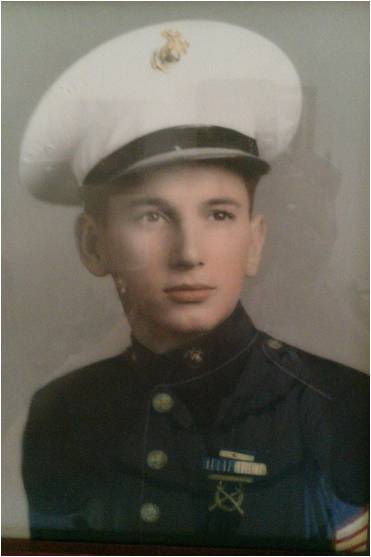
By Gary Wilson, Ph.D.
I first met Fred E. Killebrew on a golf course near Houston, Texas in April, 2013. I arrived at the golf course by myself and the person behind the counter asked if I would play with two brothers, Fred and Charley Killebrew. I soon learned that Fred was 90 years old and his brother, Charley, was in his early 80’s. Before long I also discovered that the brothers were former Marines. Fred had fought in World War II and had served two tours in the Pacific and Charley had fought and been wounded in Korea. After getting to know Fred better, I asked if I could have an interview. I conducted a series of interviews with Fred and the first was on June 7, 2013 at his home in Seabrook, Texas.
Upon reaching his home, I immediately saw a large pole, flying the flags of the United States and the Marine Corps. The welcome doormat was a Marine Corps mat. Once inside, Fred introduced me to his wife, Betty – his wife of 68 years. Around the walls were pictures of family members, including his son Tom, a former Marine, who had died in 2005. There were other plaques and memorabilia, many related to the Marines.
Fred told me he had been a gunner and radio operator in World War II, flying in a SBD Dauntless and in a Grumman Torpedo Bomber. His flight log from World War II had been in his house when Hurricane Ike hit the Texas coast in September, 2008, and he had lost it. He did not have an exact record of the number of missions he flew in World War II, but it must have been over 200. He did show me his flight log from the Vietnam War and at the beginning of that log, he had recorded his flight hours from World War II. He had flown 413.7 hours in the SBD Dauntless in World War II. He said that each of his World War II missions averaged about two hours. During the Vietnam War, Killebrew flew 286 ½ missions. He and his pilot bailed out while in the Pacific in late 1972, and in doing so, Killebrew broke his neck. He retired from the Marine Corps in 1974.
Since Fred had lost his flight log from World War II, everything he told me was from memory. He was born September 10, 1922, in Galveston, Texas, and was the son of Emmit Dewitt Killebrew and Grace Kemp Killebrew. Fred’s father had enlisted in 1914 in the U.S. Army and had been a sniper in World War I. Fred’s grandfather was Cherokee and had been part of the “Trail of Tears” in the 1830’s.
Although other family members had been in the military, Fred was the first to join the Marines. He had wanted to be a Marine ever since he was twelve years old. At age nineteen, he joined the Marines, leaving in the middle of the night from Dallas, Texas on April 11, 1942. He travelled to San Diego as part of the Second Recruit Battalion, Recruit Depot and trained for ten weeks. Fred admitted he was a “know it all” in boot camp, because he had three years of ROTC while at Lamar High School in Houston, Texas. He had graduated in 1941, and was already familiar with close order drill and other Corps regimen. While in basic, he received $21 per month as an E-1; however, out of that amount the government took out $6.50 each month for a life insurance policy and another $4.20 per month for medical expenses. After those and other deductions were taken out, Killebrew remembered he had $8.30 left over. While in basic, Killebrew made a 98 on the General Military Subject Test which placed him in the highest group. Fred entered the Corps an E-1 and left basic the same rank.
After basic, Fred wanted to be a pilot, but he had not been to college. The Marines required pilots to have two years of college. Instead of pilot training, he went to radio school at Texas A & M in College Station, Texas as part of the Marine Aviation Detachment where he trained for about two months. There he had his first leave. He had just won a large amount of money while gambling and decided to buy a uniform and paid $142.00 for his dress blues.
Fred did not, however, want to be a radio operator, and after radio school, he returned to the North Island at San Diego. He met a Chief Marine Gunner Rice who told him about a position opening in gunner school. Fred entered gunner school on October 1, 1942 as part of Air Regiment Sq-2, Service Group, Marairwings, Pacific, Fmf, Nas, San Diego and trained on twin 30 caliber machine guns which he remembered fired 3,600 rounds per minute. Fred’s desire was to be a gunner on Marine aircraft; however, Fred was not able to fly during gunner training, because the Marines had so few aircraft available at that time. While going to school, he also taught Morse code as a side job.
He graduated from gunner school in late October, 1942 and departed San Diego enroute to Samoa, a distance of over 4,700 miles. He sailed on the M.S. Day Star, whichwas a Danish ship seized by the United States in World War II and turned over to the American President Lines to operate in the service of the U.S. Fredcouldn’t remember how long it took him to arrive in Samoa, but he guessed it was several weeks, because the ship zig zagged the entire route. He remembered crossing the equator and becoming a shellback, which is a time-honored ceremony to recognize military personnel who cross the equator for the first time.
In January, 1943, Killebrew was assigned to Headquarters Squadron, Marine Aircraft Group Thirteen (MAG-13), Fourth Marine Aircraft Base Defense Wing, in Samoa, which had been activated 1 March 1942, in San Diego, California. A week later the group's forward echelon was en route to Samoa. Major General Charles Price assumed command of the Defense Force, Samoan Group, in April 1942 and was in that position until May, 1944, when he assumed command of the San Diego Area.
The first planes from MAG-13 arrived at Tutuila (Samoa) on 2 April 1942 at which point they assumed responsibility for the air defense of American Samoa. In the early days of the war Samoa was seen as very vulnerable and open to attack by the Japanese, especially prior to the victories at Midway and Guadalcanal. MAG-13 pilots were mostly untrained and each MAG-13 squadron was also instructed to organize as an infantry company should the need to defend the islands ever arise. Fred was stationed at Tutuila Airfield on Samoa, and flew in the war for the first time. He flew in PBY 5-A planes with pilots Whitey Hobbs and Tony Roscoe. He flew anti-submarine and escort missions and served as a radio operator and as a gunner. He remembered flying to Suva, the capital of Fiji and other nearby islands. I asked Fred his first impressions of Samoa, and he said it was beautiful. I asked what else he did on Samoa besides fly missions in the PBYs, and he told me that he dug trenches and latrines, helped install lights on the airfield, and whatever else he was told to do as an E-1. He was an E-1 for 13 months before being promoted.
Fred later departed Samoa and went by a LST, riding in the fantail, to Funafuti in a large American convoy, a distance of over 700 miles. He couldn’t remember when he arrived; however, it must have been approximately April or May, 1943 and he did not leave Funafuti until a year later in April, 1944. During World War II, the atoll was part of the British-owned Ellice Islands. Funafuti gave the Allies a protected rear area as they prepared for Operation Galvanic, the invasion of Tarawa in the Gilbert Islands in November 1943. Japandid not learn of the American occupation of Funafuti until March, 1943, just prior to Fred’s arrival. That spring the Japanese began air attacks on Funafuti. During the 13 months ending in November 1943, Japanese bombers struck Funafuti nine times. Fred related that he did not fly while on Funafuti. His primary duty while there was to serve as corporal of the guard for men guarding ammunition sites. Fred remained on Funafuti until the spring of 1944 when his first Pacific tour in World War II ended.
Killebrew returned to the United States on April 25, 1944 for a 30-day leave. He went from Miramar, California (near San Diego) to Dallas and Houston to visit family and friends. After his 30-day leave, Fred shipped back to Miramar, California at Marine Corps Station, El Toro where he was an instructor in gunner school. He also completed turret training on the 50 caliber machine gun and began to fly in the Douglas Dauntless. The Marines then sent Fred to the 474th where he trained and flew with Lieutenant Douglas Albert Daugherty. The lieutenant then got orders to go overseas, and at that time pilots and gunners travelled together since they had trained together. Killebrew departed California on September 25, 1944 for his second tour in the Pacific.
The Marines assigned Killebrew and Daugherty to Marine Observation Squadron 1 (VMO-1) which had been commissioned on July 1, 1937 at Quantico. This squadron was redesignated Marine Observation Squadron 151 (VMO-151) on July 1, 1941. When Fred joined the VMO-151, he was assigned to Eniwetak in the Pacific Theater, where he flew anti-submarine patrols and scouting missions. He also flew missions to the Kwajalein Atoll and other parts of the Marshall Islands. Along with the rest of the Marshalls, Eniwetak was captured by the Imperial Japanese Navy in 1914 during World War I and mandated to the Empire of Japan by the League of Nations in 1920. The Japanese administered the island under the South Pacific Mandate, but mostly left local affairs in hands of traditional local leaders until the start of World War II. Americans captured Eniwetak from the Japanese in February, 1944.
Following its capture, Eniwetak became a major forward naval base for the U.S. Navy. The daily average of ships present during the first half of July 1944 was 488; during the second half of July the daily average number of ships at Eniwetak was 283. Following the end of World War II, Eniwetak came under the control of the United States as part of the Trust Territory of the Pacific Islands until the independence of the Marshall Islands in 1986.
Fred said he had not been at Eniwetak long when the Marines broke up his squadron again, and sent him along with four other gunners and pilots to Saipan. While in Saipan, he was a gunner on a Grumann Torpedo Bomber (TBF). He didn’t remember how many missions he flew in Saipan, but he said it was several. He stated that he didn’t see any Japanese planes while on any of his patrols.
Fred departed Saipan and returned to Eniwetak for more service. Killebrew again flew anti-submarine patrols and escort missions for American ships in and around Eniwetak. He said his job wasn’t to shoot down Japanese aircraft, but to keep Japanese planes away so American pilots could drop their bombs. Lieutenant Daugherty and Killebrew flew the Douglas Dauntless SBD which carried a single one-thousand pound bomb or two five-hundred pound bombs under each wing. Fred stated that often when they flew anti-submarine missions they flew so low that if they had a tail hook it would have been in the water. They often were so low that he remembered waving to American sailors on ships while looking up at them. He also related that on one mission Lieutenant Daugherty went into such a steep dive on one bombing mission that Fred passed out. At this time the pilot and gunner did not have any anti-gravity suits. Fred also told me that Daugherty was killed in the Korean War when he misjudged a night landing on an aircraft carrier.
Fred told me several stories about his time on Eniwetak. Another man in Fred’s tent was named T. L. Huddleston. He had received a letter from his wife that he needed a $1,000 as a down payment to purchase a home in the United States. Huddleston told Fred he didn’t have the money, but Fred told him that he did. Fred loaned him the money, but a short time afterwards Huddleston was killed while on a combat mission. Many men in Fred’s unit urged him to stake a claim to the money through Huddleston’s estate. Fred declined stating, “His widow needs the money more than I do.”
When Fred arrived on Eniwetak, the enlisted men had to walk a long distance to take a shower. So he and several men started digging a well so they could construct a shower near their tent. Everyone in Fred’s tent helped except a man named Dave Leader. Fred told Leader, “You’d better come out here and help if you want to use this shower”. Leader replied that he did want to help, but he was taking a nap. He would help the men when they thought they were close to water. A short time later, Fred told him that the men had dug enough and that it was his turn. Leader said okay and went to the well, dropped in a hand grenade, and after the explosion, announced, “Boys, we struck water”.
Fred related another funny story. One time he was flying with Lieutenant Daugherty, and while on a mission, Fred asked if there were any American submarines in the area. Daugherty told him no, that if he saw any subs, they had to be Japanese. Fred told Daugherty that he saw what looked like a sub at 3:00 o’clock. He told Daugherty he had seen the shadow. Daugherty called for other planes to launch a bombing run. They dropped their bombs but quickly discovered that the Japanese sub was actually a whale.
When the war was almost over, the Marines shipped Killebrew to the island of Tinian where he boarded a merchant ship back to the United States. He arrived in New York on September 11, 1945. He was supposed to land at San Diego, but the ship was rerouted to Panama. After he went through the Panama Canal, Fred was then rerouted to Galveston; however, before he arrived in Galveston, the ship was rerouted again to New York (pier 92). Fred gave his orders at a Marine station in New York. He was a staff NCO at the end of the war (which in World War II was an E-3). Later he shipped to Cherry Point, North Carolina as part of the 9th Marine Air Wing. Following the end of the war, he took leave to Dallas where he met his future wife, got married, and returned to Cherry Point Air Station, North Carolina.
*Dr. Wilson is an Assistant Professor of History at College of the Mainland in Texas City, Texas.