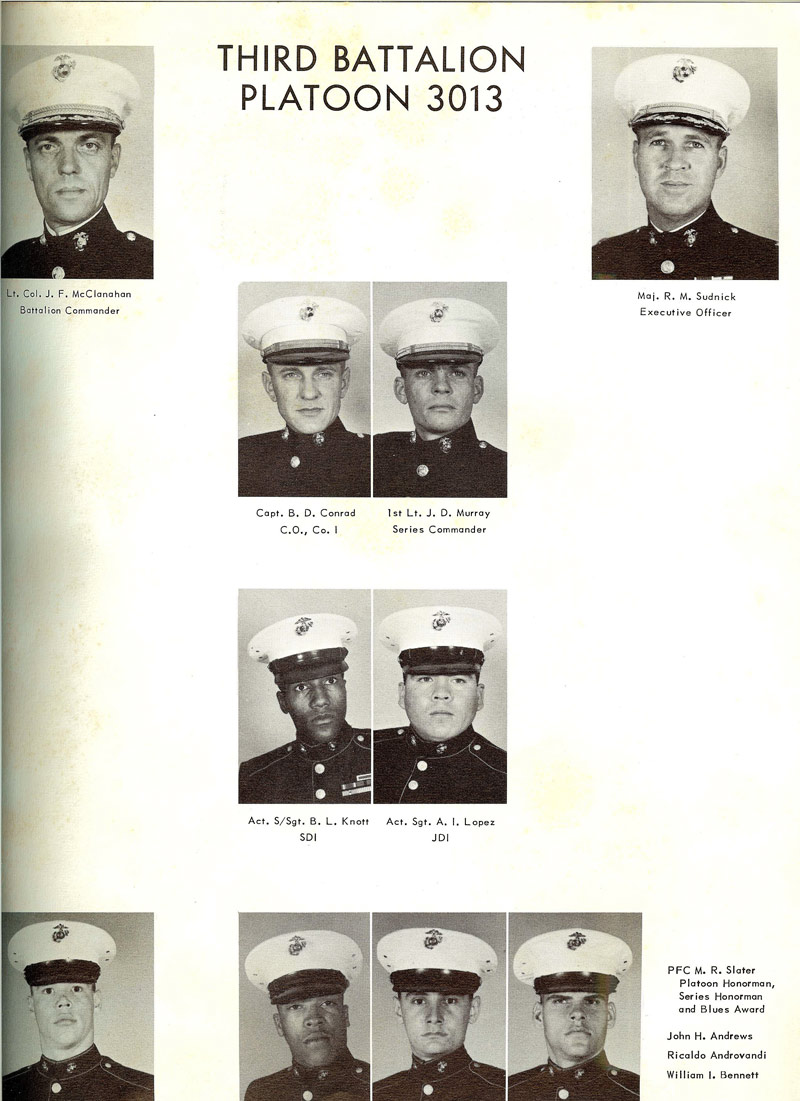
Sgt. Robert Treitler’s response [American Courage #238] to Sgt. Robert D. Gordon’s pictures of the San Diego Quonset Huts stirred up old memories of my days in Boot Camp at MCRD San Diego. I was the Guide for Platoon 3013 (and still have the arm band) that began training just a few days after the Marine Corps birthday in November 1958 and graduated in February 1959. At that time there were black metal stoves in the huts, but they were NEVER permitted to be used for heating. In fact, they were polished inside and out, but we did not know that at first. Early on in our training, one unfortunate and misguide recruit decided to sneak a smoke while on fire watch. The next morning, one of our junior drill instructors Acting Sgt. Dan Hudson (for some reason not pictured in our ‘graduation’ book) immediately detected the odor of cigarette smoke and shortly thereafter discovered a cigarette butt that the unwitting recruit had stubbed out in the stove during the night. That’s when we learned that the insides of the stoves were spotless. Within a matter of minutes, the recruit was identified and he confessed to his misdeed. He left our platoon that morning and we never saw him again. The scuttlebutt was that he received a general discharge as unfit for military duty. For those who might not know, smoking was permitted in the recruit training area only when the smoking lamp was (rarely) lit, so it was very easy to detect the odor of a cigarette during most hours of the day or night.
We also polished the concrete floors of our huts. Although I was not aware of any recruit that had a cigarette lighter in his possession, each recruit was expected (required) to purchase a can of lighter fluid. We used lighter fluid and tee shirts to polish the floors until they shined. In the case of our platoon, I think there was virtually no possibility to sleep with any clothes on other than tee shirts and skivvies because we stood before our racks in tee shirts and skivvies before being given the order to hit the sack. It was indeed cold. The morning air was often filled with the sounds of recruits coughing up the phlegm that accumulated during the night. The salt air did not seem to help a bit. It was even worse at Camp Matthews where we had a light snowfall on New Year’s Day 1959 and it was cold enough that Field Jackets with Liners were barely adequate for many of us.
Our Senior Drill Instructor was Acting S/Sgt. Bennie L. Knott. I don’t recall ever seeing another Marine that I thought was more ‘squared away’ than him. Fairly early during training we went on an extended Sunday-morning run (we were told it was approximately five-miles, but I don’t know if that was accurate) shortly after breakfast as punishment for some transgression real or imagined. S/Sgt. Knott ran backwards much of the time while watching over his flock and exhorting those who were lagging to keep up the pace. Several members of the platoon had to be assisted by other recruits, but we all finished the run although many of us had to throw up along the way. During our run, we passed by a Navy recruit training area and S/Sgt. Knott gave us the ‘eyes right’ command so that we could look through the chain link fence and watch the swabbies as they lolled about enjoying the Sunday morning as though they were on a picnic. He had a few choice words for the benefit of anyone within hearing distance; I think a couple of the words might have rhymed with ‘runts’ or ‘wussies’.
Our other Junior Drill Instructor was Acting Sgt. Lopez. He was by far the shortest of the three Drill Instructors and some of us reckoned that he suffered from a ‘Napoleon’ complex as he sure liked to concentrate his attention on some of the larger recruits. One of the tallest recruits in our platoon was a seemingly tough kid from St. Louis. He was even tougher when he graduated. He certainly proved that he could take a punch in the solar plexus and keep on going.
I don’t think it would serve any useful purpose to go into too much detail, but I can definitely affirm that the drownings and subsequent changes that took place at Parris Island notwithstanding, physical contact was used for disciplinary purposes at MCRD San Diego on an as-needed basis. There were a few recruits who certainly ‘needed’ it from time to time. S/Sgt. Knott informed us that he himself was a Parris Island graduate and assured us that he would see to it personally that the quality of our training would not be adversely affected by what was going on in South Carolina (which happened to be his home state). He said that there were no groups of mothers that would be monitoring our training.
On one occasion, a setback recruit joined our platoon. Judging from his actions, he must have thought that he was a real old salt. On the very evening that he joined us, our Drill Instructor ordered all members of the platoon (roughly 80 of us housed in three huts) to do pushups. We were already stripped to our tee shirts and skivvies preparatory to hitting the rack, so we were ordered to do the pushups in our huts. Our newly joined ‘salt’ decided that he need not join in the exercise. Unbeknownst to him, there were several tiny pinholes located in various areas of the huts so that the Drill Instructors could peep in and see what was going on. Upon discovery that our new arrival had elected to ignore the order to do pushups, the Drill Instructor on duty burst through the hatch, grabbed hold of the ‘salt’ and taught him a lesson that I doubt he ever forgot. In the process, some of the hardboard sheathing that lined the hut was cracked. To the best of my knowledge, every other recruit in the hut, including me, thought that the drubbing was well-justified.
Our Third Battalion series began training during a time of major transition. When we first began training, the old 13-man squad LPM was in effect. Very early in our training we had to switch to a new LPM and 8-man squads. If there was any confusion on the part of the Drill Instructors, I was not aware of it. At the same time, a new rank structure was being implemented. Instead of progressing from Pfc. to Cpl. the rank Lance Corporal was reintroduced and assigned pay grade E-3. NCOs retained their rank but had to add ‘Acting’ to the rank (e.g., S/Sgt. became Acting S/Sgt.). There was a time requirement such that any NCO who did not get promoted by a deadline date had to drop the Acting moniker and take on the rank of the pay grade. Thus, for example, an Acting Cpl. E-3 who did not get promoted to Cpl. E-4 by the deadline became a Lance Corporal E-3.
For me, Boot Camp was overall a very positive experience. As I mentioned earlier, Act. S/Sgt. Knott, a black man, was from South Carolina. I was a white boy from Georgia who happened to be living in Montana at the time I joined up which is how I ended up in San Diego rather than Parris Island. There was one other southern white boy in our platoon who also happened to be from Georgia but living west of the Mississippi at the time of his enlistment. I confess that I had some concerns as to whether that might be problematic for us. My concerns were unjustified, so much so that, in my opinion, the three-month period spent in Boot Camp was perhaps the most ‘colorblind’ period I experienced during my four-year tour of duty.
It was thanks to Act. S/Sgt. Knott that I had the good fortune to graduate as Platoon Honorman, Series Honorman and Blues Award. This was all the more surprising to me because I f****d up seriously on the first inspection after I was appointed Guide. The inspecting officer asked me what were the duties of the Guide and I mentioned some of the things I was actually doing. Afterward, Acting S/Sgt Knott saw to it that I knew the ‘official’ duties of the Guide. He pointed out that, whenever queried, the proper response was: ‘Sir! The duties of the Guide are to maintain the direction and cadence of march.’ That was so burned into my consciousness that I have never forgotten it.
Use as little or as much of this email as you find appropriate. It was sort of fun sitting down and recalling these memories from more than a half-century ago. Although I have tried to report accurately on my Boot Camp experience, I cannot deny that the passage of 50+ years might have contributed to a slight lack of clarity on some points and stand ready to be corrected if any of your readers are so inclined.
I have included a copy of one page from the book (now falling apart) we received upon graduation from Boot Camp chronicling our experiences as recruits.
Semper Fi,
Cpl. Michael R. Slater 1958-1962