It’s 1969 and I’m with Fox Company, 2nd. Bn./ 2nd Mar. Reg/ 2nd. Marine Division on a Caribbean float. We’re doing jungle training in Panama with the Black Palm Jungle Survival school; which is run by the Army’s Green Beret unit. We were waiting to learn about using a Zip Line for a river crossing. It’S true, we were riding on zip lines years before it became a fun experience that you paid to do. Like I was saying, we’re standing around this Army Captain as he demonstrated how to make a floating device from our ponchos. I guess he didn’t understand that Marines know how or are taught to swim before leaving boot camp. He also told us how to use a zip line in order to get back across this same river. When questioned about the safety of this wire, the captain stated that he would give a month pay to learn what it felt like just before this wire broke. Well, we took our turns swimming across this stream and climbing up this tree using a ladder. I’m not sure where this ladder came from. I never saw anyone humping one of these in the bush. But I digress, I was number three in line so I’m sure about this. A Marine put the strap over his head and under his arms—he takes one step off and about to become air born when—you guessed it—the wire broke. We got it fixed without the benefit of instructions from the Green Beret. We finished the training without further incident or this captain. By the way, he never made good on his promise to give the Marine his paycheck and I’m sure this young man could have used the money—-a PFC only made about $105.00 a month back then. Now for those who are wondering about making a floating device using your poncho, you lay your poncho flat on the ground and take off all your clothes and put them in the center. Then using your boot laces, you tie the four corners together and get into the water holding on your poncho. You then quickly get out of the water and open the poncho up and get redress. My concerns about this: no weapon came across with you (maybe that’s why “they” exchanged the M-14 for the M-16—it must float), you are butt naked standing on the river bank trying to dry off before putting your clothes back on (I guess the enemy have to stop laughing before they can shot you full of holes), and , lastly, you may have noticed that I didn’t say anything about your pack and other gear that is still on the other side of the river. I guess that would be the least of your concerns as you are running through the jungle butt naked, bare footed, wet, and without a weapon. No wonder those Green Berets are so tough and few. oh well, it’s like Capt. George, my CO, told me as my feet were turning a different color from being so wet for so long (remember the floating device), I finished the Black Palm Survival Training.
Sgt Grit wants to hear from you! Leave your comments below or Submit your own Story !
We made our floater using a garbage bag as a liner in our Alice Pack it work well and we strapped our M14 on top our floater.worke well most of the time.
I went through boot camp in January/February 1970. We did not do swim quals. I do not know why. Good thing though because I cannot now or ever swim. I asked my Drill Instructor (who I made contact with via Sgt. Grit) a couple of years back but he did not recall not doing the swimming. I guess the pool was broken.
In 1967 if memory, serves me, it was called drown proofing!
As it was at MCRD San Diego in 1970.
I was in plt 2008 in 1970 and went through drown proofing and got my butt kicked out of the pool when I was discovered to have 3 day measles.I was quarantined and put in isolation from other members of my platoon; It would have been easier just to have drown that day. I was labeled a sickly puke by my DI that day of discovery.
TOM . PARIS ISLAND 1965. IT WAS CALLED DROWN PROOFING THEN ALSO THE D.I. SHOUTED EVERY ONE IN THE POOL. IF YOU SANK TO THE BOTTOM AND DID NOT COME BACKUP YOU WERE CALLED A SINKER. IF DID COME BACKUP YOU WERE A FLOOTER. ONLY FLOOTERS HAD TO DO THE DROWN PROOFING. IT SURE WAS HAIRY. IF YOU TRIED TO GRAP ON TO EDGE OF THE POOL THE D.I. WOULD PUSH YOU BACK TO THE CENTER. SOME GUYS GAVE UP AND SANK AFTER TRYING TO THREAD WATER FOR A WHILE. I VERY NEARLY BECAME ONE OF THEM BUT FEARED THE RESULT WHEN THEY DRAG ME OUT FROM THE BOTTOM SO I TRYED TO MAKE IT WORK. IT WORKED. I SWEAR I COULD HAVE TAKEN A SHORT NAP JUST FLOATING ON TOP OF THE WATER, I REMEMBER YOU USED A MOTION WITH YOUR LEGS TO KEEP YOUR HEAD ABOVE WATER EVERY 4 OR 5 SECONDS SO YOU COULD TAKE A BREATH OF AIR. IT WAS AMAZING AND I AM STILL A BELIVER. IF EVER GET STUCK OUT IN THE OCEAN I WILL TRY TO REMEMBER HOW TO DO IT. SEMPER FI MARINE.
It was “Drown Proofing” in ’69 too! Plt 3017, MCRD, PISC Ooh-Rah!
I went through PI in 1968 and could not swim. It was called drown Proofing and I proved I could drown, the instructors had long poles and when you went to grab it they would push you under with it. Until you finally made it to the side of the pool.
Funny story. When you get right down to it, Marine do just bout everything better than the rest.
Except die (smile). We can blame all that know-how on our drill instructors and combat training instructors (usually Force Recon guys). I went through San Diego in early ’66. Many of us would take a short tour on the USS George Clymer, a leaky left-over troop ship from WWII whose bilge-pumps ran 24-7. For drown-proofing we started in the training pool, than later after boot camp, did it in sea-water at Delmar Basin. Some guys never learn, though. I can’t say about the Old West, but there are a million ways to die at sea. One was to leave your fully loaded field-transport pack secured to your back and be dragged under to drown before you can be rescued and/or be smashed between the Mike-boat (Higgins boat) and the hull of the troop shop. Leave your helmet buckled so you can break your neck when you hit the water from 60-odd feet where you fell off the net, ohh and, leave us not forget, sticking your head up above the edge of the landing boat and have ‘Charlie’ save you the trouble of breathing. Well, I covered all the important ones. We don’t even want to get into evac-ing (when it’s your turn), a P-5 landing craft that just deep-sixed. By the way, I personally don’t know of any P5’s that ever deep-sixed during combat operations, since we did our training at Delmar Basin. Two guys lost it while undergoing the training. One of the guys went nutso when they restarted his life-support. He was later dismissed from the Corps. The other man panicked and drowned… they couldn’t restart him
Very funny; thanks for starting my day with a good laugh!
1961, Hawaii. We had different gear then. Two Marines would pair up for river crossing. Using two shelter half’s or ponchos laid together we would lay our M1’s corner to corner making an X with them. Tie off the rifles in the corners with our blanket roll straps. Then wedge our two pack’s under the M1’s to bow out the shelter half/ponchos and wha la a little boat. There was enough room to add our boots and whatever we wanted to keep dry. We of course would get wet as we pushed/floated this boat across the stream/river. Fun training.
I went through PI Feb 1960. I always thought I could swim like a fish. We learned the poncho trick along with diving to the bottom of the deep end of the pool to retrieve a dummy rifle, also swim with a full pack along with other tricks. The bad thing was after doing all these antics we got a card that said “Beginner Swimmer”. I have wondered since what did it take to be a good swimmer or just swimmer card.
Called drownproofing PI Spring 1969. Never been able too swim, I sink and stay sunk. Every time I was pulled from the pool, Sgt Reid said something about monkeys, sex, and football
Did the same training with 3/6 in 1968. I remember a rope not a wire. Trouble with rope it stretched and last guys were left over water. Maybe why they switched to a wire. I remember that river, had nets a both ends of training area. Two reasons, one catch the guys who made lousy rafts and the other to keep the Crocs out. Also a 7knot currant. That whole place was the pitts, snakes, rats, bugs, etc. Guys were unhappy to say the least, 90% Viet Nam returnees in our Co. alone.
$105.00 ? As I recall it was more like $62.00 a month take home
as I recall in 1951 as a PFC it was twenty dollars twice a month on pay call except when the powers that be wanted to build the IWO memorial in DC they paid us twenty two dollars and the two dollars went right to the next table and you donated toward the IWO memorial or you were in a heap of trouble
went through the same training, zip line across then make a float to take gear back across. we used a fire team float where all rilfes and 782 gear on one float. I agree up above 90% of us were Nam vets and it did have a major current. You always had atleast one who forgot to let go and land in the water on the zip line and he would do a header into a tree on the other side.
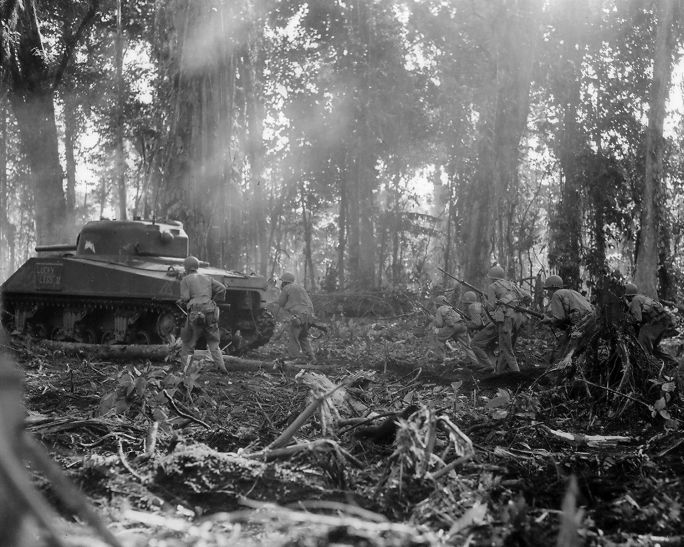
Just two short points. I hope the picture accompanying this article is not supposed to represent the actual training, that is unless it was around the second war. Having been a Marine Corps Tanker in the 60’s and 70’s I can tell you the tank in the picture is not. Secondly the base pay for a Put in 1963 was $72.00 per month so the one that thought 65. in 1969 was a little off. In RVN in 67/68 we made 65. per mo. combat pay.
He was CORRECT. I was a Pfc in 1968 and my pay was $98. a month
All I can remember about pay was $82.50 per month..that was 1966.
I was in P.I. May, June,& July of 1965. I was drown proofing then , & it works.
the picture shows an M4 tank and an early ww2 one at that.
PI 1965. went to drown proofing early at rifle range. before qual we got some shots in our azs. Then march to pool.Launched by parachute harness with 782 gear. The shot made you leg DEAD. You swam fully clothed (boots and all). We were called sinkers.I was holding on to bubbles trying to float.You want to learn how to survive, go to USMC Boot Camp!! Kill!!!
Funny how some training never changes that much. I was in Panama in ’96-’97, and we went through a “condensed” course at Fort Sherman on the Atlantic side, where the Army ran their Jungle Warfare School. We didn’t use zip-lines; we made rope bridges for river crossings – but we did utilize the “poncho rafts”. We used our “willie pete bags”, or water proof bags, inside our ALICE packs which created the floatation device, and wrapped two of them together with the waterproof ponchos. We kept our cammies on, thank God; there were barracudas in that water and didn’t want to dangle a worm in front of them, HaHaHa. All in all Panama was a GREAT experience though.
I checked and an E-2 base pay in 1969 was $127 and change. I’m not sure why I thought it was lower; I guess it just felt that way every pay day. Anyways, thanks for your help with the correction.
Parris Island 11/75-02/76. I remember swim qualification, I believe that’s what they called it, and having to jump into the water from a 30 ft.(?) tower with utility shirt and trousers on, nothing else. We then had to swim to the edge of the pool and down along the side towards the middle, across the middle and back down along the other side to the ladder and out. Needless to say I couldn’t swim very well and made it to the middle of the pool where I grabbed the edge of the pool and tried to climb out. Of course the Drill Instructor was right there and repeatedly stepped on my hands, lol (not funny at the time of course). I thought for sure he was going to let me drown but did eventually let me crawl out. I think I used the word can’t in there too during all of this pissing him off even more. I ended up an 1811 Tank crewman and don’t remember any kind of swim training until 78-79, Guantanamo Bay, Cuba. Had to stay afloat for 5 minutes which I was able to do somehow. Semper Fi all and Happy 242nd