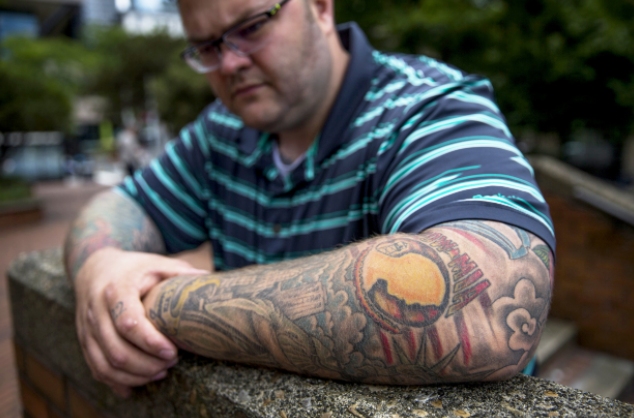
The American flag, when borne on the shoulder patch of an active-duty soldier, is supposed to be reversed, says Timothy Mangolds.
“It’s supposed to commemorate (that) you’re always running toward battle” with the flag appearing as if it’s flowing behind you, explains the 27-year old who served in the Army from 2009 to 2012.
When their lieutenant was killed in action in Kirkuk, Iraq, in 2011, Mangolds and his platoon decided to get identical American flag tattoos. But Mangolds’ tattoo, the colors of which emulate the subdued palette found on combat uniforms, is righted, with the stars on the left, as you might see on a flagpole or a lapel pin.
After some discussion, Mangolds’ platoon had agreed it would be proper to adopt the more conventional orientation. “As a sign of respect to him. Because he’s going back home,” Mangolds says.
The tattoo is a reminder of his lieutenant’s sacrifice. “This guy, had a wife, he had a kid, and they (have) to live their life without him even though he’s there in spirit,” Mangolds says. “It’s just a constant reminder to take advantage of what you have because he was young when he died. He was only 25. You know life could end at any second, at any moment.”
Many active service members and veterans boast similar artwork on their arms, legs, backs and hands. Expressing a dedication words perhaps cannot, these bodily remembrances tell tales of loss, service, patriotism and resistance. Some of these stories, like Iraq veteran and Auburn native Joshua Wheeldon’s, are novels, unfolding over vast swaths of skin.
Listening to Wheeldon, 33, describe his tattoos is like listening to a man thumb through an old photo album. Unsure of where to start, he speaks first of a tattoo that mimics one his grandfather had. “My grandpa had that eagle on his forearm. And he was in the Navy in the ’50s. Myself, I was in the Army from ’04 to ’09,” he says.
Another captures Wheeldon’s attention. “One of my friends got killed in Afghanistan so I got a yellow ribbon tattooed around my wrist with his name on it. And it’s, like, pulling a grenade pin.”
Later, he continues, “Then my great-uncle was a POW in World War II, so I have the POW and MIA flag on my arm.”
That’s just his left arm.
“And then my right arm: I have, like, my dad was in the Navy so I have King Neptune, and the ship my dad was on and an anchor,” Wheeldon says. He stops and summarizes the rest: “And a whole bunch of stuff like that.”
Perhaps Wheeldon’s most devastating tattoo is a simple figure on his finger. It’s a small but conspicuous 22 — the number of veterans who kill themselves every day in the United States, according to a 2012 report authored by the United States Department of Veteran Affairs. (The study has since come under question.)
“Four of my buddies killed themselves the year before last,” Wheeldon says.
Wheeldon’s tattoos help him remember their stories. “It’s a piece of you; you don’t want to forget. It’s something that will live with you forever.”
Sgt Grit wants to hear from you! Leave your comments below or Submit your own Story !
Amen..Beautifully writin article..
I was a marine from 1977/1979?no war at that time/ I got a general discharge because at 4 yeas old I was knocked out cold from a bully who tripped me that was the only time I was ever totally unconcious/ my recruiter where I joined the Corps and was recruited 0in massapequa NY long island/ he didn’t state that on my application /MY STAFF SEARGEANT found out about it n the recruiter was dishonarably discharged for omitting that important info I lost all my credentials n my pride/ I was pissed I don’t care about having THE dd214 but I’d like to receive info from the Corps n being recognized went to Paris island then camp lejunne this is where I dropped parkinsons disease
My name is ANTHONY RUSSO I MADE A MISTAKE I PUT AMTHONY PLEASE UPDATE THIS
Good comment! There have been various efforts over the years to restrict or make getting tattoos against regulations. However, this has been a tradition in the Corps for many, many years and no doubt goes way back to our origins as Marines. As stated, it is a simple way of communicating our love of our comrades and devotion to the Marine Corps, as well as pride in the outfits we served with, especially in combat. Sometimes, it is hard to express things in words. Therefore, the symbolism of tattooing your feelings onto your arms, etc. is a way of saying what you feel. I don’t think that many times, the commanders above us understand what it is we are expressing. I can understand regs that prohibit some tattoos, ones that are disrespectful or obscene. But, the ones expressing our deep feelings about the things we have experienced and our loyalty to our comrades and Marine Corps are totally different. They are as much a part of our tradition as Marines as many other symbols of our service. I have never had any civilians offended by my Tattoos. On the contrary, I have had many ask about them and what they stood for. It has kept the memory of my experiences and my comrades, especially those I lost, fresh in my mind. I have several. Marine Corps Emblem on my upper right arm, an In Memory Of Tattoo below that with inverted rifle with helmet on top. On my left arm, an old school tattoo with a large Eagle Globe and Anchor with a banner that says, “Death before dishonor”, and above that, my combat Tattoo with the outfit I served with in combat, the First Battalion, Ninth Marines. I am very proud of my tattoos, and especially when someone asks me why I have them. I wear them all with great pride.