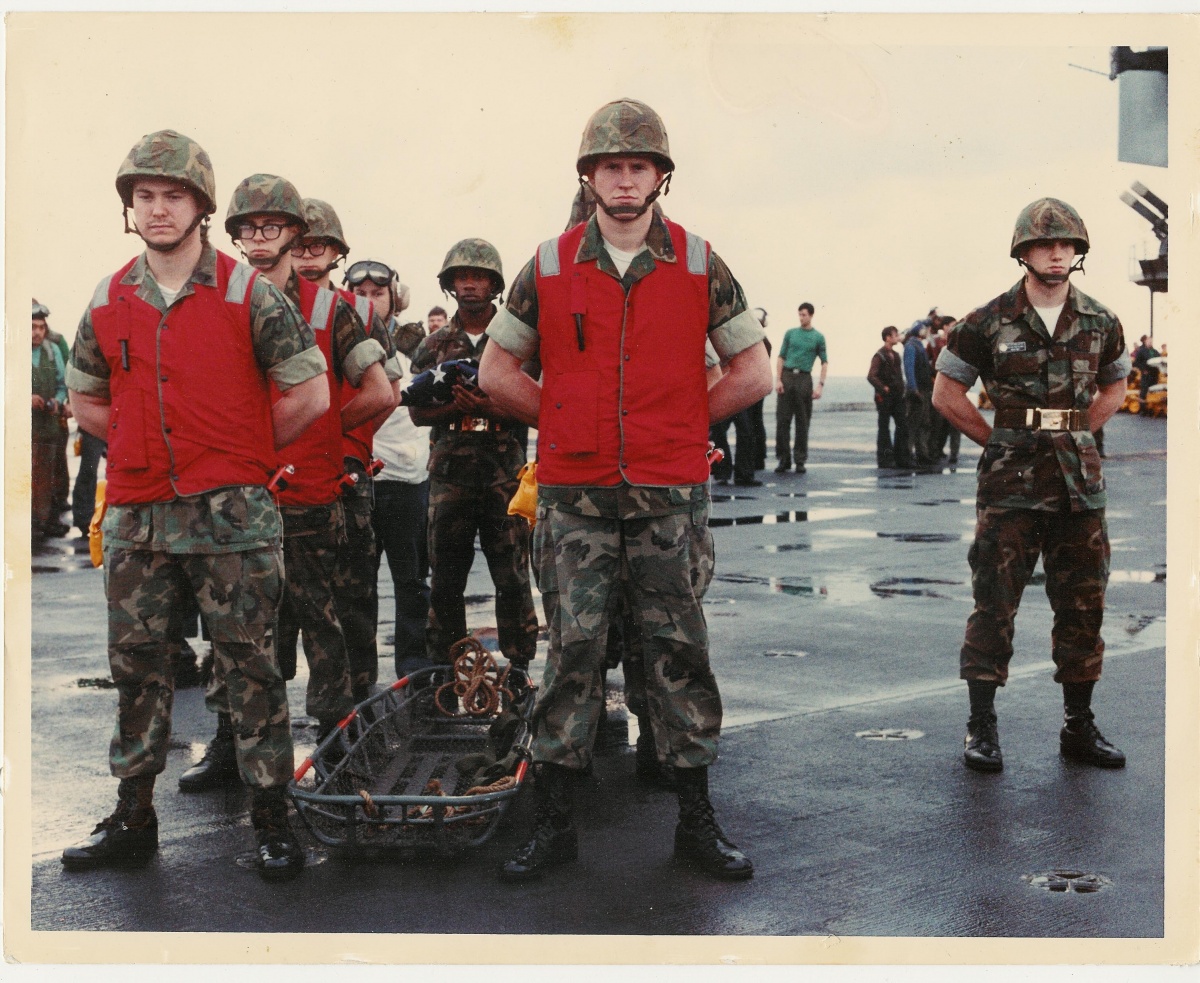
Dear Sgt Grit,
I don't expect you to post such a long winded trip down memory lane. However, if you could pass it along to another site that does allow it, maybe someone will read it and remember some of our Marines. They deserve to be remembered. I am the Marine in the center of the picture.
Dear Sgt grit,
I served with the Marine Detachment on the USS JFK CV-67 from May 82 to September of 84. I have many great memories of my time in the the Corps. Serving with these Marines was a privilege that I am forever grateful for. They helped shape me into who I am today. I was looking at pictures of my time in the Corps. My daughter saw a picture of me wearing a flight crew helmet with my hands on my hips, ready to board a Navy helicopter. She asked if I flew it. I laughed. It was a picture of me on the USS Butte. A Navy resupply ship that I was on for a week before linking up with my ship in the Indian Ocean. I thought that I would never wear one of those again, so I posed for the picture, then went back to my nervous, still slightly sea sick state. The Butte was a miserable rolling roller coaster that sucked body fluids out of a person without sea legs. I had none. I was anxious because I could see Marines on the side of the JFK and they looked dead serious. These would be my new mentors and I wondered what life on board would be like. There is another picture in that album that brings back a few memories as well. December 7th, 1983. Three days prior, December 4th, 1983, we had conducted a bombing mission on Syrian gun positions that were firing on our Marines on shore in Beirut and at our aircraft from the Kennedy. We marveled at one F-14 that had AAA damage and sat in the hangar bay. Accidents and death due to air crashes was not uncommon but enemy fire was. Six weeks earlier, we had been in Rio De Janeiro on a fantastic liberty port visit. We set sail with the intention of passing through the Suez Canal, through the Red Sea and into the Indian Ocean. We were scheduled to hit some ports that were usually for West Coast MarDets. I had hit a few of them after arriving on board and traveling through the Suez Canal. The newer Marines wondered what the "I.O." would look like. However, my next "Cruise" was strictly "the Med' as we called it. As I write this, I can still hear captain Wheatley's voice on the 1-MC saying that he was "optimistic" that we would finally be hitting a liberty port somewhere soon. We had gone 77 days without one. Naples was the usual stop. People would cheer, but no liberty call would come. I finally swore that I would look that word up to see what it meant. I started believing that it meant that the outlook was bleak for liberty. We actually argued about the definition of the word until the Gunny settled it and made me look foolish again. Gone were the days of dreaming about Australia and the sights we would see. After Rio, we were diverted to a position off of the coast of Beirut. The Med was a strange place. I was a senior Marine at this point. Well, senior compared to the other E-3's and below. I had just turned 19 and was scheduled to be the youngest Marine cutting the cake again in the coming November. I was getting tired of that role and prayed that a younger Marine would finally come aboard. I walked around asking each Marine their birthday. They would ask why. I was a team leader and was embarrassed that I had a 25 year old Marine under my authority. Life on board was both exciting and boring at times. We fell into our usual role in the Med. The Soviets were constantly squaring off against us. They would follow our ships and pick up garbage. They would steer their ships at ours as we launched aircraft into the wind. At times, they would "buzz" our ship with huge TU-95 bombers. They would be so close that you could see them making hand signals out of the window. Clearly see their faces. I remember asking the Marine next to me on the .50 cal mount that we manned as one of our duties what that meant. He said I should know since I had Russian friends back home in Brooklyn. He told me that it meant the same thing that we meant when we raised our middle finger. I can still picture how stupid I must have looked as I placed my thumb between my index and middle finger while trying to figure out how that meant the same thing. The Gunny would come out and check post. He would always leave by saying, "Don't push the trigger on that thing and start WW III. Can I trust you to not start WW III?" There was always a hint of humor in his voice as he chided you. The truth is that he was somewhat correct. The conflict in Beirut had reached a boiling point. Weeks earlier, the barracks were bombed. Any Marine knows what occurred next. My thoughts on liberty became pessimistic. I stopped caring and wanted to get into the fight on shore. Sea Duty Marines are a rare breed. Sometimes, fleet Marines will poke fun at you for serving on board ship. I suppose one has to serve in a Marine Detachment to understand the daily life. It is a tough assignment. Your primary task is to protect and ensure the deployment of what we were only allowed to call "Special weapons". You lived a life of secrecy. Everything was on a need to know basis. You were not supposed to discuss your job with anyone. Even a spouse. We were all infantry Marines by trade. We took offense to any cutting remarks about us being, "…sea going bellhops". Those comments were sometimes a precursor to a good brawl back in Virginia Beach. Life in the Med became for me what it does for any Marine. The Soviets were rattling their sabres. The Syrians and other Militias were taking shots at our Marines on shore on a daily basis. In the middle of this conflict, all we cared about was whether the Gunny was, "looking for me" or, if the Gunny "was pissed" when he was looking for me. Our ship had gone to the "Yards" for rehabilitation prior to the cruise. We as a detachment were supposed to be split up amongst the other carriers. Our commanding officer was able to keep us together. After a few days off loading "special weapons" we were assigned one open barracks area on Ft. Story near the end of Virginia Beach. We trained hard in infantry tactics for eight months. Gunny Shutters was a Viet Nam veteran purple heart recipient and rumor had it that he led Marines to more than one super squad victory years prior. That he wore a gold rifle badge for that year. There was a picture of him in life magazine while wounded in Viet Nam. I can tell you that he walked on water to us as did all of the other Viet Nam NCO's and officers. Ambush drills, patrolling, navigation, rappelling, you name it. We did it and learned it well. The Army thought that we were crazy for occupying those old open squad bays as we called them. They were the Taj Mahal to us. Basically, not a ship's rack. We painted the rocks outside Scarlett and Gold and made a big USMC out of them. Oh, as a reminder, never say, "You mean you want me to get red and yellow paint from the Army Gunny?" Anyway, after months of training at the same base where Amphib Recon School was located, we were back out to sea. We wanted to put our skills to use. I for one wanted to employ the M-14's that we still used on ship. We used them primarily for silent drill. Nevertheless, we had fully functioning ones as well. As I remember, eight of them were fully automatic. Non MarDet Marines would see them and look puzzled. Only 2nd award experts and above were chosen as designated marksmen to use them from the super structure of the ship during operations or any other use for them. I was a 2nd award out of Sea School. We took pride in carrying that Viet Nam era masterpiece. I thought it was a better weapon for the urban landscape on shore. Our snipers on shore were doing well though with the M-40's so we took comfort in that. Yet, we wanted our own payback for friends lost and former MarDet Marines who now served on shore. Back to December 4th, 1983. I remember the catapults launching aircraft after aircraft. We were a bit late in starting the bombing mission. The sun had come up already. It was supposed to be a night time mission. Orders to change the type of ammunition on the aircraft of the supporting carrier USS Independence helped delay the mission, as well as other factors. Awhile after take off, I was performing my usual duties, when I saw a pilot come through the Admirals passageway. His lips were dirty. I thought that he may have drank something to stain them. Furthermore, they usually take another route that allows for the passageway to stay clean. I then saw another one who looked like that. I went up to the cat walk and saw an A-6 pilot get out and kiss the flight deck. The Navy crews, who we looked down upon as less than Marine, were in over drive. My service rivalry seemed to melt away as I felt proud to be a part of this ship's crew. I was mesmerized by the sight. Everyone had a grim look on their faces. I don't know where I got the courage, but I asked a passing pilot why they were kissing the deck. He said that there were just too many SAM's in the air and that if I were up there seeing that, that I would be doing the same thing. He was animated and pausing a lot as he tried to paint a picture of that sky with his hands. I then realized that he was getting emotional. He jusy said that it was every damn missile in their inventory firing. I felt like an idiot for asking. He just walked through the Admiral's passageway, over the waxed floors that we Marines tended to each day. The word came to us that we had one of our A-6 aircraft shot down and the "Indie" had one shot down as well. My buddy from back home, Joe Alfano, was a Navy radioman on the Indie. I would sometimes hear his voice in CVIC. Another buddy from home, Myles Lifer, was a sailor on board as well. His job had us crossing paths in our duties involving special weapons. I thought it strange that they were Navy because both of them were tougher than I was right before we departed for basic training. Well, I thought at that moment that the only forces that could do that would be the Soviets. We were told that the Syrians had nothing that we could not counter. I actually thought that WW III was taking place. I knew we would have to prepare our "special weapons" and be ready to deploy them. The A-6 pilots would be needed again and I hoped that they would be up to the task. Only later that day did we learn that it was Syrian AAA that downed them. We lost eight Marines on shore that day as well. Sgt Manny Cox led his Marines in a brilliant display of leadership that should still be taught in SOI today. Unfortunately, he was KIA near the end of the battle, along with seven other Marines. Lt. Robert Goodman, the only African American aviator was shot down and taken hostage. He had done an emergency landing only weeks earlier, having been caught in the arresting net while losing a wheel in a shower of sparks sitting atop his A6 Prowler. I thought him to be a lucky man. We all looked up to him for surviving that near miss. The pilot, Lt. Mark Lange, an officer whom I knew very well, was KIA. I remember him telling me how to avoid motion sickness while on the liberty boat in one port. He tried to talk me out of getting sick. It didn't work, but he was a fantastic officer. We were angry. I don't think that I ever imagined that I would be back here since the day that I looked down and asked why a liberty boat was being pulled back up on board while we stood in the liberty line ready to go on liberty in Haifa Israel. It was June 6th, 1982. I was seventeen at the time and had been in eight months already. The sailor who I asked said, "Are you kidding me? Is it broke? No, a war just started. Where have you been? All Marines were told to report to the MarDet at once." I went down to the MarDet that day and saw my fellow Marines preparing for evacuating civilians from Beirut. No liberty in Israel. One of the Marines had his father on board as we sailed to help evacuate any U.S. personnel. We used to call them "Tiger cruises". I wondered what Mr. Johnston was thinking when his trip took an unusual turn. It was non eventful for us. Nobody was injured of killed. We were back in Norfolk a bit later, none the worse for wear. I figured that Lebanon was a passing memory. Not our war I suppose. I could care less for any small country that I never even heard of. I was wrong. Here I currently found myself wondering how I could get myself off of ship's duty and contribute to the battles on shore. I started suggesting to our commanding officer, Captain Hogan, that we should offer our Marines with M-14's. We were familiar with them and knew how to use them as part of our duties. The Captain said he thought that may be a good idea. He told me that he would suggest it. He promised that he would get us all into the fight one way or another. I had visions of me engaging the enemy and getting some revenge. I remember pestering him with new ideas each day. One day, the X.O. approached me and told me that I should not read two well known weekly magazines. That I should read the third one because it was less biased. I asked what that meant. He told me to get out and go to college because I could not read through the garbage that some biased author was writing about our Marines on shore. I had been asking him questions about things that were written about us that I knew to be untrue. I figured that it was a mistake on the part of the magazine. Eventually. one magazine allowed an article that said, "The Marines left Beirut with their tails between their legs." I was furious but had that ah ha moment with the X.O.'s advice. We had access to information from CVIC that most grunts did not have. Life on board became like box seats to a big show. Or perhaps, a baseball game where you may get a chance to reach out for a foul ball at best. It was frustrating, but these journalists seemed to be writing their own scripts sometimes. You would be reminded of the bigger picture with the Soviets that shadowed us. We started losing shipmates to accidents. More than actual enemy fire. Welost one of the best F-14 pilots and the "rear seater" who was about to retire. We mourned "LT Bam Bam". He was a powerful weight lifter and an inspiration to we weak young kids during weight room time. On December 7th, we were recognizing Pearl Harbor day. The Gunny approached me and said, "Pick a few men and see me on the flight deck." He told me what gear to grab. A stretcher was one of them. The enemy had decided to keep Lt. Goodman and return the remains of Lt. Lange. His remains were coming back to the JFK. We set an honor guard out on the flight deck. I was tasked with carrying his remains. I was not nervous at all. As part of our duties, the MarDet is responsible for responding as stretcher bearers for every medical alert. I would guess that we looked more fit since we had to P.T. six days a week. I had already carried a few people, both alive and dead. Out of 5000 sailors, death comes one way or another at random times. It is routine. I already understood what "dead weight" meant. I had come from a bad neighborhood and had a few friends killed already. One after being shot in the neck, in an argument with another friend, over a girl, dying as we held him. As they say, just like in the movies. Brian's eyes rolled back as we begged him to stay with us. Avery went to prison and I went upstairs with blood all over me as my mother beat me for not listening to her. Weeks later, it was the same thing, except James survived because his opponent picked bird shot, having no understanding of shotguns and loads. Once again, the blood on me cause me to be beaten by my poor worried Mother. I knew how heavy my corner of the stretcher would be. All I worried about was making sure that I did not do anything to embarrass the MarDet and avoiding the Gunny's wrath. When the helo came in, I remember looking at something that I only saw in old pictures. It was a Browning .30 caliber MG in the window of the "Helo". It had the broom handle stock. I had thought that they were obsolete. That is what I was staring at when my eyes fell upon the back door. When it came down, there were people on board who seemed to run off more quickly than usual. Every high ranking officer had a grim look on their face. Something did not sit right in my mind. Lt. Lange was in a wood coffin. He had been handed to us by the enemy and it was up to us to ensure that he was placed in a proper aluminum casket, draped with the flag. When given the command to take him out, we all stopped and became confused. There were no handles on the coffin. We had to use a pry bar to lift the edges up to get our fingers under it. We waited a few minutes for the pry bar to appear. The stretcher that we were told to bring seemed out of place. When we picked him up, we all looked at each other with a confused look. The box seemed to weigh about 600 lbs. We struggled to get a grip. A fear of mine came over me. I always feared that I would drop my end of a stretcher one day. I prayed that I would have the strength to do my part. I once carried one corner of a stretcher as we ran for an aircraft elevator as the Doc did CPR. There were no wheels under it like in the civilian world so each compression challenged my grip. I almost dropped my end that day and felt ashamed. We were told to place Lt. Lange down upon the stretcher. I then realized what it was for. When I looked up, I saw something that finally made my heart race. There was one of the Navy EOD technicians. He looked pale and was sweating. He had a case with him that said EOD on the side. It was some sort of portable X-ray machine. I asked our MarDet X.O. what he was there for. He just told me to stand by. We struggled to lift him and walk him over to the aircraft elevator. When we placed him down, the cables that make the railing for the elevator when it is in the hangar bay level position came up. About 100 sailors immediately went as close as they could to the edge and began to look down at us. I again asked the X.O., Lt. Trafton, what EOD was there for. He told me not to worry. I suddenly realized that they thought for sure that there was a bomb in the coffin. I wondered why they would bring him back to the ship if they thought that. It did not make sense. I looked at Lt. Trafton and said, "Sir, look up there. If something happens…" He cut me off and yelled that everyone on the flight deck should back up and clear the area. I figured that I had my answer right there. When I turned around, I saw that EOD was tinkering with his gear. It was not working. His hands were shaking. I knew that I was not dreaming. It was surreal. The Captain of the ship, Captain Wheatley, stood in the hangar bay. He ordered the door closed. I had seen that door open and close hundreds of times and never gave it another thought. Now I hoped I would see one more. I just thought of my family and said a prayer real quick. I felt at peace and just waited and wondered what it would be like to die. I figured it would be quick, so I did not worry. I just did my job; which was to wait there for orders. At some point, I realized that we had been told to stand at the edge of the elevator with our hands on the back of our necks. We all began to ignore that order and approach the EOD technician. Our X.O. was getting concerned about something. The EOD man looked as if he reached his tipping point. I was not sure what was going on, but it looked like the usual people with answers had a lost look on their faces. As I remember, Lt. Trafton was as composed as he always is. He asked for the pry bar. Cpl Ron Millette assisted in prying the top open. When it was open a crack, Ron called me over. He whispered something to me. I asked him what he said, again hoping that it had nothing to do with what he just did. He asked me to do what he just did and tell him what I feel. I then realized that Ron had reached inside and felt for wires, a bomb, you name it. He asked if I felt a body in there. It dawned on me if they doubted if Lt. Lange's remains were even in their. There was no communication as to what was going on. You sort of figured it out but nobody ever said a thing about a potential bomb. He was concerned to say the least, so I felt inside without hesitation. I felt the back of a cold hand so I told Ron that. He said, "OK, that is what I thought." He seemed as relieved as was I. I had felt other things in there as well but had no idea as to what I was feeling. The one thing that I did feel, but could not understand, was the feeling of cold. More cold than it should be. It just would not register with me until later. The signal was given to open the door hangar bay door. We picked Lt. Lange up and began to walk off of the elevator. I remember photographers and a video crew waiting with the Captain and thinking that they have an easy job. We took an ordinance elevator to the medical level. The last time on that elevator was during a freak accident with a visiting pregnant Navy spouse while back at Norfolk. She fell down a ladder well and hemorrhaged. We ran with her to that elevator but it got stuck for about 45 minutes. She passed away. i knew that was no concern at this point in time. We carried him down the passageway into medical then the door was closed. The doctors performed what doctors do. I won't go into the details. One thing that amazed me was that there were parts of an aircraft as I believed. I am not sure since nobody spoke much. Also, ice was in there as well. I remember wondering why an enemy would do that for us. It made me wonder if U.S. personnel did indeed pack him up on shore before his arrival on board. Yet, the the prior moments seemed to contradict that idea. I wondered if I was imagining the danger and making it out to be more than it was. I could not imagine taking him on board if there was a possibility of a bomb in the coffin but the events that took place were conflicting with that common sense notion. I never spoke to any other Marines about it afterwards. I tried to talk to Ron, my Sea School buddy, but he just put his finger to his lips and made the "ssshhhh" sound. Ron was a serious, yet quiet Marine, so I respected him to no end. Promoted to Sgt. as fast as one can be. We Marines then had the responsibility of placing him in the proper casket. We placed the flag on his casket and carried him to the flight deck so that he could be flown home. I can still see the faces of the sailors that were flying off due to EAS. We held up the aircraft and placed him in the aisle next to them. It is a small aircraft, so any of them could easily have reached out and touched the flag. I felt bad for them. They were not used to this. Then again, I felt as if they got a dose of reality just before getting discharged. Lt Lange was flown off and interred in his home state. Lt. Goodman was released after Jessee Jackson, accompanied by Jeremiah Wright and Louis Farrakhan, negotiated his release. At the time, our MarDet officers told us that it was a way to embarrass our President, Ronald Reagan. Only when I aged did I realize what he meant. We stayed off shore for a few more months. Marines continued to fight and die for their country. We sailed back to Norfolk. I was awarded the Marine of the Quarter award for our detachment. I had no idea why. I looked up to every one of my Marines and felt like I should be more like them. Not the other way around. The Gunny found me one day. He said, "Sinclair, your dream sheet came back. You got what you wanted. 29 Palms." I said that I wanted Quantico. He laughed and said that he may have made a little change before it was submitted. He said he could get me a quota and a waiver for D.I. school since it was the same billet and needed a waiver. I laughed and said no. He then got to the point. I should extend. It went pretty simple. He said "Six months." I said none. He said, "29 Palms." I said three months. He said, "Six months." I said four. He said, "Five." I said four and a half or I am buying sun screen." He laughed and said, "Four and a half it is!" as he walked away laughing. We "off loaded" special weapons. The ship went into the yards. The new Marines went to a smaller base at the other end of Virginia Beach called Little Camp Pendleton to start training like we did in what seemed like years before. I was made the Sgt of the guard. I would stop by the base to see the newer Marines and help the Gunny, "…straighten them out." To make them, "Sat instead of Unsat." I should have known better since I quit drinking at sixteen. I lent my car to a Marine in my team who brought it back with two used tires and two missing hub caps. He was a great guy though so I just shook my head. I felt like an old man already and I think they were talking about me still being the youngest Marine on board. To get my sword ready for the cake. Thankfully, September came and I was sent to camp Lejeune. I had enlisted for four years, only days after my 17th birthday. Those who enlisted for three were being discharged or allowed to serve their last few months at Norfolk Marine Barracks. If I remember correctly, Lt. Col Geraghty was the commanding officer there when we returned. Leaving the ship was a sad day. You expect to be happy but have mixed emotions. It is tough saying goodbye, so I drove past Ft. Story and continued up route 17. I did not want to get emotional while saying so long to so many great Marines. I went on to join up with India Co. 3/4 who were part of sixth Marines. I had one of the best commanding officers that I ever served under, Captain John Kelly. He was tough but fair. Lt Col Livingston was our battalion C.O. He was a MOH recipient. Another great man. We traveled down to Central America during one training cycle that involved live ammunition. Nothing much, but I saw a bright future for Kelly in the Corps down there. Until we had an issue with firing a SAW near friendly forces. It was a new weapon that we were testing and I heard Kelly was given a letter of reprimand for improper training. We were properly trained. I was there when the order to pull the trigger was given. It was an NCO that went against the training on the weapon. I argued but was ignored up until they fired. I figured if true, his career was over. The man was determined though. I departed Camp Lejeune on August 8th, 1985. I had 67 days terminal leave and was going to turn twenty-one on the 26th of the month. Saying goodbye was tough. I had my little brothers down there to ride home with me so I had to tough it out in front of them. There is nothing that can be said when two Marines shake hands and say so long. Just a Semper Fi. Weeks later, I found myself sitting in a college class constantly thinking about the Corps. Trying to answer civilian questions would either make me angry or make me laugh. "No, the Marines and the Navy do not go to the same bootcamp. I don't care what your brother said Mam." Her reply was, "Mam? I am only 19! Who are you calling Mam? Jerk!" Soon, the Iran Contra scandal became big news. I stopped answering questions after the first professor gave his version of what was occurring in Nicaragua. I asked him if he had ever been there. My sneer seemed to startle him as he looked at my jacket with all of the countries visited. He asked me the same question. I said, Sure, during the Banana Wars" to the laughter of the class. They had no idea what that was but he smirked because he was a wise man and knew. I took my MarDet X.O.'s advice and finished school. My hearing excluded me from civil service so I became a teacher in Brooklyn NY. Every time that a civil service exam came out, I would take it just to be certain that my name was on the list. After the first Gulf War, I saw that anyone who served during active duty during the Gulf War was given five extra points. I could not believe that. It had been perhaps eight years since Beirut for these Marines yet they still got nothing. I was angry for our Marines who gave so much. The next Police exam I took, It said, "Beirut, Grenada or Panama" as long as you had an expeditionary medal. You could still have just served in the states during the Gulf War. I left the box blank even though I had the medal. I was fed up. Captain Kelly went on to become Lt. Gen. Kelly. He lost his son, 2nd Lt. Robert Kelly to an IED in Afghanistan last year. Like his Father, a former enlisted Marine with multiple combat tours, he gave his life for God, Country and Corps. But most of all, for a wounded Marine in his command. Like Lt. Lange before him, or any Marine in Beirut or any of our Nation's wars. Their sacrifice is sometimes remembered only by those who care to remember. I didn't need a civil service commission to tell me that I once walked with giants. Semper Fidelis!
Mike Sinclair
Brooklyn, NY
Well said Brother!
Well written. Thank you. Semper Fi
the last line says it all.don zell,cpl. of marines,1959-1963
Semper Fi Marine
Well written Marine. I appreciate what you have said, about liberty ports, I pulled two med cruises, ha ha, straight to Beirut each time with the 22nd MAU, three hole days of liberty in Haifa out of 12 months deployment. As a Beirut Veteran “our first duty is to remember”, and I am very pleased that you pointed that out, as when we stop remembering it all begins to fade, I return to Camp LeJeune every Oct 23rd to keep their memories alive and invite any Marine out there to join us, it is very humbling, I am tearing up as I write this, we lost a lot of “GOOD MEN” and the last in country was our very own weightlifter Maj Alfred Butler, a Marine’s Marine before we loaded up and headed home.SEMPER FI
Thank you for that story. Semper Fi
Thank you for your informational on Sea Duty. I was with the 8th Marines, grunt radio operator. I read every word and soaked-up all of the emotions. Your story was very well written.