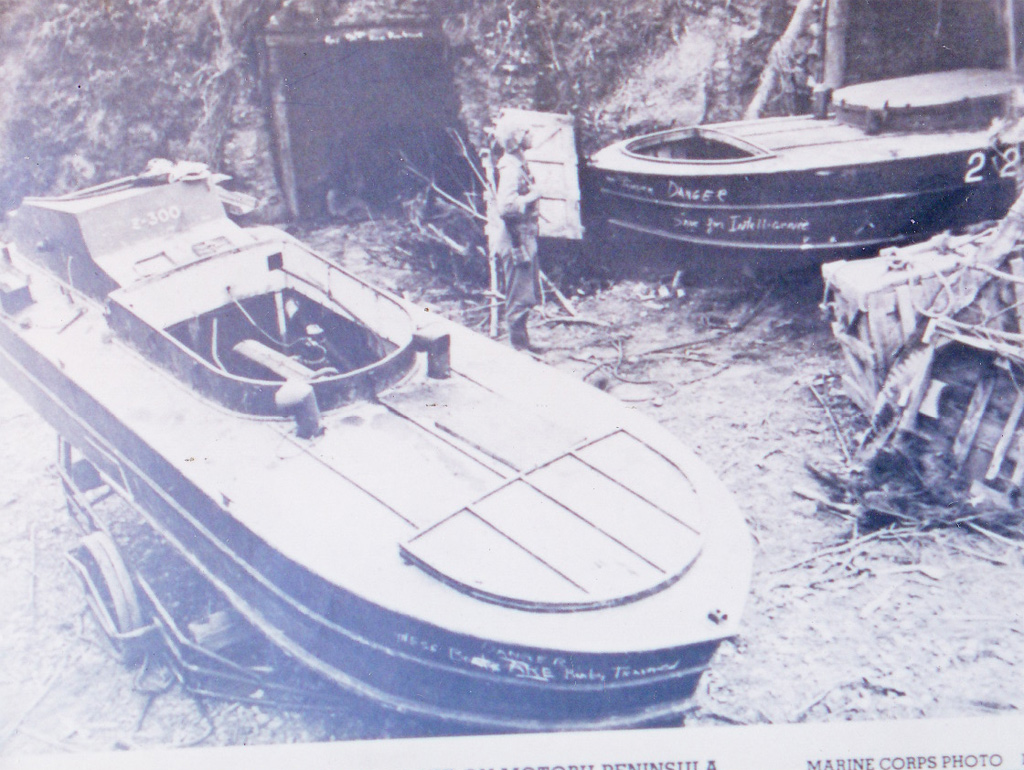
During the Battle for Okinawa most Marines are aware that the Japanese used Suicide (Hari Kari) planes against us. But there was more, they used Suicide Boats against us also. Inclosed is a picture of the suicide boats. Some boats had Ford and Chevrolet engines in them. They were not effective for lots of reasons, we had PT Boats and other types of patrol craft that kept them from being very effective, as soon as they began their run the PT boats were on them. There were problems with this idea on stopping the Hari Kari Boats also, some were armed with two depth charges, which went off at shallow depths which could cause damage to nearby ships and serious injury and death to American and Allied Personel.
Among other exciting things they intended to us​e against the Invasion Forces were Swimmers, that had explosives attached to themselves and could damage a ship, their purpose was to put explosives on the ships screw which would prevent the ship from moving but I saw ships screws turning from time to time which would make it difficult for a swimmer to attach anything to the screw.
And when we Arrived in Japan after they surrendered there were hundreds of tunnels dug into the hills with tracks coming from them where suicide boats could be launched (we could still see the tunnels when we went to Korea, stopping at Japan). The Invasion of Japan according to Naval Intelligence at the time, would cause nearly a million casualties (both American, Allied and Japanese).
Many of us that were preparing for the invasion of Japan, expected it to be our last day on Earth. Even a friend who was a Gunner on a B25, expected he wouldn’t live through the invasion of Japan. All this information will be in books about our preparation of the Invasion of Japan but little thought will be given to the thousands of ships and thousands of men that were there, the thoughts and the letters that were not mailed because the writer lived through the Invasion.
GySgt. F. L. Rousseau, USMC Retired
First I ever heard them referred to as “hari- kari” planes,but I guess it would be same-same as kamikazi. Nick
I did a little research and found this”
“They’re very different things!
Harakiri means “stomach cutting”, and refers to the ritual suicide of samurai.
Kamikaze means “wind of god”, and despite its link to WW2 in Western culture, the original meaning (and the one Japanese primarily think of when they hear it) is an actual weather event. Well, two actually. The original kamikaze were two storms that very fortunately (from the point of view of the Japanese) occurred on the two occasions the Mongols tried to invade Japan. The storms caused massive damage to the Mongol fleets, allowing the Japanese to defend their country against a weakened invading force.
The suicide attacks that westerners know as kamikaze, are normally called tokkōtai by the Japanese, which is short for tokubetsu kōgekitai, meaning “special attack unit”…..Bob 1381…
Vietnam 1966/1967.
Bob, you really did your research, very interesting. I enjoy researching stuff as well, not much else to do these days. Thanks! Harry 1371
I have been “bit” so many times that I like to research anything that doesn’t sound right. We’re all human and we make mistakes or have misunderstandings about things. I’ve noticed a lot of people talking about stolen valor when someone submits a post because of what they might have said that didn’t seem right. Think about it, many people who reply are Vietnam Vets like you and me. And, many of them were draftees and maybe didn’t have a lot of education or didn’t get involved with terminology as much as others. For example; I wear a cover (cap,hat) that has “3rd MARINE DIVISION” and “VIETNAM VETERAN” embroidered on it along with the 3rd Mar Div logo patch. Many Vietnam veterans have come up to me and ask “were you in the 3rd MARINES? As you know, 3rd “MARINES”, to me, refers to the 3rd Marine REGIMENT, not DIVISION. I just let it pass because sometime I wonder if they actually knew the difference…..Bob 1381…Vietnam 1966/1967.
Also have been bitten a few times as well. One time I was walking through a parking lot at a shopping mall and noticed a guy wearing a 1ST MARINE DIVISION VIETNAM cover and stopped to talk to him and ask him what unit and years he was in country. Told me that he could not remember what year and was hesitant to say any more and said that he didn’t have time to talk. Pretty sure he was a wanna-be.
Seppuku or ” Disembowelment”, is ” Falling on Sword”. MCRD. Vietnam 70.
Never knew that. Very interesting post. Thanks for the education.
Anyone ever see a Water Buffalo explode? I did . On a road heading south of Dien Ban near Hoi An. Bill 0331
I don’t mean the one with wheels that carry water!
I saw on get it’s leg blown open when it stepped on an antipersonnel mine at Phu Bai in 1967.
Bob 1381…Vietnam 1966/1967
I saw what was left of one after it stepped on 2 antitank mines just outside the wire at Khe Sanh during try. It was just out in front of my mortar pit. I thought an atomic bomb went off and the smell of burn hair and shit was over powering. After day light we found the hind quarters about 75 yards down the hill
My father was on Okinawa with the 6th Marine Division at Sugarloaf Hill. He passed in 2018 at 92 and still was proud and patriotic Marine . Semper Fi !
Hi Elaine, my dad was also with the 6th, he was in George Company, 2/22, his platoon was the first to assault Sugar Loaf, he passed away at 87, and raised 3 future Marines, 2 that retired as Lt. Col.’s and a Sgt., needless to say that would not have been the case if the Japanese had not surrendered.
Brian S., Sgt. 73-77
Me,and a couple of fellow marines went cave hunting while in Okinawa. Found some in Ishakawa, that we visited. My friend Wik found some bones in one we visited. He was walking around kin village with it. Japs there took a dim view of it, to say the least !
Thank you for sharing this great history
First, I’m glad to see the stories of our younger days as Marines again cause I had seen them in a while on “Sgt. Grit”! Especially Retired Gunny Rousseau. You can bet we’re “Still as mean and U.S. Marines”. RamTwo ret 0369
As the tide of the war turned more and more against the Japanese, they conjured up a plethora of suicidal tactics to stem that tide. For the naval department this meant kamikaze planes, kaiten submarines, fukuryu suicide divers or human mines, and shinyo suicide boats.
It has been real interesting reading the reply’s from my brothers of places I was assigned to. I spent my last 1 1/2 yrs at MCAS Futema and remember traveling the island every chance I had. Being a NCO I had the opportunity to live off base, which I did. 1970-71. Viet Nam 1968, landed in county in time to move 3 rd Mar Div from phu bai to Dong Ha.
My Uncle from Chicago was a WW2 Marine. He received 2 Purple Hearts. He was instrumental in capturing a Japanese Invasion Swimmer.The swimmer was attaching explosives to the screw of the LST which was pulling into a bay very slowly. My Uncle and several other Marines jumped overboard and captured the swimmer. It seems that revolving in time with the screw, attempting to attach the explosives,the swimmer was so dizzy that could only swim in circles and was easily captured.
Now I have another Uncle from Indiana…..
Great info and very interesting, thanks Gunny…semper fi