Hello Sgt Grit,
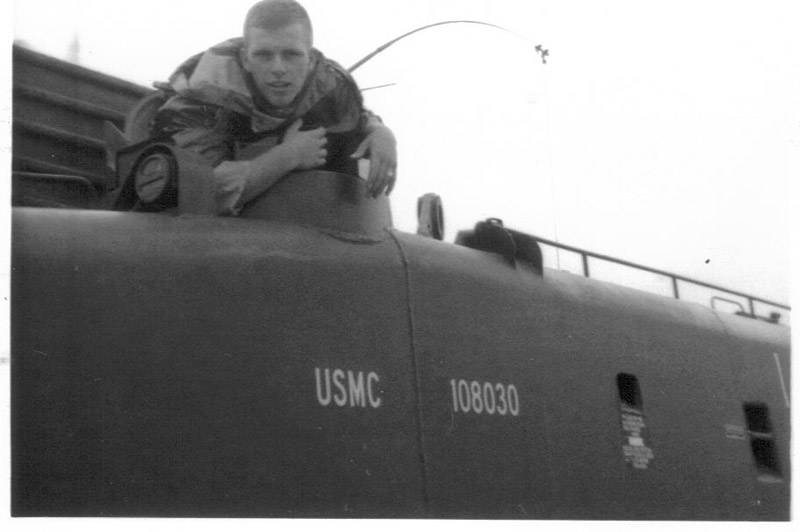
Here my story for you. We in Amtrac were known as Amgrunt, had the Tracks to drive but we did alot of foot patrols. When I first got to 1st Amtrac up by the Cua Viet river we had to be a initiated into the platoon, this was done to see if we could work together as a team, first the old timers would put a ring of sand on the ramp of the amtrac, next we took a few swings with a sledgehammer to see if we could hit the center, then came the blindfold, to see if we still could hit the center, but unkown to us we were beating the h-ll out of our cover[ keep mine for a ong time]. Sure had a good time doing it too the newbees, But my first time was cut short, on my first patrol to the DMZ I was wounded, spent the next 41 days in the hospital at Cam Ranh Bay before I went back to my unit. sending you some photos of the first copterIi took a ride on, I was on a stretcher up by the door, talk about a cold ride,[ but another story]. here are some pictures of me and the Amtracs. Thats me looking out of the drivers hatch. Use the ones you want,
Semper Fi
Sgt. Larry Walker
Nam 67-70
Category: Vietnam
Khe Sanh Historic Road Marker
“A Place That Always Was”
By Craig W. Tourte
H.Q. 1/13 Khe Sanh 67-68
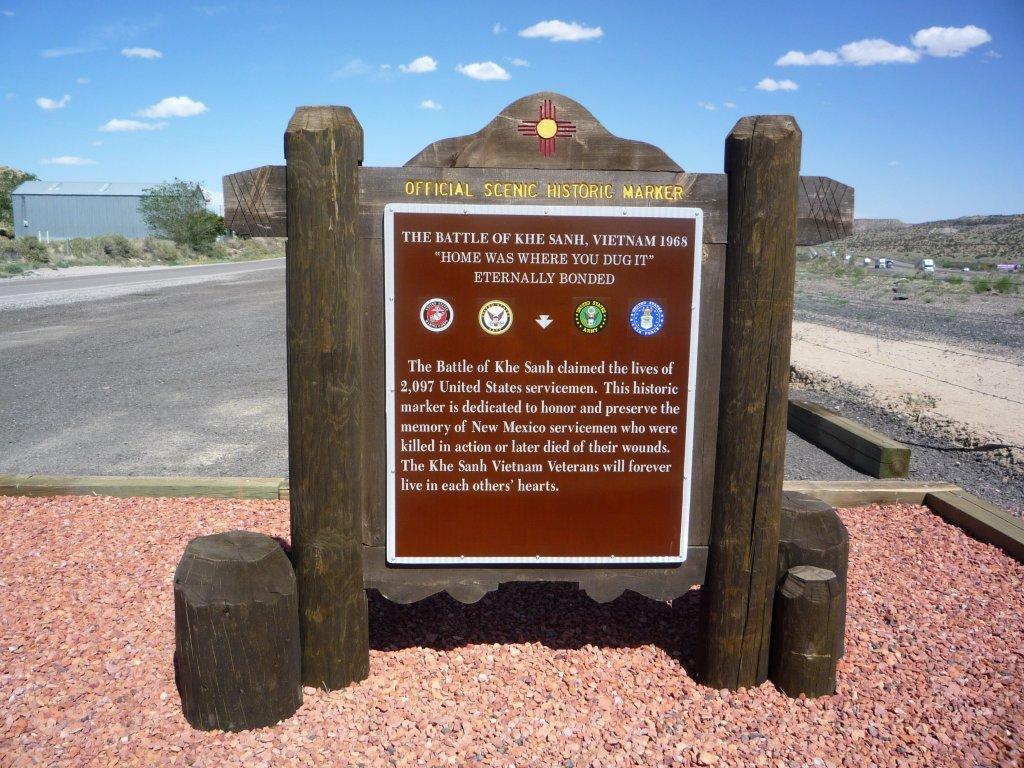
On Tuesday, November 10, 2009, the state of New Mexico dedicated and unveiled an Official Scenic Historic Road Marker honoring those who died at “The Battle of Khe Sanh, Vietnam 1968.” The beautiful wooden marker is inscribe: “The Battle of Khe Sanh claimed the lives of 2,097 United States servicemen. This historic marker is dedicated to honor and preserve the memory of New Mexico servicemen who were killed in action or later died of their wounds. The Khe Sanh Vietnam veterans will forever live in each others’ hearts.” In addition, the marker is inscribed with the names of nine of those who were killed from the State of New Mexico. I am sure more names will eventually be included, as that information becomes available.
“The location of the “Official Scenic Historic Marker” is identified as being at New Mexico 124, Mile Marker 16.5. In actuality, it sits along the old Historic Route 66 Highway, North of Interstate 40 at the 104 Exit in an area identified as Acoma, New Mexico. It was an approximate 50 mile drive along Interstate 40 from the City of Albuquerque to reach an area known as “The Sky City.” The Sky City is actually an area where the Acoma people lived centuries ago atop a mesa to protect themselves from enemy attacks by neighboring bands. The Native American’s who live in the area are identified as the “Acoma” which means “Place of readiness.” According to a little research, “Native American legend” describes Acoma as a “place that always was.” Native history says “…it was first inhabited about 700 A.D.” “Archaeologists agree that it has been continuously occupied from at least 1150 A.D. to the present.” Acoma, New Mexico is generally considered “America’s oldest continually inhabited city.”
The drive from Albuquerque to “The Sky City” where the Historic Marker is located is not unlike any other drive I have taken along a desolated high desert highway. Long, straight and lonely for the bored and weary traveler who too often focuses attention on what’s over the next rise. One could pass Acoma in the blink of an eye and never know anything was there except sand, sagebrush and red dirt. I wondered why a monument honoring these heroes would be erected in such a desolate location and not in a more densely populated area.
It was early evening when I drove out to the site of the Historic Road Marker where I met Harold E. Lockwood (HMH-CH-53 Sea Stallions) for the first time. Harold is a tall, proud Native American, former Marine and Vietnam Veteran who is the Sergeant at Arms of the National American Indian Veterans. We stood together as darkness approached, surrounded by red sky with a few wispy clouds off in the distance and tall red table top mountains rising up from the desert floor. Harold identified his house a quarter mile or so away from where we were standing. With the swing of his arm in a wide arc he told me about his cousins, friends, other relatives and Native Americans who lived nearby and identified those who had served and those who had made the ultimate sacrifice, all from the Reservations. We talked about the arrival of the early Missionaries, the Native American children who had been taken from their parents and even to this day, the hardships his people face.
We spent a few minutes talking about his service in the United States Marine Corps and the three years he served in Vietnam. The tragically brutal injuries and death he had observed as a helicopter machine gunner, too often recovering the dead and wounded. The missions off of ships made by young boys who eagerly entered combat for the first time, all dressed in new green uniforms and combat gear and his painful recovery of their remains after the battles. Harold remembered all of these events clearly and with great sadness as he looked up into that red evening sky, silently remembering the pain that is often overwhelming, as he searched for the words that would somehow explain to the outsider, the horrors he had witnessed. Remembrances I knew were still prevalent.
The following day during the dedication ceremony there were a group of young children from one of the local Native American schools who preformed a dance. Adorned in Native American costume, I observed they all had very intense looks on their faces. I realized that the dance these children performed was a serious cultural interpretation of events and beliefs that had been handed down from one generation to the next. The dance was significant to the Native People and fitting in that it was performed in memory of those who had sacrificed for their people and our country.
As I stood alone looking out across the Acoma, viewing the red earth color of the valley and hills, not so dissimilar in color to the red clay of Khe Sanh, I glanced up into the very wide open sky and understood why fate had brought “The Battle of Khe Sanh” marker here. Somehow fate had brought this remembrance marker to this spot, because this place is a “Place That Always Was,” A “Place of Readiness” and in a way, a place of safety for those who we will never forget.
Craig W. Tourte
CTourte[at]sbcglobal[dot]net
John and Joe at Hill 327
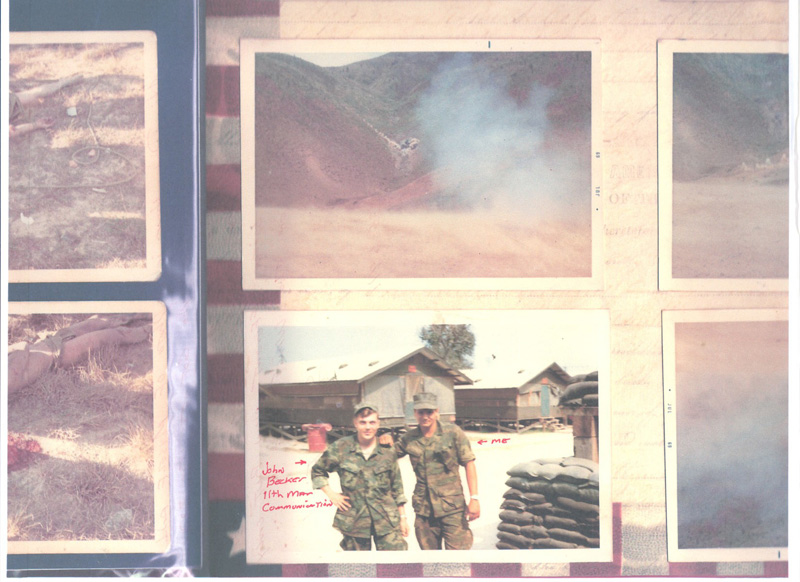
This is one of my buds and me who got to Hill 327 when I was a two digit midget! And John was also with the Comm. Unit. I look a little different now but only 2inches more on the waist line.
Semper Fi
Joe
Number 6 on the flight line at Phu Bai
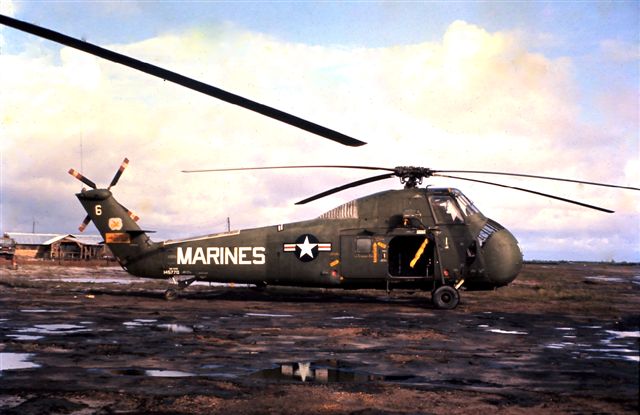
I read the story in the Jan. 13 issue about the UH34D resupply of the Rock Pile in Oct. of 1966. The number on the tail looks like number 6. I was flight crew on the number 6 during Oct. of 1966 with HMM161 based at Hue Phu Bai. That might be me in the door of the plane sense there were only two us who flew with the number 6 and we were both on the plane. I can remember several times resupplying the Rock Pile. We could only get one wheel on a small platform with our tail sticking over the side of the mountain, and the wind blowing over the top made it difficult to stay there very long. Here is a picture of the number 6 on the flight line at Phu Bai.
Thanks, T L Smith
Airwinger
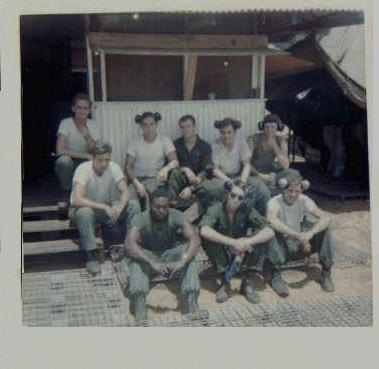
I served from 09-1965 to 05-1969 from Memphis to Yuma and Iwakuni to Chu lai and back to Cherry Point
Jet engine mechanic but worked most of my time on flight line with TF-9J/A-4/TA-4F
poem from Vietnam 1966
I don’t know where this might fit in, leave it up to you if you find it worth posting.
I was with Charlie Battery, 1st Battalion, 11th Marines 1966 in I Corps when I sent this home to my bride to be
OMEGA Omega he said. Omega he cried The bringer of death, to one who just died. I am the last, you'll know on earth. The one who ends, your life from birth Omega he said. Omega he cried. Your life in my hand, your future to give. You were born to die, not given to live. I am the end, of all you know, Sent from on "high" to bring you low. Your life in my hand, your future to give. I never knew you, you never knew I. We did not question, but went forth to die. "Orders" they said, "The enemy kill" You were my foe, I did their will I never knew you, you never knew I. The bringer of death. The reaper am I. Patiently waiting, for you to come by. Nearer you came. so unaware. To end your life, I did not care. The bringer of death. The reaper am I. I look down my sights. I see you quite clear. The image I see, seems so very near. The recoil soft. You drop mid stride. What have I done. Another has died. I look down my sights. I see you quite clear. Omega am I. Avenger so deft, That when I kill you, there's less of me left. Mine not to ask. I do as told. I kill you first, then I grow old Omega I am. Avenger so deft. It is to late now. I've taken your life. A picture I find, of your child and wife. Do it again? You know I would. As you to me, as if you could. It is to late now. I've taken your life. Omega, the end. Omega, it's done. The battle is o'er and no one has won. They lied to me. They lied to you. I took your life and took mine too. Omega, the end. Omega, it's done. jadeMarine Corps Leage Members Web Plummer
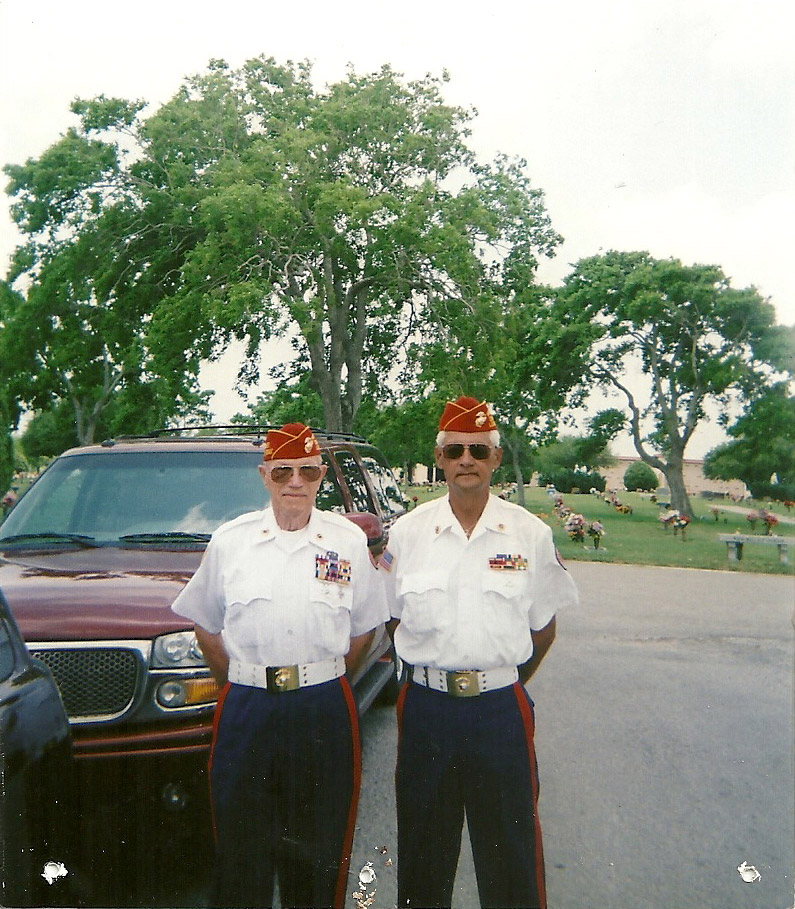
Sgt.Grit, My name is Reymundo Gonzales from CORPUS CHRIST,TEXAS,my twin brother Reynaldo & I graduated from Hi School on JUNE the 4th 1967 & were standing side-by-side on those famous YELLOW FOOT-PRINTS on the 6th. I arrived in VIET-NAM on NOV.26th, 1967 & my brother was sent to RECON in Camp Pendelton. I spent 23 month in NAM as a SCOUT SNIPER with 7th Marines HD. QUATERS CO. Scout Sniper Platoon out HILL 55,working with all THREE BATALLIONS,1/7 ,2/7, 3/7 in DODGE CITY,ARIZONA TERRATORY,aruond LIBERTY BRIDGE.CHARLIE RIDGE.
A Salute
To All the Marines who served in Viet Nam I salute you :
Semper Fi " You Did Great "
Vietnam Fiction – Episode 1 – You’ll Love Iwakuni
Episode 1 – You'll love Iwakuni
Gunnery Sergeant Vince Spalding, USMC, and I were settling in for Friday night happy hour at the Iwakuni MCAS Staff NCO Club. Iwakuni is a major air station with a large contingent of Marine squadrons occupying one side of the airstrip. Navy VP aircraft and JDSDF forces were also sharing the facilities. Iwakuni makes an ideal Marine Corps location because not only did it have an air station but also a deep water port which made it possible for AKAs, APAs, LSDs, LPHs, LSTs and carriers to embark Marine aircraft, equipment and personal with a minimum of delay.
Declared Sane
Minh did a good job explaining the mental health check deal. He said the committee didn't accept a report from a US private doctor and I needed to be examined at a hospital.
Going there was an interesting experience and I have been having fun explaining this event with my colleagues here in the US. I knew no one at the mental hospital could speak English so I was expecting some mischievous fun. It started with the filling out of a certain form which was, of course, all in Vietnamese. Some of the lines I recognized from filling out the numerous visa applications and entry papers because they are bilingual. I know what a dia chi is, so I put in Thu An's street address. This caused a minor ruckus. The lady, of course, didn't buy it and wanted my US address. So I started over with a new form. From her reaction, these forms must be very expensive. On the next form, I didn't know what a few things were, so Thu An tried to help me, unsuccessfully. They do the same thing we do in Paris. If they think you don't understand what they are saying they say it louder the second time. I think she and the admitting nurse took over and finished it for me. I then had to sit across from another unhappy looking woman who looked it and me over for an exaggeratedly long time for no obvious reason.