Guarding Heaven’s Gate

Sgt Grit,

In March 2011, another Marine was promoted to guarding heaven's gates.  After a year-long battle with brain cancer, Lance Corporal Tom Nelson is dancing with his Lord Jesus Christ. 

Tom joined the Marines in 1968 and served until 1970 as a Combat Engineer for A Company, 9th Engineer Battalion, First Marine Division in Viet Nam.  He served in Viet Nam from 1969-1970.  He was awarded two purple hearts, combat action ribbon, good conduct medal and various other awards.  He served his country at 110%.  His family in central Indiana will always love and remember him with his dedication to his country and his Lord.  Semper Fi read more

The Last Man: The Final Irony of the Vietnam War – Part 3

Is such treachery beyond comprehension?

When a young man joins the Armed Forces he assumes he will be serving his country. For the majority, that assumption is valid. For the minority that find themselves in combat, they quickly learn that they will be serving their brothers. The President won’t be dragging you to safety. The Constitution will not cover your advance or withdraw. Your brothers will. read more

The Last Man: The Final Irony of the Vietnam War–Part 2

May 15, 1975

The Trip to Bad Intelligence

Up early on the 15th, Lindow, his fellow crewmen and mechanics and the Marines began preparing for the assault.

L/Cpl. Joseph Hargrove, an E Co. machine gunner must have said to himself, “What a birthday party!” He was 24. Just three weeks prior, he and Rogers had made a trip into Henoko, the Okinawa village outside of the 9th Marines base at Camp Schaub to purchase a gift for Hargrove’s new wife. But that was so long ago. Now he had to find out which chopper he and his team, PFC Gary Hall and Pvt. Danny Marshall had been assigned. The only thing for certain Hargrove knew was that they weren’t taking him anyplace to celebrate. read more

The Last Man: The Final Irony of the Vietnam War–Part 1

The Last Man: The Final Irony of the Vietnam War

By Dick Lancaster

Captain Harry Cramer Jr., the first man, was an obvious pick for the new Special Forces concept the Army had in mind after the Korean War. While secretly training South Vietnamese in the art of ambush, Cramer was killed near Nha Trang on October 21, 1957. His death was ‘an accident’ because officially, America had no combatants in Vietnam. He was quietly buried. We moved on. read more

The Last Man: The Final Irony of the Vietnam War

The Last Man: The Final Irony of the Vietnam War

By Dick Lancaster

Captain Harry Cramer Jr., the first man, was an obvious pick for the new Special Forces concept the Army had in mind after the Korean War. While secretly training South Vietnamese in the art of ambush, Cramer was killed near Nha Trang on October 21, 1957. His death was ‘an accident’ because officially, America had no combatants in Vietnam. He was quietly buried. We moved on. read more

Lost Radio Call sign book – L/Cpl Broadstone 2311333

I was trying to think when I recovered this book – a small pocket size book with the follow in the first page:

L/Cpl Broadstone – 2311333 – 3/26 Mike Co., 3rd Platoon, 5190 – Radio man.

I think I recovered this when I was picking up comm equipment at the casualty point at the hospital in east DaNang.  it is in still great shape and if anyone knows him or served with him, I think he would love getting this back and I will for sure get it back to him. read more

Da Nang 1970

Dear Sgt Grit,

I am a Marine from the Gulf War era who was raised by a Vietnam Veteran (Sgt. Greg Theis, USMC(ret.) and I just found a picture of my father in Da Nang in 1970.  My father is the surly Marine sitting down facing the camera with a cigarette in his mouth.   As you may have guessed by the hair pushing regs he was an airwinger; a Sergeant in the Crash Crew stationed at the multi-force air base near Monkey/Marble Mountain (?).  This photo was taken minutes before the rocket attack which severely injured my father and killed the Marine on the far right of the picture whose hand is all that made it into the photo.  That Marine who lost his life was standing in front of my father securing the fire-hose as they sprayed down a rocket pod from an F-4 Phantom.  The pod continued to fissle and eventually exploded in its stall landing my father in the burn ward of Naval Hospital Camp Lester for a year on Okinawa before being sent home for medical retirement.  Ironically Camp Lester was the Command that processed my medical discharge 25 years later for injuries I incurred during the Gulf War.  Feel free to post the picture if you think it would be appreciated.   read more

Tail Sticking out

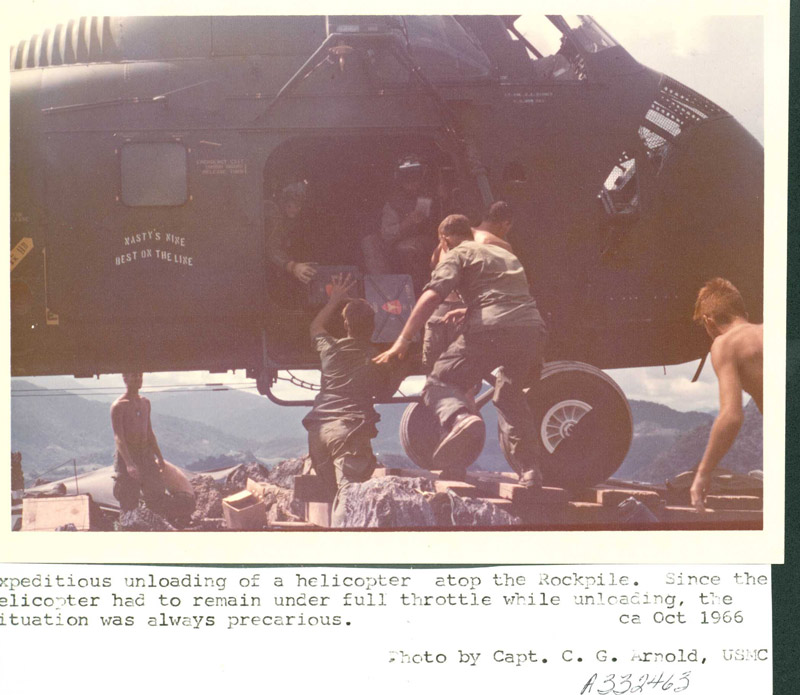
An UH-34 in the air at the Rockpile. If you look close, you can  see T.L. Smith standing in the door of his UH-34 with the tail  number 6 on it. How Many Marines have a picture of themselves  taken in the field while flying a resupply mission to those of  us who held the Rockpile? They were our "Life Line", and I'd  like to be able to thank him after 45 years.   If you don't know about The Rockpile, the attach word file is  from Time Magazine in Oct 1966.  S/Sgt. Ted Dudley   Time Magazine, October 1966   The terrain was as tough as any the U.S. Marines had ever  contested. It combined the horror of a Guadalcanal jungle with  the exhausting steepness of the slopes at Chapultepec. Added to  that were fusillades of bullets as ferocious as at Tarawa and  showers of shrapnel that turned the forest into a tropical  Belleau Wood. But "the Rock-pile," as Viet Nam's latest big  battleground has come to be called, is weirdly unique. There,  just south of the inaccurately named Demilitarized Zone, a task  force of six Marine battalions has been battling two entire  divisions of North Vietnamese regulars whose apparent aim is to  invade Quang Tri province. So far the Reds have failed. Over the  past few months, Hanoi's hordes have shifted away from their old  infiltration route, the Ho Chi Minh trail, which empties into  the isolated Central Highlands. Instead, more and more have been  striking directly southward into the populous coastal plain (see  map). The aim of the Marines' "Operation Prairie" is to cut  those arteries from the DMZ and push the Reds so far west that  they will once again be forced to use the trail.   Key to the fighting is "the Rock," a jagged, 750-ft. fang of  granite that thrusts upward at the intersection of three river  valleys and two enemy trails. During July's Operation Hastings,  the Marines established a reconnaissance post atop the Rock, and  a lone sniper fed by airdrops of C rations controlled the area.  Now it is a Marine battalion command post, under almost steady  siege. Across from the Rock rears the Razorback-a steep ridge  whose sides are pocked with caves dug by the Japanese in World  War II, but now occupied by North Vietnamese. Several hundred  yards below the Rock, the Reds have dug "spider holes" from  which they lob mortar fire and mount ambushes. Two miles to the  south stands Hill 400, dominating the Rock-pile and infested  with Reds. Last week the Marines moved simultaneously against  the Razorback and Hill 400. By week's end, both were in their  hands.   Snakes & Lanterns. Fighter-bombers seared both hills with  flaming napalm, then returned with rockets, heavy fragmentation  bombs and machine gun fire. For three days, the Reds on Hill 400  hit back with mortar and small-arms fire so intense that Medevac  helicopters could not land to take out Marine wounded. Finally,  Marine pilots used 1,000-lb. bombs to blast craters deep enough  to provide cover for the choppers, and a few critical cases were  evacuated. Then the Marines moved out, stormed the hill with  satchel charges,* and blasted the Reds out of their holes. They  found a Communist regimental command post replete with  underground rooms and trenches.   Near the Razorback, Marines were treated to an eerie spectacle  at night: dim lanterns moving back and forth on the ridge across  from them. "The North Vietnamese are afraid of snakes," sneered  one Marine. "That's why they carry them flashlights." Whatever  their purpose, the lights provided excellent targets for  artillery and air strikes. To date, Operation Prairie has killed  943 Reds, and the Marines have taken moderate casualties in the  process.