Article by Pete Mecca
CovNews
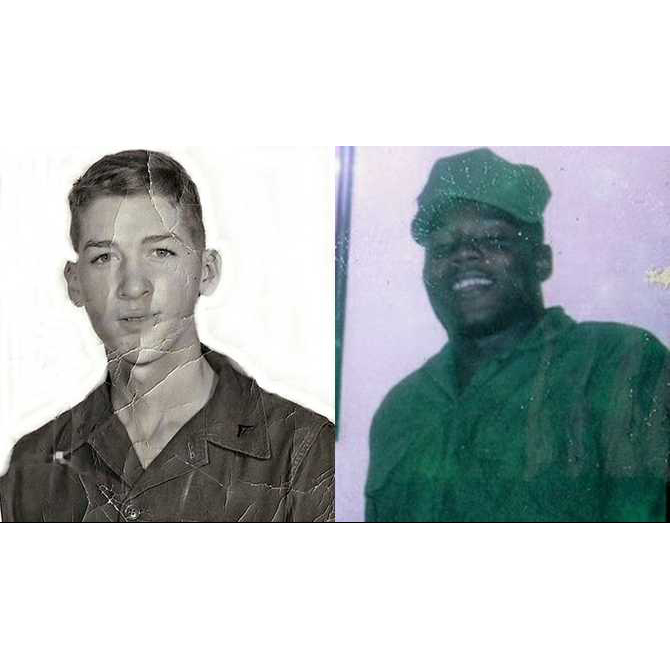
More than one Leatherneck would agree, it's befitting that a young man from Montezuma chose to join the United States Marine Corps. The month was November, the year 1965, the man: Eli Fobbs.
"I remember basic at Camp Lejeune," Fobbs said. "Back then the Corps didn't play around. They'd insult your momma, sister your wife; shoot, those guys would bust your nose and scare you to death. It didn't take me long to believe I'd joined the wrong organization."
Fobbs had what it took to become a Marine. After advanced training at Camp Pendleton, Fobbs arrived at Da Nang, South Vietnam in June, '66 with arguably the most dangerous job in 'Injun' Country': that of an M-60 machine gunner.
Assigned to the 1st Battalion, 9th Marines, dubbed "The Walking Dead", Fobbs went into combat almost immediately. A hard-hitting breed of Marines, "The Walking Dead" even carried Tabasco Sauce in their packs to kill the taste of WWII era C-rations.
In early April, '67, Charlie Company approached the village of Phu An, a well-established haven for North Vietnam's 234 Division. Fobbs stated, "It was near dusk and we were told to dig in, but the sandy soil was so saturated we hit water at 3-to-4 inches. So we kept low to the ground in a prone position."
At nightfall Charlie Company moved out toward a tree line then all hell broke loose. "The enemy came out of nowhere," Fobbs said. "We got hit hard and took a lot of casualties."
A deadly hindrance was the recently introduced M-16 assault rifle. Never properly field tested and hurried into combat, the new M-16 jammed consistently which rendered U.S. soldiers defenseless.
"We had called for reinforcements and were told to 'cease fire' on our right flank because Delta Company was coming in to help us," Fobbs said. "It wasn't Delta Company, it was the enemy. They swarmed all over us, dropping hand grenades and executing our wounded. I got hit in the arms and legs and was overwhelmed by 4 Viet Cong. They took my K-bar knife, the machine gun, and then drug me into the tree line. I was screaming in pain. The VC jabbed my wounds with sticks trying to make me talk. Shoot, I didn't even understand Vietnamese."
Charlie Company had been decimated. Almost every platoon member was either dead or wounded. The company commander was dead; the FO was dead – there was no leadership.
Another Marine, Lance Corporal James Stogner, had been 'in country' for months. Before the firefight erupted, illumination, for some weird reason, had been called in to 'light up the area.' Stogner was a battle-hardened Marine and recognized the sounds of diverse artillery rounds. Perceiving that the 'lights would soon be on'; Stogner knelt and waited for the night to turn into day.
As the obscured sky became sunlit, Stogner spotted three enemy soldiers in front of his position. He took out all three with an automatic burst from his M-16. Then his M-16 jammed and the receiver slammed back into his face, breaking his nose and lacerating his skin. The illumination burned out; night returned. With a K-bar knife as his only protection, Stogner, vulnerable and with few options, lay in the dark trying to figure out his next move Stogner heard the moans of wounded and dying Marines, many yelling for help. Then he heard Vietnamese voices, a lot of them, slipping into the perimeter to shoot wounded Marines in the head and strip them of weapons and gear.
Instead of slipping away, instead of saving his own skin, Stogner joined the enemy, so to speak, in the darkness, armed with his K-bar knife. In short order he killed numerous NVA soldiers, thus saving many Marines from a certain death. Still Stogner moved, like a nocturnal hunter, until he found and silenced more NVA soldiers, saving even more Marines.
The NVA in the tree line knew something was amiss. Their men were being silenced which meant one, if not more, member of the Marines were still alive. Chi Com grenades blanketed the Marine position. Stogner survived the barrage, but was now alone in the dark. He decided to crawl away from the killing zone until he heard a Marine shriek in pain from the tree line. The Marine in trouble was Eli Fobbs.
Fobbs recalled, "The VC or NVA, whoever those guys were, kept jabbing my wounds and beating me. One of them heard something and left the torture area. He never came back." James Stogner had slipped into the area, grabbed the lone NVA in the darkness, and silenced him with the K-bar knife. One of the other NVA soldiers came to investigate. He, too, soon visited his ancestors.
"The other two guys were still going at me when suddenly this skinny white dude came screaming out of the darkness like a wild man," Fobbs said. He stabbed one in the chest and quickly grabbed the last guy, wrestled him to the ground, and, well, he was a goner, too."
Stogner threw Fobbs over his shoulder, grabbed the M-60 machine gun, and struggled back to friendly lines. Amid grenade explosions and small arms fire, Stogner eventually delivered his human cargo to safety until both were airlifted out for medical treatment the next morning.
James Stogner and Eli Fobbs recovered from their wounds and returned to combat. Fobbs earned 3 Purple Hearts in Vietnam while Stogner was awarded at least two Purple Hearts during his tour of duty.
The inexcusable irony is the total lack of acknowledgment for Stogner's heroics in the best tradition of the United States Marine Corps. Many of the eyewitnesses, especially the officers, were killed in action and any paperwork that may have been processed was lost in never-ending paper-shuffling.
While loading additional casualties onto choppers the next morning, a Corporal named Carl Van Meeteren overheard Gunnery Sergeant Bush comment on Stogner's courage.
"I saw men in the Korean War get the Medal of Honor for doing things like this," he said.
The Medal of Honor requires at least two reliable witnesses. Eli Fobbs is one. Fobbs assistant gunner, Bob Carpenter, was the other. In December of '93, while sitting at the breakfast table with his wife and two sons, for reasons known but to God, Carpenter pulled out a .45 caliber pistol and ended his own life.
"You know, I've seen and talked with James, but it took us 41 years to get together," Eli Fobbs said. "We are dear friends. But I have black friends that don't believe this story, a story of a skinny white kid saving a black man in combat. I got news for them, the only color in war is red, and we all bled it."
In war, the few too often pay the price for the many. Perhaps it's time for the many, especially our congressmen, to pay more investigative attention to the few.
Story submitted by Wayne Armstrong
One badass Marine, glad he finality got the recognition he deserved, just to bad it took so long. He missed out on a lot of perks that go along with the honor.
So to this day the Marine is honored for Nothing!!!! It’s hard to understand. Semper Fi. Do or Die.
When is this man (Fobbs) receiving the Medal of Honor??????
Basic (aka boot Camp) at Camp LeJune? Infantry training at Pendleton? M-16 in Viet Nam in June 1966? ? ? In this War Story there was at one point no Leadership then the next morning while loading wounded on a chopper there appeared a Gy Sgt. I served in Viet Nam March 67 to April 68 and got a M-16 in Jan 68 just days before Tet 68. If ever (in my opinion) there is a bull $#!T war story it appears here today. AMAZING! Semper Fidelis.
Eh, SgtMaj….not legit to me either. 1stSgt, Retired (’63-’84)..RVN Jan ’68-Feb’69. Semper Fi
half of our platoon were white or caukacion. it was the right thing to do to help one another. we helped each other. there was a lot going on at that time almost like today. we came through those hard times as americans. the war was over for me at or about 1973. wish we didnt have war but sometimes you have to stand up for what is right,. thank all
helped people we were a team .
Very questionable. Boot camp PI 1964. One of my DI’s Sgt. Baker lost a stripe for hitting a recruit. RVN 4/66-12/67, FAM fired an M16 mid 67.
I did read some of these a very sad story of a veteran soldier. My heart bleeding with pain and sorrow when a trained soldier and after years of combating becomes a veteran as a brave fighter from a dedicated war, they all shall be deserving much better treatment not only as a human being but as well as a good American soldier. I do my part as a volunteer in a veteran hospital, you can see all different type of people veterans; Spanish, Black Man, White Caucasian, Indochina Man, from Manila, Phillippine, from Bangkok, Thailand,and so many different people with different skin colors men, I say,but we all been brother and together, Oorah!. The only color we did see a lot, like some one said “the red color”. In training camp wounded soldier in Campus Lejeune, North Caroline in 1963 accident cut with a kay-bar knife, lots of bleeding. My best friend and my brother a good marine, was a black man, David Somerset, we was kill in action 1965.Honor to al of them. “Semper Fi
A Marine is not a soldier. A Marine is a Marine and Marine is ALWAYS capitalized. The Marine fighting knife is the KA-BAR. We (Marines) do not go to training camp or basic, we go to boot camp. Basic is for the army, air force and the navy – I think. Training camp is for football. Please get our terminology correct.
Forgot one. Lejeune is not a campus – its a Marine base and is called Camp Lejeune and it is located in Jacksonville, North Carolina. Our East Coast “training camp” is located in Beaufort, South Carolina and is known as Parris Island.
Its great to hear that every marine is the same color, red white and blue, and getting there recgoniton that is due
Boot camp Feb 1964, thru May(June)…. Drill Instructors laid hands on…. Only D I I heard of loosing a stripe was an abuser….
@ P.M. Dominguez: What is a “Special Forces Tactical Operations” mean? And only a Cpl after 10 years?
Either someone has a very poor memory or this story isn’t true. Too many inaccuracies. I was in D-1-7 from 8-66 till 4-67 down in Chu Lai. A couple of armorers brought out a few M-16s in late March or early April of 67 to have troops fire them and become somewhat familiar with them. I was offered the opportunity to fire them but was a short timer and opted out. At that time I didn’t have a lot of faith in what looked like a plastic Buck Rogers toy. If I remember correctly the overall length of 44″ and the 11 lbs. ( w/o bi-pod ) plus the flash suppressor worry of the M-14 was a drag, both literally and figuratively, especially in dense jungle growth.However there is something about laying your cheek against a piece of wood and squeezing off a round with a very distinctive recoil though, that I always found very reassuring. Of course carrying 7 to 10 magazines of 7.62 ammo was also a weighty problem. Still beat carrying the base plate of an “81”.
I’ve never heard of Boot Camp being referred to as Basic, or being at Camp Lejeune, NC. I was in Boot Camp plt 312 in Feb. 63. and Thump Call was just part of the program.
This story starts out with a lot of Bull. Parris Island is boot camp. Its not Basic training at camp Lejeune. I have often heard of fake Marines telling people the went to camp Lejeune for Boot camp that’s how you know they are fake. I was in PI 1961 platoon 231 we had M1 Garands
I just cant write this off just yet…..What if he was a swamp rat from PI, and advance training at Camp Lejeune, moved to Camp Pen. for staging…He could be suffering from (LNWS) Lejeune nasty water syndrome…Letter from VA gave a symptom of possible confusion, among others…I was packing a M1, at first, but graduated to a M14…Only tie I saw a M16 was in the movies…Also didn’t have much to do with the M15 either…
I am not of that era so I can’t comment on the Viet Nam terminology or exactly when the M16 was issued, but I must admit that the phrase “Basic at Camp Lejeune” struck a nerve with me and sent up my BS Detector, but I read on and then I thought to myself that the piece is obviously written by a news reporter who probably took quick notes when he heard Fobb’s story and probably misquoted him and wrote the story as it made sense to him, the author. Fobbs probably went to PI and like all of us grunts, then went to Geiger for Infantry Training School (called ITS during my time in 1981). I clicked on a link somewhere after reading the story and saw a picture of him and James Stogner later in life, so the story probably has merit. Then too, as one of you Jarheads mentioned earlier, maybe Fobb’s memory is not what it once was. I keep in touch weekly with Tim Wheeler, my best buddy from the Corps and there are several times I run something by him and he recalls it differently than I do, and we are only 55. Semper Fi brothers!
I heard the story from stogner, Van Meter, and Ron Gray who was also there that night…
I had all three of them in my boat fishing on the Kenai River in 2007.
It’s too bad some of you would try to discredit the survivors I’m such a horrible night
USMC, Nam.Vet. Corporal, P.M. Dominguez (Special Force Tactical Operations) 1962 to 1972 Tom Tilque (A real Marine) commented, ” Cpl after 10 years”. Tell us Dominguez, what did you get busted from (if you know what busted means) You also are as full of $#it as a Stuffed Turkey. I also like George Williams comment about LNWS LeJeune Nasty Water Syndrome never heard of that before. I got to Lejeune in March 87 just on the tail end of the LNWS and neither me or my family show any symptoms of suffering from drinking the H2o. Dominguez and Pete Mecca of CovNews, Y”all need to get your $#it in one bag and whatever you do “don’t loose the bag.” Semper Fidelis to all my Brothers who suffered as I did going through Boot Camp. lol Then I was a D.I. two times. PAY-BACK is a Medavac. Oh how I love to talk about the GOOD OLD DAYS.
Sgt Maj Edwards, Dominquez also referred to the story as “sad story of a veteran soldier.” What Marine refers to another Marine as a soldier? And then he used the term “training camp” and then of course my favorite….the Kay-bar. Damn….the dude has a huge set of kahoonas to get on a Marine site and try to blend in.
A Marine who came through and should have gotten the MOH sadly men like him are never given any recognition or remembered it is important that we as Marines not forget what men like this man did. let us have a minute of silence when the chance present’s it self and remember all those Marines who have paid the ultimate price for our freedom