Sgt. Grit,
I was assigned to Task Group 79.5, Special Landing Force "Bravo" in
1967-68 and served with a Marine contingent on board both the USS Tripoli LPH-10 and the USS Valley Forge LPH-8. In addition to regular Admin duties, I was also responsible for writing the telegrams that went home to the families of Marines who had been killed or wounded. Our ships generally carried a helicopter squadron and a BLT which deployed into
various parts of the country for assorted operations. While in-country,
we steamed up and down the coast between Da Nang and the DMZ while launching operations. It was particularly interesting to see the evolution of service rivalry change when operations went forward. When I transferred from one ship leaving station to another coming on station, I could see the Navy rivalry bristle when the Marine air and ground forces came on board. However, later on, when the birds launched with their squads of Grunts, it was the sailors on board who were assigned Litter Duty for the inevitable return of "Medivac Inbound" flights,… bringing the dead and wounded Marines back to the ship. Litter Duty required the litter crew to enter the tail end of the landing CH-46's and bring the Marines on their stretchers from the aircraft to the flight deck elevator where they would go down to the hangar deck for triage… either for emergency care or to the fantail for that final respectful preparation in returning home. It was a bloody and sobering task with high drama and frantic work on the Hangar Deck as heroic teams of Navy Doctors and medical staff struggled to save life and limbs. It was the effect of this hand-in-glove function that quickly dissolved the rivalry and bonded the Navy-Marine Team into an attitude of support and mutual respect, if not brotherly affection. As for me, every time a Medivac Inbound announcement was given over the Ship's PA system I knew that I would soon have a stack of SRBs and OQRs land on my desk,… each with a buckslip detailing the circumstance of the identified Marine. My task was to open each service record and translate the pertinent details of that Marine's personal data along with the information on their wounds into a telegram that would go to their family. Each service record opened directly to the photo and personal info of the affected Marine,…. including SGLI choices and so forth. I was often surprised at the number of Marines who chose "No Coverage" even thought they had a wife and family at home. I believe it was the self-comforting psychological act of saying, "If I choose "No coverage," I wouldn't be fair for me to get killed, so that's my best move." Regrettably, this tactic failed with sad regularity.
This was a particularly emotional task for me as I realized that the families at home who were waiting and praying for their Marine to return home safely, would soon be receiving the message that I was preparing at that very moment. Each book in the stack brought a new face, new information and new circumstances. The messages were, by necessity, both blunt and curt. A sample might read: "This is to inform you that Cpl.
John Doe was wounded (or killed) by enemy small arms fire (or mortar,
etc) with wounds to his left leg (torso, neck etc.) during Operation Badger Tooth in Quang Nam Province, RVN. Condition: (Critical, Serious, Fair or Good) / Prognosis: (Guarded, Critical, Serious, Fair or Good).
Sometimes the stack of service records was large,… sometimes small,…
but always continual. I served on active duty in 1965-69, but joined
Mag-46 at MCAS El Toro in 1974 as a reserve MP and then changed over to
Air Intelligence a few years later. In January of 1991 I was activated
and sent to Saudi Arabia for Desert Storm where I served in the G-2 under General Boomer before returning home in May of that year. I am exceptionally happy to say, that the Desert Storm conflict was the mirror
OPPOSITE of my Vietnam war experience. I retired in 1994.
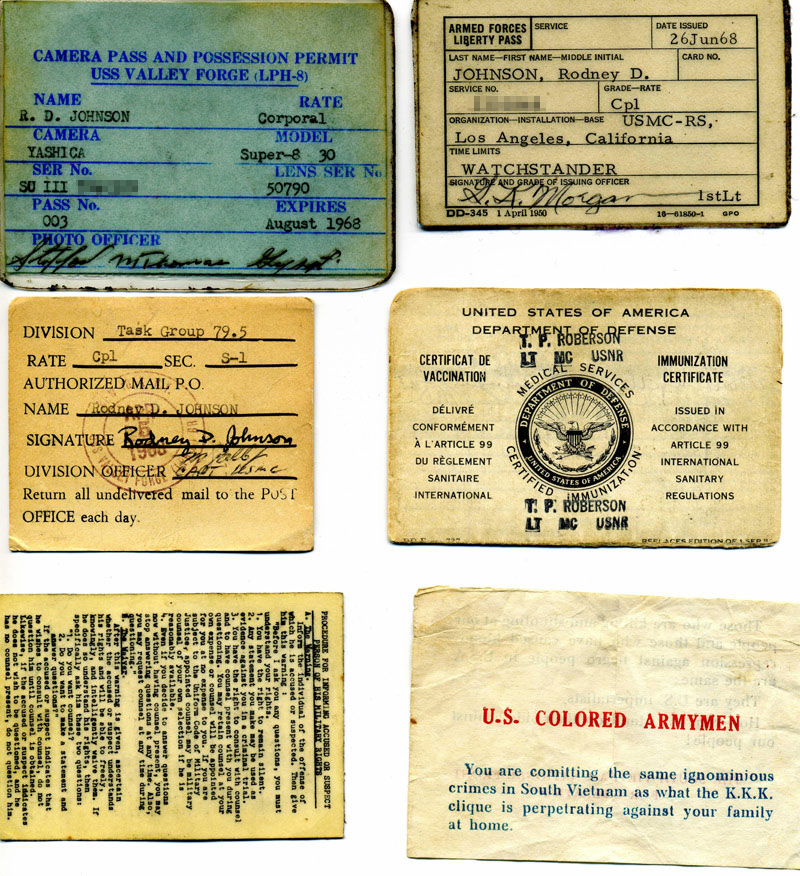
I managed to hang on to a variety of documents and photos during these many years and submit a few of them for review in the attachment.
Semper Fi,
Rodney D. Johnson
MGYSGT, USMCR (ret)