Don,
This is the first story I ever wrote. I was mad at what the
Marine Corps had written about Kingfisher and I wanted the first
hand truth told. I sent it to a Col. Summers, who used to be the
editor of Vietnam Magazine and he accepted it first shot. He told
me I needed about 200 more words so I e-mailed my BN CO. and he
helped me with things that a L/Cpl Machine-gunner was not privy
to. They published it in the Spring of 2001. I tell it like it
was! Semper Fi!
Jack Hartzel
Operation Kingfisher
A Show of Force
July 28-30, 1967
Up to this point in the war, the DMZ had been largely off limits
to U.S. ground forces because of the political sensitivity back
home. Operation Kingfisher an operation that would take us all
the way to the Ben Hai River would be a major change in thinking
for the Third Marine Division. However, Division Command decided
that the Operation would go forward.
The NVA had to know something was going on by the buildup of men
and equipment at Con Thien. The NVA weren't sure what was going
on so they just blended into the woodwork and waited. We were a
reinforced battalion with a platoon of tanks, three Ontos, and
three LVTE's. The brass billed Operation Kingfisher as a
"spoiling attack" into the DMZ. Our leaders thought we would just
march up to the Ben Hai River, flex our muscles, and return to
the south… no problem! It is rumored that LBJ and his cronies
sent us up there to show the American public that we could,
hopefully bolstering his failing administration. The NVA had
other ideas.
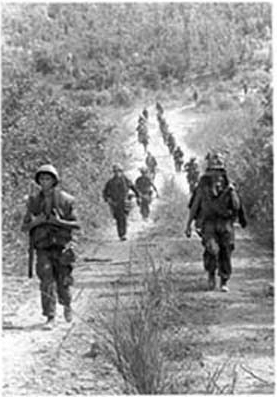
We started the day going north on Route 606, heading toward the
Ben Hai River. All the "salts" were scared sh-tless, and that was
saying something because almost everyone had a case of dysentery.
We knew this was Charlie's home area and that we would probably
be in deep sh-t sometime in the near future. The company I was
in (Echo) and Golf Company were on the flanks; the main body of
the Operation and the tanks, Ontos, and LVTE's were on the road.
Hotel Company was held back waiting until the rest of us were
almost to the river.
We hardly made any enemy contact on the way up to the Ben Hai
River. The only contact I remember is an NVA soldier shot a
Lieutenant in the helmet. The Lieutenant was lucky; it only
knocked him out. An M-60 gunner blew the NVA away. Near the
Battalion Commander's CP, we discovered an NVA field hospital
that had been hastily evacuated as we approached. That really
made us edgy. We knew that on the other side of the river, were
all the g–ks in the world. We also knew that they would not let
us this far north without hitting us.
The terrain was thick and very hard to move through and that made
us move more toward the road—just what Charlie wanted. The enemy
knew that we had to leave by the same road we came in on. They
were containing us, making us bunch up, just what they tell you
not to do in training. We found out later that the NVA were
already moving units into positions already dug in and they were
waiting for us.
When we had almost reached the river, A-4's laid down a
smokescreen to the west between the high ground and us. Hotel
Company was then Helo-lifted into a zone at the river. My
Battalion Commander said it looked like something from Quantico
it was so perfect. We set up defensive positions and dug in the
best we could. I had my machine gun facing south, the way we
would be leaving.
A couple of hours after dark a few other Marines and I began
hearing noises, talking and digging. That's right, digging! We
didn't sleep a wink all night. I reported the sounds to our
Platoon Leader. He came and sat in our hole, and he listened for
himself. I think he was scared too. He reported the noises to
our Company Commander. After all, we had to walk down that road
the next day.
We heard on the radio that Hotel Company was hearing loud truck
noises and hollering from across the river at suspected crossing
sites and on Hill 73. There were no confirmed sightings though.
Artillery was fired at suspected sites; damage was unknown. Our
Battalion CO received a radio message from the Ninth Marine
Regimental CO stating that five NVA battalions were en route to
engage us and to get the h-ll out of there. Our CO told him we
had gotten in here… we would sure as h-ll get out.
The next morning at first light the engineers in Golf Company's
area checked out the stream crossing on the road parallel to the
Ben Hai river heading northeast the direction we intended to go.
The engineers determined that the M-48 tanks would bog down,
which could mean trouble with Charlie so close. Our CO called
Ninth Marines Headquarters and informed them that we would be
heading out on Route 606. The NVA were concentrated along the
river road anticipating that our tanks would bog down and that
they would crush us.
We made a break for it around 10:00 AM. We broke through the
mines on Route 606 and started south. The NVA pressed and they
never broke contact with Golf Company. Hotel Company was supposed
to be rear guard, but Golf Company never broke free from their
contact with the NVA. Hotel Company was ordered into the line of
march. My Company (Echo) took point; I believe second platoon was
point platoon. It took us a long time to move hardly any
distance. The terrain was thick and the number of men and the
amount of equipment moving down that little dirt road made our
progress very slow.
After we had been moving for about an hour or so, we heard a loud
explosion. Marines screamed in pain, and every Corpsmen in the
area was there. The NVA had buried a 250-pound B-52 dud in the
road and an NVA soldier leaning up against a tree had detonated
it. He was killed by the blast and he took a squad of Marines
with him. That must have been the digging we heard!
Cpl. Bill Underwood a Squad Leader in 3rd Platoon, Echo Co. said
he was standing next to a tank talking to a Marine and decided to
go back to his squad. When he returned to his squad he heard a
loud explosion and turned around and the Marine he had been
talking to was gone, he was d-mn near vaporized. He said all that
was left of that Marine he put in a poncho and put the poncho on
the tank.
We walked past the place where the bomb went off. There were
entrails in trees. There were heads and legs and arms, and feet
still in boots! There were Marines all over the place, picking up
body parts. I guess somebody got the job of figuring out whose
parts were whose. It was not something a young man who had just
turned 20 years old wanted to see. The history books say five
Marines wounded. That is bull! I was there! There were dead
Marines all over.
Just a short distance from the first explosion the engineers
found another bomb, also command detonated. The engineers
detonated this one saving a lot of lives. The moment the second
bomb went off, the NVA hit us with machine guns, rifles and
mortars. They dropped the mortars right on the road, making us
dive to the sides of the road to avoid being hit with shrapnel. A
lot of Marines were stabbed by Punji stakes placed by the NVA.
Some other Marines were killed or wounded by booby traps rigged
on the roadside.
From then on it became a running battle south with them trying to
break us up and close their horseshoe ambush. There were NVA on
both sides of the road. I said to my A-gunner, "I saw a bush
move." He said, "You're scared, and you're seeing things." I
shot the bush; it fell over dead!
From that point on, nothing was sacred. We riddled every bush,
every tree, or anything that might have an NVA in it with
bullets. Anything and everything was fair game. I walked faster
than I'd ever walked before. There's an old saying among Marines:
"Marines never retreat, they advance in an opposite direction".
Bullsh-t! We were retreating, getting the h-ll out of there!
We started to notice troops off to our right and left. I recall
someone saying, "Friendlies on the right, Friendlies on the
left." I remember someone else saying, "There are no Friendlies
on the right or left." We had no flankers out. At least a company
of our men opened up on the NVA, who were wearing U.S. flak
jackets, jungle utilities, and helmets, and carrying M-16 rifles.
I think we killed between eight and ten NVA. It's hard to count
or remember when you're firing and moving. It's not as though we
could stop and take a careful body count.
I really believe that if we had not had the spotter plane calling
in air strikes, I wouldn't be here today writing this. The NVA
were smart and they knew the only way to survive our supporting
arms was to stay as close to us as possible. That meant that when
the spotter plane called in the Phantom Jets, the napalm was
dropped so close to us we could have roasted hot dogs. The
Phantom pilots were good; they came so close to the tops of the
trees that we could see the pilots waving at us. One of my best
friends and Air Wing Marine (Wing Wiper) John Caruso told me that
he and his Bro's used to clean tree branches out of the landing
gear of the Phantom Jets… That's Close! We saw NVA on fire,
running out of their bunkers. That was a h-ll of a way to die. I
will never forget two smells… the smell of burning flesh, and
the smell of death.
We started to round a bend in the road, and an NVA let loose with
an RPG and disabled the lead tank. Soon after that tank took a
round in the turret, an Ontos was also hit with an RPG. Another
Ontos came up to aid the first Ontos and tank. It opened up with
its machine gun, and suppressed the NVA fire long enough to get
the wounded loaded and to get the h-ll out of there.
I remember that after that, track vehicles were flying down that
road. They almost ran over my A-gunner and I just as we hit the
dirt from another mortar barrage. Thank God we were young and
could move, or we would have been "road pizza". The Corps valued
the tanks and the Ontos more than they value us grunts. That
really sucked. Steel over lives, Weird way of thinking. Instead
of the tanks' reinforcing us and giving us support, they turned
into our liability. We had to protect them from the RPG crews,
and we used them as ambulances to transport dead and wounded. We
lost two tanks and two Ontos.
In the official history of the Operation, there is only mention
of three crewmen in each tank crew being wounded. That too, is
bull. I personally pulled a dead Marine out of his tank. He was
blown nearly in half. An RPG round went through the tank, through
the Marine, and bounced around inside the tank. It made a really
nasty mess! I remember that well, because it was 100 degrees or
better, and he had been in the tank for about eight hours. He had
swollen up to double his size, rigor mortis had begun, and he had
turned black.
I helped carry a lot of dead and wounded to CH-34's and 46s. I
recall thinking how bad it had to be if we were using 46s to
transport dead and wounded. CH-46s were big and could carry a lot
of cargo.
Most of my company got out of the ambush, but we left two squads
in there. That night after we set in, our Colonel informed us
that in the morning we would be going back in and getting our
guys. We liked hearing that; Marines don't leave anybody behind.
Being the kind of CO he was, and not wanting to wait, our CO
decided to try to link up with Hotel Company and the rest of the
Battalion that night. He took operational control of a company
from Third Battalion, Fourth Marines, and a section of tanks.
Once Marines started back in the NVA realized they could not
defeat us in detail and they broke free and ran. They had already
done enough damage as it was.
The linkup was delayed until daybreak in the interest of avoiding
a mistake. We could hear an Echo Company Platoon Leader, a
Lieutenant on his radio who was caught inside the ambush telling
us not to resupply them anymore. His Marines were fighting so
fierce he said, "They'll go to Hanoi." They were just doing what
they had to do to survive.
The next morning at daylight we moved out heading north tracing
our route from the day before. When we finally rejoined the rest
of our Battalion the NVA had vacated the area. The Lieutenant
whom we had heard on the radio and several of his men had been
caught in the open and were captured. The NVA hog-tied them with
comm. wire and bayoneted them and eventually murdered them in
their attempt to draw Corpsmen and Marines into their killing
zone. We had heard their screams the night before but passed them
off as an NVA trick. All the time it was our own men being
tortured to death.
Most of the dead had died the day before. Others died from lack
of medical treatment because there was no medevac the night
before. We medevac'd the rest of the dead and wounded and were
out of the DMZ by around 12:00. We had Third Battalion, Fourth
Marines watch our backs until we were clear of the area. This
"Show of Force" cost the lives of 23 Marines and wounded 251
others. Of the wounded, 191 had to be medevac'd. I believe
Marines died and were wounded because of poor reconnaissance and
over-zealous Commanders. I do not mean to say that my Commander
made poor decisions… I mean that poor decisions were made in
the planning stages at Third Marine Headquarters. I again say,
that if it had not been for our supporting arms and their
pinpoint accuracy on targets, my unit, Second Battalion, Ninth
Marines might have been annihilated.
The NVA had everything in place that day to achieve that end. I
believe someone was watching over us that day!